Inner freedom
The Subconscious Mind: What Science Really Says (and What It Doesn't)
You've probably heard that your subconscious runs 95% of your life and can be reprogrammed while you sleep. The truth is humbler, and kinder. Here's what research supports, what it doesn't, and seven gentle ways to work with your autopilot.

Anita Freimann, PhD · The Happiness Doctor
7 min read

In this article
- What is the subconscious mind, and how does it work?
- Subconscious vs unconscious: what's the difference?
- Signs your autopilot is running the show
- Lives we keep living out of habit
- What science really says about the subconscious mind
- How to reprogram your subconscious mind: seven gentle steps
- Can your subconscious tell the difference between real and imagined?
- Questions readers ask
One lesson from secondary school has stayed with me for decades. Our psychology teacher drew an iceberg on the board, with a waterline across it. Above the water, she said, you usually see only about a tenth of it. Then she marked the tip: this is your conscious mind, and everything below the waterline is your subconscious. It got me thinking, and almost ten years later I began studying it properly.
For a long time I took the numbers that travel with that picture at face value. In my book I repeated the popular claim that the subconscious makes up 95% of who we are, and I began my spiritual search with a simple thought: if it runs most of what we do, it must hold the key to happiness. Today I would write it differently. The iceberg is a beautiful image, popularly linked with Freud's ideas, but it is a picture, not a measurement, and I have not found a study that measured the famous 95%.
In my book Courage on the Journey of Happiness, this story belongs to the challenge about spiritual techniques, many of which promise to “reprogram” the subconscious. Here is what I have learned since.
What is the subconscious mind, and how does it work?
In everyday language, the subconscious mind means everything your mind does without you being aware of it: skills that run themselves, habits you perform half-asleep, quick likes and dislikes you can't explain. Psychologists rarely use the word; they speak of automatic, implicit or non-conscious processes. It isn't a second self secretly running your life. It describes how much of the mind works quietly in the background.
My favourite example is typing. In one study, skilled typists averaged about 72 words a minute, yet when handed a blank keyboard they could correctly place only 15 letters on average1. Their fingers knew; they didn't. That is how the automatic mind works: through repetition, knowledge moves out of your attention and into your hands, your reactions and your routines.
Subconscious vs unconscious: what's the difference?
Mostly, who is speaking. Freud used the two words interchangeably at first, later stuck with “unconscious” to avoid confusion, and professional writing still prefers it2. “Subconscious” lives on mainly in self-help. In modern psychology, the unconscious is far less dramatic than Freud's hidden drives: ordinary mental work outside awareness. Psychologist Timothy Wilson calls it the adaptive unconscious, and suggests that if consciousness is the tip of the iceberg, it may be closer to a snowball on top of it3.
Signs your autopilot is running the show
You might recognise a few of these:
- you reach for your phone before you have decided to
- you say yes, or snap at someone, before you have time to think
- you make the same promise to yourself every January
- you explain choices with reasons that don't quite fit
- you feel drawn to some people and wary of others, without knowing why
Lives we keep living out of habit
In my book I describe how easily we let circumstances shape our days, until we are living a life we never really chose, simply out of habit. I don't believe the answer is to fight your autopilot; it is what lets you drive, type and talk at the same time. The answer is to wake up often enough to see where it is taking you, and then to choose. Don't wait for your life to get off autopilot by itself. As I wrote, that moment never comes.
Try not to live automatically, but in full awareness.
For the bigger picture of how thoughts and beliefs shift, start with how to change your mindset.
What science really says about the subconscious mind
As an economist who has spent many years studying happiness, I trust research that is honest about its limits. Psychologists John Bargh and Tanya Chartrand argued that most of our moment-to-moment mental life runs on non-conscious processes, which they called mental butlers that anticipate our preferences without being asked4. Helpers, not enemies. Yet even they measured no percentage; they quoted other researchers' rough conclusion that the conscious self plays a causal role only about 5% of the time. When Wendy Wood and her colleagues actually counted, using hourly diaries, between a third and a half of students' everyday behaviours were habits, done almost daily in the same place, often while thinking about something else5.
Some famous evidence has not held up. In a 1990s study, people who unscrambled words linked to old age seemed to walk more slowly afterwards. When Stéphane Doyen and colleagues repeated it with infrared timing, the effect disappeared, returning only when the experimenters expected it6. In nine experiments, David Shanks's team could not show that thinking about professors improves quiz scores7. Automaticity is solid; many dramatic “one word changes your behaviour” findings are not.
We are also less transparent to ourselves than we feel. Richard Nisbett and Timothy Wilson asked shoppers to pick the best of four pairs of stockings. The pairs were identical, yet the right-most was chosen almost four times as often as the left-most. Nobody mentioned position, and when asked directly, nearly everyone denied it8.
And the recordings that promise to reprogram you while you listen? Anthony Greenwald, Anthony Pratkanis and colleagues tested subliminal self-help audiotapes double-blind, secretly swapping some of the labels. After a month, neither the memory nor the self-esteem tapes did what they promised, yet more than a third of listeners believed they had improved in whatever area the label named9.
How to reprogram your subconscious mind: seven gentle steps
I still say reprogram, but I mean something humbler than the internet does. You can't delete old patterns overnight. You can retrain them the way they were learned: through attention, repetition and the situations you live in.
- Notice before you change. Because introspection is unreliable, watch yourself the way a kind stranger would. Timothy Wilson suggests we learn more about ourselves from what we do than from searching for hidden motives. This noticing grows in small moments; see how to live in the present moment.
- Find the cue. Automatic behaviour is set off by situations: a time, a place, a person, a feeling. When the old pattern shows up, ask what happened just before.
- Write an if-then plan. Psychologist Peter Gollwitzer showed that plans linking a specific situation to a specific response help people reach their goals, because the situation then triggers the response almost automatically10. If it is 9 pm and I reach for my phone, then I put it on the charger in the hallway. You are using your autopilot on purpose.
- Repeat it in the same place. Habits grow where behaviour is repeated in a stable setting, so small and daily beats big and occasional. For how long it takes, see how to break bad habits.
- Change the room, not only your mind. Make the new response the easy one: the book on your pillow, the phone out of reach, the walking shoes by the door.
- Question the old sentences. Many automatic reactions grew from beliefs absorbed in childhood. Write down the sentence behind the pattern and ask whose voice it is; I go deeper in limiting beliefs.
- Be gentle when autopilot wins. Old patterns wait for a tired evening. A slip is information, not failure. And if a pattern is tied to painful experiences that still overwhelm you, please talk to a qualified therapist, who can help in ways no article can.
Can your subconscious tell the difference between real and imagined?
This popular self-help claim holds a grain of truth. In an online experiment by Nadine Dijkstra and Stephen Fleming, people imagined a striped pattern while watching visual noise, and those with more vivid imagery were more likely to report a pattern when none was shown11. But their conclusion is far from the slogan: we normally keep imagination and reality apart, because imagined images are usually weaker than real ones. Visualise if it helps you rehearse, but don't expect it to fool your mind into a new life.
My teacher's iceberg is still a lovely picture. I would change one thing: what lies below the waterline is not a stranger working against you, but a faithful helper that learned whatever you repeated. It is no accident that one of the three parts of my programme Permission for Life is called Free. Inner freedom begins with noticing the patterns you inherited and practising new ones until they become yours.
Questions readers ask
Is the subconscious mind real?
Yes, if you mean mental processes that run outside awareness: habits, skills, implicit memories and quick judgements are well documented. No, if you mean a separate hidden self with its own will. That is a metaphor, useful as long as you don't take its numbers literally.
What is the difference between the conscious and subconscious mind?
Your conscious mind is what you are aware of right now: the thought you are thinking, the choice you are weighing. The subconscious, or non-conscious, mind is everything that runs without that spotlight. They are a team, not rivals.
Can you reprogram your subconscious mind while you sleep?
Not in the way it is usually sold. In one study, words played during light sleep left a faint trace in brain activity, but on waking people could not remember which words they had heard12. That is a long way from changing beliefs or habits with recordings at night. The retraining happens while you are awake.
Do subliminal messages work?
Not as promised. Subliminal self-help tapes were tested double-blind: the memory and self-esteem tapes did not deliver their claimed effects, although more than a third of listeners felt they had improved in the area named on the label9. What changed was expectation, not the subconscious.
What is the best book about the subconscious mind?
The best known is Joseph Murphy's The Power of Your Subconscious Mind, a self-help classic many find encouraging; read it as inspiration, not science, because its promises go far beyond the research. For the science, Timothy Wilson's Strangers to Ourselves is a readable start. My book, Courage on the Journey of Happiness, offers twelve challenges for living more consciously; you can read the introduction free.
Your turn
Take five quiet minutes with a notebook and answer honestly:
- Which of my everyday reactions did I learn so early that I have never questioned them?
- Where in my life am I living out of habit rather than by choice?
- If a kind stranger watched my week, what would my behaviour tell them I value most?
Did this article speak to you? I’d love to hear what you noticed, what you tried, or what you’re still struggling with. Write to me at anita [at] anitafreimann [.] com. I read every message.
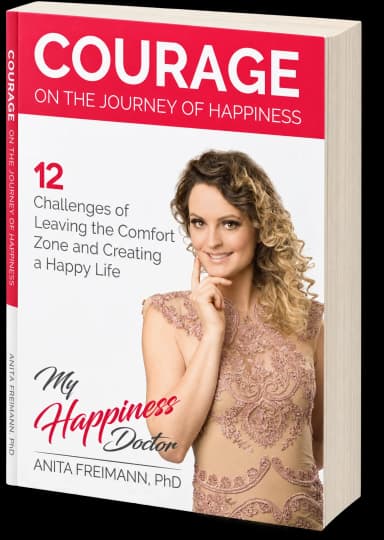
Free preview of my book
Courage on the Journey of Happiness
Get the whole introduction free: how to use the book, who it is for, and my own story of why I wrote it, plus the full table of contents with all twelve challenges. This article grows out of one of them, Practice of Spiritual Techniques – Raising Vibrations.
Sources
- 1.Snyder, K. M., Ashitaka, Y., Shimada, H., Ulrich, J. E., & Logan, G. D. (2014). What skilled typists don't know about the QWERTY keyboard. Attention, Perception, & Psychophysics, 76(1), 162–171. doi.org/10.3758/s13414-013-0548-4
- 2.Miller, M. C. (2010). Unconscious or subconscious? Harvard Health Publishing. www.harvardhealth.org/blog/unconscious-or-subconscious-20100801255
- 3.Wilson, T. D. (2002). Strangers to Ourselves: Discovering the Adaptive Unconscious. Cambridge, MA: Belknap Press of Harvard University Press. doi.org/10.4159/9780674045217
- 4.Bargh, J. A., & Chartrand, T. L. (1999). The unbearable automaticity of being. American Psychologist, 54(7), 462–479. doi.org/10.1037/0003-066X.54.7.462
- 5.Wood, W., Quinn, J. M., & Kashy, D. A. (2002). Habits in everyday life: Thought, emotion, and action. Journal of Personality and Social Psychology, 83(6), 1281–1297. doi.org/10.1037/0022-3514.83.6.1281
- 6.Doyen, S., Klein, O., Pichon, C.-L., & Cleeremans, A. (2012). Behavioral priming: It's all in the mind, but whose mind? PLoS ONE, 7(1), e29081. doi.org/10.1371/journal.pone.0029081
- 7.Shanks, D. R., Newell, B. R., Lee, E. H., Balakrishnan, D., Ekelund, L., Cenac, Z., Kavvadia, F., & Moore, C. (2013). Priming intelligent behavior: An elusive phenomenon. PLoS ONE, 8(4), e56515. doi.org/10.1371/journal.pone.0056515
- 8.Nisbett, R. E., & Wilson, T. D. (1977). Telling more than we can know: Verbal reports on mental processes. Psychological Review, 84(3), 231–259. doi.org/10.1037/0033-295X.84.3.231
- 9.Greenwald, A. G., Spangenberg, E. R., Pratkanis, A. R., & Eskenazi, J. (1991). Double-blind tests of subliminal self-help audiotapes. Psychological Science, 2(2), 119–122. doi.org/10.1111/j.1467-9280.1991.tb00112.x
- 10.Gollwitzer, P. M. (1999). Implementation intentions: Strong effects of simple plans. American Psychologist, 54(7), 493–503. doi.org/10.1037/0003-066X.54.7.493
- 11.Dijkstra, N., & Fleming, S. M. (2023). Subjective signal strength distinguishes reality from imagination. Nature Communications, 14, 1627. doi.org/10.1038/s41467-023-37322-1
- 12.Andrillon, T., & Kouider, S. (2016). Implicit memory for words heard during sleep. Neuroscience of Consciousness, 2016(1), niw014. doi.org/10.1093/nc/niw014
This article is for education and reflection and is not a substitute for professional help.

About Anita
Anita Freimann, PhD, the Happiness Doctor, holds a doctorate in the economics of happiness and spent more than 16 years at the Faculty of Economics in Osijek. She is the author of Courage on the Journey of Happiness and the creator of Permission for Life.
More about Anita