Presence
How to Live in the Present Moment When You Have No Time
You can remember happiness and look forward to it, but you can only feel it now. Here's why a busy mind keeps leaving, what research says, and seven small ways back that fit into a full day.

Anita Freimann, PhD · The Happiness Doctor
7 min read

There was a time when I lived almost everywhere except where I was. I was a perfectionist then, and I kept a little notebook, my planner, in which every task had its place. Some nights I woke up wondering whether I had finished everything on the list. Sometimes the task I was worrying about wasn't due for another day or two. Sometimes I had already done it. Looking back, I can see it plainly: my thoughts lived in yesterday and tomorrow, so happiness had no chance to find me today.
Today I rarely make plans more than a few months ahead, because every day feels more like an adventure than a list. In my book Courage on the Journey of Happiness, the present moment shares the very first of twelve challenges with healthy selfishness, and that pairing is no accident. You can only be fully present in a life you have given yourself permission to live.
What does it mean to live in the present moment?
Living in the present moment means that your attention is where your life is: with the coffee you are drinking or the child telling you about her day. It doesn't mean you never think about the past or plan the future. It means you do those things on purpose, and then come back. Eckhart Tolle, whose book The Power of Now I recommend in mine, built a whole teaching on a simple observation: the past and the future exist only as thoughts, while life itself is always happening now.
Signs you're living everywhere but now
You might recognise yourself in a few of these:
- you arrive somewhere and can't remember the drive
- you are with your children or your partner, but your mind is in tomorrow's meeting
- you reach for your phone in every pause, even a ten-second one
- you replay yesterday's conversation while today's is happening
- you think life will start once this busy period is over
Why is it so hard to be present?
Because your mind is doing what human minds do. Remembering and planning are how we learn and stay safe; the trouble is that they rarely switch off. In my book I describe a moment most of us know: you are driving and suddenly realise you can't remember the last ten minutes, as if you had been on autopilot. You were there, and yet you weren't.
For many women in midlife there is another layer. We carry the lists, the dates and everyone else's needs, so the mind learns to live one step ahead. That isn't a flaw in your character. It is a habit, and habits can change.
The present moment is the only place you can feel happy
This is the thought that changed the most for me. You can remember happiness, and you can look forward to it, but you can only feel it now. A hug or a good conversation exists only while it is happening. If your mind is elsewhere at that moment, the happiness is still there; you just aren't there to receive it. That is also why postponing happiness never works, as I wrote in Is happiness a choice?.
And it is why my book puts healthy selfishness and the present moment into one challenge. When you do things only out of duty, you may be there in the flesh but not in spirit, and the people around you can sense it. Permission to choose, and to say no, is what lets you truly show up for what you said yes to. If that part is hard, start with how to stop people pleasing.
As soon as you start living in the moment, you are already there; it is not a destination.
What happiness research says about living in the present
As an economist who has spent many years studying happiness, I find the research here unusually clear. Harvard psychologists Matthew Killingsworth and Daniel Gilbert built an iPhone app that asked people, at random moments, what they were doing, what they were thinking about and how they felt. Across 2,250 adults, minds were wandering in 46.9% of the moments, and people were less happy when their minds wandered than when they didn't, during every activity, even the least enjoyable ones. Drifting to pleasant thoughts made them no happier than staying with what they were doing, and what people were thinking predicted their happiness better than what they were doing1.
Economists arrived at a similar place from another direction. Daniel Kahneman and Alan Krueger argued that people's reports of how they feel are most accurate close to the moment itself, and proposed measuring how much of their time people spend in an unpleasant state2. To me, that means a life is lived, and felt, one moment at a time.
Psychologists Kirk Warren Brown and Richard Ryan found that people who pay more attention to the present tend to report greater well-being, and that mindful moments went with more positive emotions3. In a 30-day diary study, Paul Jose, Bee Lim and Fred Bryant found that savouring was one of the ways good events turned into a happier mood4. And presence with people is fragile: when Ryan Dwyer, Kostadin Kushlev and Elizabeth Dunn asked over 300 people to share a restaurant meal with friends or family, those who kept their phones on the table felt more distracted and enjoyed their time together less5.
What about mindfulness courses? A review led by Julieta Galante, covering 136 trials and over 11,000 adults outside clinical settings, found that mindfulness programmes eased distress and improved well-being on average compared with doing nothing, but the certainty of the evidence was moderate to very low, and they did not clearly outperform other active approaches6. For short practices the benefit is small and shrinks further once unpublished studies are taken into account7, and a group of researchers led by Nicholas Van Dam has warned that poor studies and misinformation can leave people misled and disappointed8. Being present is not a miracle cure. It is a small daily skill that gives you back your own moments.
How to live in the present moment: seven gentle steps
You don't need an hour a day. You need small moments of coming back, repeated until they become a habit. These are the ones I use myself.
- Catch yourself, without scolding. The moment you notice your mind has wandered, you are already back. Noticing is the practice, not proof that you have failed.
- Take ten breaths. Breathe in through your nose and out through your mouth, counting each breath up to ten. I started relaxing daily around 2013, and it still gives me a way out when things get difficult.
- Turn one daily chore into an anchor. Brushing your teeth, the first sip of coffee, washing your hands. Choose one and do it with full attention every day: the taste, the temperature, the sound.
- Do one thing at a time. When you eat, eat. When your child talks to you, put the phone face down or in another room. Doing three things at once splits you into three.
- Savour one good moment a day. When something pleasant happens, stay with it a few seconds longer than usual. Notice it, name it, let it land.
- Let your senses bring you back. When your mind races, name three things you can see, two you can hear and one you can feel. Your senses are always in the present, even when your thoughts are not.
- Drop one duty that keeps you elsewhere. An obligation kept only out of guilt is a place where you are present in body only. Let one go this week.
How to be present when you have no time
When your day is full from the first alarm to the last load of laundry, being present sounds like one more task. But presence doesn't need extra time. It uses the time you already have: two minutes waiting for the kettle, the walk from the car to the office.
In my book I wrote that every day has 24 hours, and the real question is for whom and for what we use them. You may not have spare hours, but you always have this moment. Start there. And if your mind keeps pulling you into worry or low mood for weeks and it becomes hard to cope, that is not a failure of willpower; talking to a doctor or a mental health professional is the right next step.
Being present is simple, but not easy when your life has been organised around everyone else for years. It becomes easier once you give yourself permission to live a life you want to be present for, which is what my programme Permission for Life is about. It begins today, with one breath you actually notice.
Questions readers ask
How can I live in the moment when I have anxiety?
Gently, without forcing it. Slow breathing or naming what you can see and hear may help you come back for a moment. But anxiety that is strong or lasts for weeks deserves proper support, so please talk to a doctor or a mental health professional.
Is living in the present the same as mindfulness?
They are close relatives. Mindfulness usually means paying attention to what is happening now, with openness rather than judgement, often trained through meditation. Living in the present is the everyday result, whether or not you ever meditate.
Does living in the present mean I shouldn't plan for the future?
No. Planning is useful, and so is learning from the past. The difference is whether you plan on purpose and then come back, or live inside your plans all day.
How long does it take to learn to be present?
There is no finish line. Every time you notice your mind has wandered and bring it back, you have done it. The effects of brief practice are modest, so think of it as a daily habit rather than a quick fix.
What is the best book about living in the present moment?
Eckhart Tolle's The Power of Now is the classic, and I recommend it in my own book. For something practical that connects presence with putting yourself first, I wrote Courage on the Journey of Happiness as twelve challenges, and you can read the introduction free.
Your turn
Take five quiet minutes with a notebook and answer honestly:
- When my mind leaves the present, where does it go most often, to the past or to the future, and what is it looking for there?
- Which ordinary moment of my day would I most like to really be there for?
- Where am I present in body but not in spirit, and what would it take to choose it fully or let it go?
Did this article speak to you? I’d love to hear what you noticed, what you tried, or what you’re still struggling with. Write to me at anita [at] anitafreimann [.] com. I read every message.
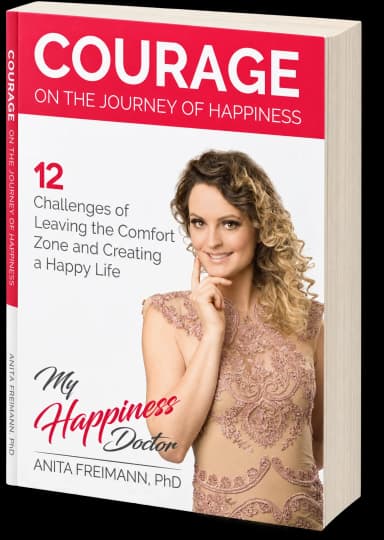
Free preview of my book
Courage on the Journey of Happiness
Get the whole introduction free: how to use the book, who it is for, and my own story of why I wrote it, plus the full table of contents with all twelve challenges. This article grows out of one of them, Healthy Selfishness and the Present Moment.
Sources
- 1.Killingsworth, M. A., & Gilbert, D. T. (2010). A wandering mind is an unhappy mind. Science, 330(6006), 932. doi.org/10.1126/science.1192439
- 2.Kahneman, D., & Krueger, A. B. (2006). Developments in the measurement of subjective well-being. Journal of Economic Perspectives, 20(1), 3–24. doi.org/10.1257/089533006776526030
- 3.Brown, K. W., & Ryan, R. M. (2003). The benefits of being present: Mindfulness and its role in psychological well-being. Journal of Personality and Social Psychology, 84(4), 822–848. doi.org/10.1037/0022-3514.84.4.822
- 4.Jose, P. E., Lim, B. T., & Bryant, F. B. (2012). Does savoring increase happiness? A daily diary study. The Journal of Positive Psychology, 7(3), 176–187. doi.org/10.1080/17439760.2012.671345
- 5.Dwyer, R. J., Kushlev, K., & Dunn, E. W. (2018). Smartphone use undermines enjoyment of face-to-face social interactions. Journal of Experimental Social Psychology, 78, 233–239. doi.org/10.1016/j.jesp.2017.10.007
- 6.Galante, J., et al. (2021). Mindfulness-based programmes for mental health promotion in adults in nonclinical settings: A systematic review and meta-analysis of randomised controlled trials. PLoS Medicine, 18(1), e1003481. doi.org/10.1371/journal.pmed.1003481
- 7.Schumer, M. C., Lindsay, E. K., & Creswell, J. D. (2018). Brief mindfulness training for negative affectivity: A systematic review and meta-analysis. Journal of Consulting and Clinical Psychology, 86(7), 569–583. pmc.ncbi.nlm.nih.gov/articles/PMC6441958/
- 8.Van Dam, N. T., et al. (2018). Mind the hype: A critical evaluation and prescriptive agenda for research on mindfulness and meditation. Perspectives on Psychological Science, 13(1), 36–61. pmc.ncbi.nlm.nih.gov/articles/PMC5758421/
This article is for education and reflection and is not a substitute for professional help.

About Anita
Anita Freimann, PhD, the Happiness Doctor, holds a doctorate in the economics of happiness and spent more than 16 years at the Faculty of Economics in Osijek. She is the author of Courage on the Journey of Happiness and the creator of Permission for Life.
More about Anita