Healthy selfishness
How to Set Boundaries with Toxic Family Members Without Guilt
You can love your family and still decide what you will no longer accept. Here's where the old patterns come from, what research says, and seven gentle steps to set boundaries without breaking the relationship.

Anita Freimann, PhD · The Happiness Doctor
7 min read

A friend of mine was shopping with her mother when she took a packet of pasta off the shelf. Her mother asked, a little irritated, why she was taking that one when “we” always buy the other kind. My friend said: “Who are we, Mum? I haven't lived with you for fifteen years. I always buy this pasta.” A harmless story, and I love it, because it shows how quietly the family we grew up in keeps living in our everyday choices.
Sometimes it isn't about pasta. I know a man who, at 45, only recently realised how much his mother still shapes his life. She tells him he doesn't visit enough, doesn't give her enough money, that his new partner isn't good enough. In short, that he is never enough. He loves her, he feels responsible for her, and he can no longer listen to it. That tension between love and exhaustion is where most of us get stuck.
In my book Courage on the Journey of Happiness, a whole challenge is devoted to healthy relationships with the family we come from, because no other relationships shape us so early or so deeply. Here is what I have learned about setting boundaries there without guilt and without burning bridges.
What makes a family member “toxic”?
“Toxic” is not a scientific term. It is an everyday word for behaviour that repeatedly leaves you feeling small, guilty, controlled or responsible for someone else's happiness. “Narcissist” has become an everyday word too, but it is also a clinical term, and only a qualified professional can make that diagnosis. You don't need a label to set a boundary. You only need to notice what a relationship does to you.
This article is about everyday patterns: criticism, guilt, interference. If a family member is violent, threatens you or abuses you in any way, a calm conversation is not enough and your safety comes first. Please talk to a professional, or contact local support services or the emergency number in your country.
Signs a family member is crossing your boundaries
You might recognise a few of these:
- you dread family visits and need days to recover from them
- your decisions about work, money, your partner or your children are treated as family property
- your no is treated as the start of a negotiation
- you hear “after everything I've done for you” whenever you choose differently
- you are made responsible for someone's mood, loneliness or happiness
Why is it so hard to set boundaries with family?
Because our parents wrote the first rules of our lives. As children we absorb their habits, beliefs and standards long before we can question them, and over time those standards become our own inner judge. Even when nobody tells us what to do any more, that judge keeps measuring our choices against the old rules.
And because we call it love. Children see their parents through the prism of love and often feel they owe them so much that saying no seems ungrateful. None of this means your parents are bad people. Most of them did their best with what they knew. It only means the patterns are old, and you are allowed to look at them with adult eyes.
Healthy selfishness: you can love them and still live your own life
In my book I keep returning to one idea: taking care of yourself is not selfish, it is responsible. Your parents are allowed to give you advice, because they love you. You are allowed to decide whether to take it. The useful question is not whether they have the right to advise you, but whether they are competent in this area. Can someone who has never run a business tell you how to run yours?
Untangling my own relationship with my parents was a challenge for me too. Today we have a normal, healthy relationship in which everyone lives their own life. I still talk to my mother almost every day, and my parents sometimes babysit for me, but it all rests on mutual agreement and a lot of respect.
There is no universally good relationship, with healthy boundaries for your and your parents’ behavior; this is something you have to set for yourselves.
What happiness research says about boundaries with family
As an economist who has spent many years studying happiness, I always start with relationships. The Harvard Study of Adult Development, which has followed its participants since 1938, found that close relationships, more than money or fame, keep people happy throughout their lives. Its director, Robert Waldinger, adds something comforting: good relationships don't have to be smooth. What mattered was whether people felt they could count on each other when things got hard1. In my own field, the World Happiness Report lists having someone to count on among the six factors that help explain why life satisfaction differs between countries2.
Tension with parents is also more common than we admit. In a study of parents and adult children, psychologists Kira Birditt, Karen Fingerman and colleagues found that 94% of participants reported at least a little tension about at least one topic, usually mild, and they describe such tensions as normal3. The topics included how often to be in touch, unsolicited advice and raising children.
Why does guilt hit so hard in families? Psychologists Roy Baumeister, Arlene Stillwell and Todd Heatherton reviewed the research and concluded that guilt is strongest in close relationships built on expectations of mutual care. It keeps us considerate, but it can also help the less powerful person get their way and pass their distress on to others4. So guilt after saying no to your mother is not proof that you did something wrong. Often it is simply what closeness feels like when it changes.
And distance? Karl Pillemer of Cornell University found in a national survey of more than 1,300 Americans that 27% had cut off contact with a family member. Among people who later reconciled, a key step was letting go of the need for the other person to accept their version of the past and apologise, and setting more realistic expectations5. To me, that is the heart of boundaries without burning bridges: you stop waiting for them to change and decide what you can live with.
How to set boundaries with toxic family members: seven gentle steps
You don't set a boundary once, in one big conversation. You set it many times, in small moments, until it becomes the new normal.
- Name what you will no longer accept. Be specific. Not “Mum is too much”, but “I won't discuss my marriage at Sunday lunch”.
- Separate their opinion from your decision. They are allowed to have an opinion and even to say it. They are not entitled to expect you to act on it.
- Say it briefly, kindly and once. “I love you, and I'm not going to talk about this.” The longer the explanation, the more it sounds like a request for permission.
- Protect it with action, not arguments. A boundary is about what you will do. If the comments continue, change the subject, end the call or leave earlier, calmly and without drama.
- Don't take it personally. In my book I mention Don Miguel Ruiz and The Four Agreements: what others say and do is mostly a projection of their own reality. A parent's fear about your choices says more about their fear than about your worth.
- Let guilt pass without obeying it. Expect it. Feel it, breathe, and don't go back on your decision just to make it stop. If saying no is hard everywhere in your life, start with how to stop people pleasing.
- Keep the warmth visible. Call when they don't expect it, thank them for what they have given you, show up for what matters. A good boundary says no to a behaviour, not to the person.
How to set boundaries with parents as an adult
With parents, the hardest part is accepting that the relationship has to grow up too. When we were small, they knew everything; slowly that balance changes, and many parents accept it in theory but not in practice. You can help by acting as the adult you are: telling them about your decisions rather than asking for approval, and letting them have their feelings about it.
A few sentences that help: “I know you worry, and I've decided.” “I'd rather not discuss this, but I'm happy to talk about anything else.” Some parents adjust quickly, some slowly, some never fully. There is a lot of space between cutting someone off and giving up your own life to keep them happy, and you are allowed to find your place in it.
Boundaries with the family you come from are learned and practised, ideally with people around you who understand the path. That is a big part of my programme Permission for Life. But it begins here, with one honest look at which rules in your life are really yours.
Questions readers ask
What is the golden rule of boundaries?
There is no official rule, but a useful principle is this: a boundary is about what you will do, not about controlling someone else. “Don't call me after nine” is a demand. “I won't answer calls after nine” is a boundary you can keep on your own.
What are examples of healthy boundaries with family?
Not discussing certain topics, such as your weight or your marriage; deciding how long visits last; not lending money; and making big decisions yourself, then sharing them rather than asking for permission.
What if a family member keeps ignoring my boundaries?
Repeat the boundary once, calmly, then act on it: end the conversation, leave earlier, see them less often. Someone who keeps pushing is giving you information. If they become threatening or abusive, contact a professional or local support services.
Should I cut off a toxic family member?
Only you can decide. Sometimes ending contact is the healthiest and safest choice, especially where there is abuse. In other cases, lowering expectations can make a smaller, safer relationship possible. If you are unsure, a therapist can help you think it through.
Is it selfish to set boundaries with your parents?
No. Taking care of yourself so you can stay in the relationship without resentment is responsible, not selfish. In my book Courage on the Journey of Happiness I call this healthy selfishness, and you can read the introduction free.
Your turn
Take five quiet minutes with a notebook and answer honestly:
- Which of my family's rules do I still follow without ever having chosen them?
- Whose approval am I still waiting for, and what would I do if I no longer needed it?
- What would a relationship with my family look like if it felt both loving and free?
Did this article speak to you? I’d love to hear what you noticed, what you tried, or what you’re still struggling with. Write to me at anita [at] anitafreimann [.] com. I read every message.
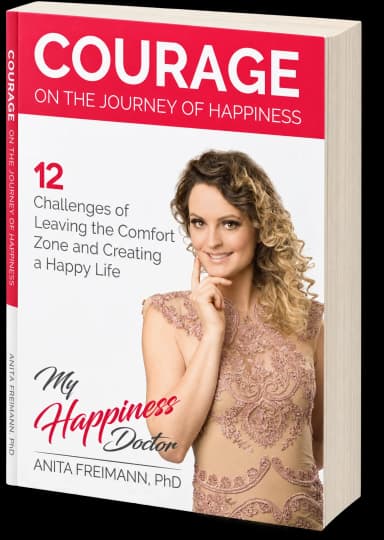
Free preview of my book
Courage on the Journey of Happiness
Get the whole introduction free: how to use the book, who it is for, and my own story of why I wrote it, plus the full table of contents with all twelve challenges. This article grows out of one of them, Healthy Relationships with Your Family of Origin.
Sources
- 1.Mineo, L. (2017, April 11). Good genes are nice, but joy is better [on the Harvard Study of Adult Development, directed by Robert Waldinger]. The Harvard Gazette. news.harvard.edu/gazette/story/2017/04/over-nearly-80-years-harvard-study-has-been-showing-how-to-live-a-healthy-and-happy-life/
- 2.World Happiness Report. Frequently Asked Questions. www.worldhappiness.report/faq/
- 3.Birditt, K. S., Miller, L. M., Fingerman, K. L., & Lefkowitz, E. S. (2009). Tensions in the parent and adult child relationship: Links to solidarity and ambivalence. Psychology and Aging, 24(2), 287–295. pmc.ncbi.nlm.nih.gov/articles/PMC2690709/
- 4.Baumeister, R. F., Stillwell, A. M., & Heatherton, T. F. (1994). Guilt: An interpersonal approach. Psychological Bulletin, 115(2), 243–267. doi.org/10.1037/0033-2909.115.2.243
- 5.Dean, J. (2020, September 10). Pillemer: Family estrangement a problem ‘hiding in plain sight’. Cornell Chronicle. On Pillemer, K. (2020), Fault Lines: Fractured Families and How to Mend Them. Avery. news.cornell.edu/node/319960
This article is for education and reflection and is not a substitute for professional help.

About Anita
Anita Freimann, PhD, the Happiness Doctor, holds a doctorate in the economics of happiness and spent more than 16 years at the Faculty of Economics in Osijek. She is the author of Courage on the Journey of Happiness and the creator of Permission for Life.
More about Anita