Happiness science
Is Happiness a Choice? What I Learned When I Wasn't Happy
Happiness isn't a switch you flip, and it isn't out of your hands either. Here's which part is yours, what research really says, and seven small choices that add up.


Anita Freimann, PhD · The Happiness Doctor
7 min read
In 2010 I was writing a doctoral thesis on the economics of happiness, and I was not happy. I was trying to be good at everything at once: good at work, a good partner, a good daughter, a good friend, while people kept asking when I would finally get married and have children. There were mornings when I could hardly get out of bed, because nothing seemed to make sense. And all of this was happening while I was studying happiness.
When I tried to explain it to my mother, she reminded me of everything I had to be grateful for: a loving family, the job I wanted, good friends, a home, a partner who supported me, the thesis I was writing. She was right about all of it, and it didn't help. So I tried to choose to be happy. I told myself it was just a phase, swept everything under the carpet and carried on like everybody else. It didn't work, and it took me years to understand why.
In my book Courage on the Journey of Happiness, the very first of twelve challenges is about exactly this: giving yourself permission to stop waiting for happiness and start living it now. Here is what I have learned since, as a happiness economist and as a woman who has been on both sides of the question.
What does “happiness is a choice” really mean?
At its best, the phrase says something true: you can choose where your attention goes, how you respond and what you do next, even when you can't choose what happens to you. At its worst, it becomes a quiet accusation. If happiness is a choice and you are not happy, then it must be your fault. Research supports the first meaning, not the second.
Signs you're waiting for happiness instead of living it
You might recognise yourself in a few of these:
- you often think “I'll be happy when…” the children are older, the project is finished, the money is better
- you feel guilty for not being happier, because on paper you have everything
- you keep busy so that you don't have to feel what you feel
- you save joy for weekends, holidays or one day, when you retire
- you try hard to think positively, and it leaves you feeling even more alone
Why can't I just choose to be happy?
Because happiness has more than one author. Researchers usually talk about three forces: the temperament you were born with, your circumstances, and what you actually do with your days. Twin studies suggest that genes account for roughly a third of the differences in well-being between people, about 32–36% in the largest meta-analysis so far1. That describes differences between groups of people, not a fixed ceiling inside you. Your own story is still being written.
You may have seen the famous pie chart: 50% genes, 10% circumstances, 40% your choices. It comes from a 2005 paper by psychologists Sonja Lyubomirsky, Kennon Sheldon and David Schkade2, and I quoted it in my book too. But good science corrects itself. Nicholas Brown and Julia Rohrer showed that the 40% was never measured; it was simply what was left over3. Sheldon and Lyubomirsky later wrote that the figure was likely an overestimate, while still holding that deliberate effort can make a lasting difference4. So the honest message is not “40% is under your control”, but “there is real room to move”.
Choosing happiness is not the same as forcing positivity
Here is the part that surprised me most. In a series of studies, psychologist Iris Mauss and her colleagues found that people who valued happiness very intensely tended to feel less happy, perhaps because they kept measuring every moment against an ideal5. Later work showed that this depends on culture6, and the samples were small, so I hold it lightly. Still, it matches what I lived through: when happiness becomes another goal to achieve, it becomes another way to fail.
And grief, illness, exhaustion or depression are not failures of choice. If you have felt low for weeks, that is not something to fix with a better attitude; it is a reason to talk to a doctor or a mental health professional. Choosing well includes choosing help.
Life will always be full of challenges. It's better to accept that and decide to be happy – not because of that, but despite that.
What happiness research says about choosing happiness
As an economist who has spent many years studying happiness, I find the long-term studies the most reassuring. Following thousands of people in Germany for decades, Bruce Headey, Ruud Muffels and Gert Wagner found that a meaningful minority experienced lasting changes in life satisfaction, and that these changes went together with life goals and choices: who they lived with, how much they worked, their social life and their health habits7. Ed Diener, Richard Lucas and Christie Napa Scollon reached a similar conclusion: our happiness “set point” is not set in stone8.
At the same time, the effects of single tricks are modest. When Dunigan Folk and Elizabeth Dunn reviewed only the most rigorous, preregistered experiments, they found that some popular advice has surprisingly little solid support so far, and that the effects of the rest are usually small9. Small doesn't mean useless. It means happiness grows like a garden: through many small, repeated choices, not one dramatic decision.
And money? At any given moment, richer people tend to be happier than poorer ones. Yet in 1974 the economist Richard Easterlin noticed that as countries grew richer over the decades, average happiness did not reliably rise with them10,11. Economists still debate this paradox; Betsey Stevenson and Justin Wolfers have argued that income and happiness do rise together12. What I take from fifty years of debate is simple: money makes many things easier, but it cannot make the choices that matter most on your behalf.
How to choose happiness: seven small daily choices
You don't choose happiness once. You choose it the way you build any habit, in small moments, again and again. These are the choices I return to myself, and the ones I see change things for the women I work with.
- Stop postponing your life. Notice every “I'll be happy when…” and ask what you could enjoy today, before the condition is met.
- Choose where your attention goes. The present moment is the only place where you can actually feel anything, including happiness. Try keeping your phone away for the first and the last half hour of the day.
- Choose your people. Spend a little more time with those who leave you lighter, and a little less with those who leave you drained.
- Say no to one thing that empties you. Every yes to something that drains you is a no to something that could fill you. If that feels impossible, start with how to stop people pleasing.
- Make room for one thing you love. Not as a reward for finishing everything else, but as part of an ordinary day.
- Speak to yourself like a friend. On a hard day, skip the forced positivity and offer yourself the honesty and kindness you would give someone you love.
- Ask for help when it's heavy. A friend, a coach, a doctor or a therapist. Choosing support is choosing happiness too.
Is happiness a choice or a result?
Both, and that is good news. Happiness is partly the result of things you didn't choose, and partly the result of countless small choices you make every day. You can't choose your genes or your past, but you can choose the next step, and then the one after that.
Looking back, my own turning point wasn't a moment when I decided to feel happy. It was the moment I stopped sweeping things under the carpet and started changing how I lived, one choice at a time. Those were not easy years, and yet I can say they were among the happiest of my life.
Reading about happiness is a beginning, not a change. Change happens when you give yourself permission to live by your own choices, again and again, with people around you who walk the same path. That is the heart of my programme Permission for Life.
Questions readers ask
Is unhappiness my fault?
No. Your temperament and your circumstances matter, and some seasons of life are simply heavy. What is in your hands is the next small step, not the whole picture.
Can I choose to be happy if I'm depressed?
Depression is a health condition, not a lack of willpower. Small daily choices can support you, but they don't replace proper help. If you have felt low for more than a couple of weeks, please talk to a doctor or a mental health professional.
What is the 50/10/40 happiness rule?
It is a pie chart from a 2005 paper suggesting that 50% of the differences in happiness come from genes, 10% from circumstances and 40% from what we deliberately do. Later research showed that the 40% was never measured directly, and the original authors now consider it likely an overestimate. The useful part remains: what you do can make a lasting difference.
Can money buy happiness?
Up to a point it helps: at any moment, people with more money tend to be happier. But over the long run, rising national income hasn't reliably lifted average happiness, a puzzle economists call the Easterlin paradox and still debate. Money makes life easier; it doesn't make your choices for you.
Is happiness a feeling or a choice?
Happiness as a feeling comes and goes, and no one can feel happy all the time. What you can choose are the conditions that make good feelings more likely: where you put your attention, who you spend time with and how you live your days.
Your turn
Take five quiet minutes with a notebook and answer honestly:
- Where in my life am I waiting for happiness instead of living it?
- What have I been sweeping under the carpet, and what would it take to look at it gently?
- Which small choice this week would make an ordinary day feel more like mine?
Did this article speak to you? I’d love to hear what you noticed, what you tried, or what you’re still struggling with. Write to me at anita [at] anitafreimann [.] com. I read every message.
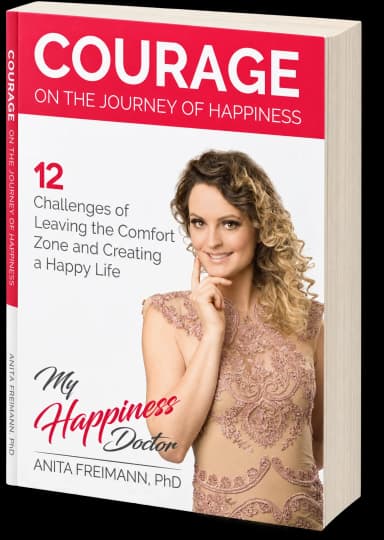
Free preview of my book
Courage on the Journey of Happiness
Get the whole introduction free: how to use the book, who it is for, and my own story of why I wrote it, plus the full table of contents with all twelve challenges. This article grows out of one of them, Healthy Selfishness and the Present Moment.
Sources
- 1.Bartels, M. (2015). Genetics of wellbeing and its components satisfaction with life, happiness, and quality of life: A review and meta-analysis of heritability studies. Behavior Genetics, 45(2), 137–156. pmc.ncbi.nlm.nih.gov/articles/PMC4346667/
- 2.Lyubomirsky, S., Sheldon, K. M., & Schkade, D. (2005). Pursuing happiness: The architecture of sustainable change. Review of General Psychology, 9(2), 111–131. doi.org/10.1037/1089-2680.9.2.111
- 3.Brown, N. J. L., & Rohrer, J. M. (2020). Easy as (happiness) pie? A critical evaluation of a popular model of the determinants of well-being. Journal of Happiness Studies, 21(4), 1285–1301. doi.org/10.1007/s10902-019-00128-4
- 4.Sheldon, K. M., & Lyubomirsky, S. (2021). Revisiting the sustainable happiness model and pie chart: Can happiness be successfully pursued? The Journal of Positive Psychology, 16(2), 145–154. doi.org/10.1080/17439760.2019.1689421
- 5.Mauss, I. B., Tamir, M., Anderson, C. L., & Savino, N. S. (2011). Can seeking happiness make people unhappy? Paradoxical effects of valuing happiness. Emotion, 11(4), 807–815. pmc.ncbi.nlm.nih.gov/articles/PMC3160511/
- 6.Ford, B. Q., et al. (2015). Culture shapes whether the pursuit of happiness predicts higher or lower well-being. Journal of Experimental Psychology: General, 144(6), 1053–1062. doi.org/10.1037/xge0000108
- 7.Headey, B., Muffels, R., & Wagner, G. G. (2010). Long-running German panel survey shows that personal and economic choices, not just genes, matter for happiness. PNAS, 107(42), 17922–17926. doi.org/10.1073/pnas.1008612107
- 8.Diener, E., Lucas, R. E., & Scollon, C. N. (2006). Beyond the hedonic treadmill: Revising the adaptation theory of well-being. American Psychologist, 61(4), 305–314. doi.org/10.1037/0003-066X.61.4.305
- 9.Folk, D., & Dunn, E. (2024). How can people become happier? A systematic review of preregistered experiments. Annual Review of Psychology, 75, 467–493. doi.org/10.1146/annurev-psych-022423-030818
- 10.Easterlin, R. A. (1974). Does economic growth improve the human lot? Some empirical evidence. In P. A. David & M. W. Reder (Eds.), Nations and households in economic growth (pp. 89–125). doi.org/10.1016/B978-0-12-205050-3.50008-7
- 11.Easterlin, R. A., McVey, L. A., Switek, M., Sawangfa, O., & Zweig, J. S. (2010). The happiness–income paradox revisited. PNAS, 107(52), 22463–22468. doi.org/10.1073/pnas.1015962107
- 12.Stevenson, B., & Wolfers, J. (2008). Economic growth and subjective well-being: Reassessing the Easterlin paradox. Brookings Papers on Economic Activity, 2008(1). doi.org/10.3386/w14282
This article is for education and reflection and is not a substitute for professional help.

About Anita
Anita Freimann, PhD, the Happiness Doctor, holds a doctorate in the economics of happiness and spent more than 16 years at the Faculty of Economics in Osijek. She is the author of Courage on the Journey of Happiness and the creator of Permission for Life. More about Anita