Abundance
How to Raise Your Vibration: A Happiness Scientist's Honest Guide
Your vibration isn't a frequency anyone can measure, but the feeling behind the word is very real. Here's what science says about lifting your mood and energy, and seven gentle ways to do it.

Anita Freimann, PhD · The Happiness Doctor
7 min read

In this article
- What does it mean to raise your vibration?
- Is your vibration a real frequency? What science can and can't say
- Signs of high vibration: what a “high vibration person” is really like
- Every technique is right, if it is right for you
- What happiness research says about raising your vibration
- How to raise your vibration: seven gentle steps
- How to raise your vibration instantly
- Questions readers ask
For many years I sang in our church choir. Whenever we sang the merrier, livelier songs, we became merrier and livelier ourselves, and the energy spread: people praised our singing and somehow left the mass happier. Today many would call that raising the vibration.
In my book Courage on the Journey of Happiness, raising your vibration has a challenge of its own, and I still use the word gladly. But I am also an economist who studies happiness, so you deserve both halves of the truth: what the word means, what science can and can't say, and what actually lifts you.
What does it mean to raise your vibration?
In spiritual language, everything vibrates, and your vibration is the overall energy you carry: heavy and tight when you are afraid, angry or ashamed, light and open when you feel joy, love or peace. To raise it means to move, gently and on purpose, from the first state towards the second.
In my book I wrote that almost everything plays a part: our thoughts, our relationships, whether we spend time outdoors, whether we move. The book's twelve challenges were chosen with exactly this in mind.
Is your vibration a real frequency? What science can and can't say
Here I have to be honest. In physics, vibration is measurable: a guitar string, a bee's wings. Your mood is not a frequency, and no scientific test can measure a person's “vibration”. The word is a metaphor, a beautiful and useful one, but a metaphor.
You may have seen a chart that ranks emotions by number, from suffering at the bottom to enlightenment at the top. It comes from David Hawkins' book Power vs. Force, and I wrote about it in my book; on his map, courage is the turning point, which is part of why courage is in my title. But its numbers are not supported by scientific research, so I hold it as an inspiration, not a measurement.
So what is real? The feeling behind the word. When psychologist James Russell mapped how people describe their moods, two dimensions did most of the work: how pleasant or unpleasant a feeling is, and how energised or calm1. Excitement is pleasant and energised, relaxation pleasant and calm, distress unpleasant and tense, gloom unpleasant and low. That is the most honest translation of “high vibration” I know: feeling pleasant, open and alive.
Signs of high vibration: what a “high vibration person” is really like
When people call someone high vibration, they mean something you can feel. You might recognise a few of these on your good days:
- you notice beauty and small pleasures, not only problems
- you feel curious and open to new people and ideas
- you laugh easily, including at yourself
- you have energy to give without feeling drained
- people feel lighter around you, and you around them
None of this means feeling good all the time. A high vibration person isn't someone who is never sad or angry, but someone who finds the way back. Emotions come and go (more in happiness vs joy), and forcing a smile over a heavy heart isn't raising your vibration; it's hiding.
Every technique is right, if it is right for you
In my book I described the spiritual practices I have tried, and ended that challenge with a thought I still stand by. You don't have to adopt anyone's method, including mine; following someone else's path leads to someone else's place. And if none of it feels right for you now, that is fine too.
In the end, there is no right or wrong technique, they are all right and they are all wrong – it depends on us and on our beliefs.
Some spiritual practices have been studied. In a study with 139 working adults, Barbara Fredrickson and her colleagues taught about half of them loving-kindness meditation, sending warm wishes to yourself and then to others, over seven weeks. They felt more positive emotions day to day, which went with more purpose, self-acceptance and good relationships, and in turn greater life satisfaction2, most clearly for those who kept practising.
What happiness research says about raising your vibration
As an economist who has spent many years studying happiness, I find Fredrickson's broaden-and-build theory the best bridge between the two languages. Positive emotions widen what you notice and what you feel like doing, and over time that builds lasting resources, such as friendships, skills and inner strength, which outlast the feeling itself: an upward spiral3,4. A good mood is not a luxury; it is one of the ways we grow.
Music is one of the quickest lifts. In experiments by Yuna Ferguson and Kennon Sheldon, people who listened to upbeat Copland while trying to feel happier ended in a better mood than those who only listened; with sombre Stravinsky, trying made no difference. Over two weeks, students who listened to cheerful music while trying to feel happier grew happier; those who only listened did not5. Music and the wish to feel better seem to work best together.
Nature counts too. George MacKerron and Susana Mourato's smartphone app asked people in the UK at random moments how happy they felt: over a million answers from more than 20,000 people. On average, people were substantially happier outdoors in green or natural places than in urban ones6. In a survey of almost 20,000 people in England, those with at least two hours in nature in the past week, however divided, were more likely to report high well-being than those with none7. It is a link, not proof.
Movement helps too: across 158 studies, a single session of aerobic exercise, even gentle, tended to leave people more energetic and positive, most of all straight afterwards8.
And then there are people. Gillian Sandstrom and Elizabeth Dunn asked coffee buyers either to be as efficient as possible or to smile, make eye contact and chat briefly with the barista. The chatters left in a better mood and with a stronger sense of belonging9. Kindness lifts the giver too: across 27 studies, Oliver Scott Curry's team found a small-to-medium effect of kind acts on the doer's well-being10. Gratitude belongs here as well; I wrote about it in scarcity vs abundance mindset. None of this is magic: the effects are real but modest, and work best repeated.
How to raise your vibration: seven gentle steps
You don't need an expensive course or a perfect morning routine, just a few small things you enjoy, repeated. These are the ones I return to.
- Name what you feel. In my book I suggest a check: name the emotions with you right now, joy, worry, contentment, fear, notice which one prevails and write it down. You can't lift a state you haven't noticed.
- Choose your soundtrack. Some songs cheer us up, some calm us, some bring back people and moments; I wrote my book with inspiring playlists in the background. Take charge of at least some of the sounds in your day, and when you press play, let yourself want to feel better.
- Step outside every day. A short walk, a park bench, coffee on the balcony. Across the week, aim for a couple of hours in nature, in whatever pieces fit your life.
- Move a little. Not a punishing workout: a brisk walk, the stairs, dancing in the kitchen. Gentle movement counts.
- Make one small connection. Chat with the cashier, the neighbour or the colleague you usually nod to.
- Do one kind thing. Send the message you keep meaning to send, or give someone a sincere compliment.
- Rest before you try to rise. Some days the most uplifting thing is to go to bed early and begin again tomorrow. Raising your vibration should never become one more task to fail at.
How to raise your vibration instantly
You can't jump from heavy to radiant in a second, and you don't have to. But you can nudge your state in a few minutes: play one song you love, step outside and look at the sky, walk briskly round the block, or send a warm message to someone you miss. Quick lifts are real; just don't ask them to carry more than they can.
And if your mood has been low for weeks, no song or walk is meant to carry that alone. Please talk to a doctor or a mental health professional.
Raising your vibration is not about feeling high all the time. It is about knowing what lifts you and giving yourself permission to choose it, even in a life full of other people's needs. That is a big part of my programme Permission for Life: slowly, in good company, building a life that feels lighter because it is truly yours.
Questions readers ask
How do I find out my frequency?
No scientific test measures a person's frequency, so be wary of anyone selling one. A more useful question is how you feel on most days. Name your emotions for a week and note what lifts or drains you; you'll learn more than any number could tell you.
What colour has the highest vibration?
In physics, violet has the shortest wavelength, and so the highest frequency, of the colours we can see11. That says nothing about your mood. In my book I suggest looking at the colours of your clothes and home: most of us are drawn to a few, and surrounding yourself with them is a pleasure.
Can raising your vibration help with depression?
Depression is a health condition, not a low vibration or a lack of effort. Music, nature, movement and connection can support you, but they don't replace proper help. If you have felt low for more than a couple of weeks, please talk to a doctor or a mental health professional.
Does a high vibration attract good things?
That is the law of attraction, which deserves its own article. There is no evidence that your vibration draws events towards you; research shows that good moods widen what you notice and open you to people and possibilities. More in does manifesting work.
What is a good book about raising your vibration?
Look for one that gives you practice, not only theory. In Courage on the Journey of Happiness I write about spiritual practices alongside practical changes in how you live. You can read the introduction free, the story of why I wrote it and what each challenge holds.
Your turn
Take five quiet minutes with a notebook and answer honestly:
- When did I last feel truly light and alive, and what was I doing?
- Which people, places or habits leave me heavier than before, and which one could I change first?
- What would I let myself enjoy more often if I believed that my good mood mattered?
Did this article speak to you? I’d love to hear what you noticed, what you tried, or what you’re still struggling with. Write to me at anita [at] anitafreimann [.] com. I read every message.
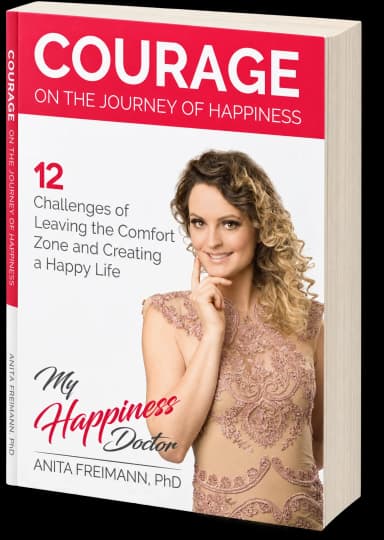
Free preview of my book
Courage on the Journey of Happiness
Get the whole introduction free: how to use the book, who it is for, and my own story of why I wrote it, plus the full table of contents with all twelve challenges. This article grows out of one of them, Practice of Spiritual Techniques – Raising Vibrations.
Sources
- 1.Russell, J. A. (1980). A circumplex model of affect. Journal of Personality and Social Psychology, 39(6), 1161–1178. doi.org/10.1037/h0077714
- 2.Fredrickson, B. L., Cohn, M. A., Coffey, K. A., Pek, J., & Finkel, S. M. (2008). Open hearts build lives: Positive emotions, induced through loving-kindness meditation, build consequential personal resources. Journal of Personality and Social Psychology, 95(5), 1045–1062. doi.org/10.1037/a0013262
- 3.Fredrickson, B. L. (2001). The role of positive emotions in positive psychology: The broaden-and-build theory of positive emotions. American Psychologist, 56(3), 218–226. pmc.ncbi.nlm.nih.gov/articles/PMC3122271/
- 4.Fredrickson, B. L. (2004). The broaden-and-build theory of positive emotions. Philosophical Transactions of the Royal Society B: Biological Sciences, 359(1449), 1367–1377. doi.org/10.1098/rstb.2004.1512
- 5.Ferguson, Y. L., & Sheldon, K. M. (2013). Trying to be happier really can work: Two experimental studies. The Journal of Positive Psychology, 8(1), 23–33. doi.org/10.1080/17439760.2012.747000
- 6.MacKerron, G., & Mourato, S. (2013). Happiness is greater in natural environments. Global Environmental Change, 23(5), 992–1000. doi.org/10.1016/j.gloenvcha.2013.03.010
- 7.White, M. P., Alcock, I., Grellier, J., Wheeler, B. W., Hartig, T., Warber, S. L., Bone, A., Depledge, M. H., & Fleming, L. E. (2019). Spending at least 120 minutes a week in nature is associated with good health and wellbeing. Scientific Reports, 9, 7730. doi.org/10.1038/s41598-019-44097-3
- 8.Reed, J., & Ones, D. S. (2006). The effect of acute aerobic exercise on positive activated affect: A meta-analysis. Psychology of Sport and Exercise, 7(5), 477–514. doi.org/10.1016/j.psychsport.2005.11.003
- 9.Sandstrom, G. M., & Dunn, E. W. (2014). Is efficiency overrated? Minimal social interactions lead to belonging and positive affect. Social Psychological and Personality Science, 5(4), 437–442. doi.org/10.1177/1948550613502990
- 10.Curry, O. S., Rowland, L. A., Van Lissa, C. J., Zlotowitz, S., McAlaney, J., & Whitehouse, H. (2018). Happy to help? A systematic review and meta-analysis of the effects of performing acts of kindness on the well-being of the actor. Journal of Experimental Social Psychology, 76, 320–329. doi.org/10.1016/j.jesp.2018.02.014
- 11.NASA Science. Visible Light. science.nasa.gov/ems/09_visiblelight/
This article is for education and reflection and is not a substitute for professional help.

About Anita
Anita Freimann, PhD, the Happiness Doctor, holds a doctorate in the economics of happiness and spent more than 16 years at the Faculty of Economics in Osijek. She is the author of Courage on the Journey of Happiness and the creator of Permission for Life.
More about Anita