Happiness science
Happiness vs Joy: The Real Difference and Why You Need Both
You can feel joy on a hard day and feel empty on a perfect one. Here's what really separates joy from happiness, what research and faith say, and six gentle ways to make room for both.

Anita Freimann, PhD · The Happiness Doctor
7 min read

In this article
- What is joy?
- What is the difference between joy and happiness?
- Signs you have moments of joy but not a happy life
- Joy vs happiness: what faith and science each say
- Affective and cognitive happiness: why a good moment isn't a good life
- What happiness research says about joy and happiness
- How to make room for joy and happiness: six gentle steps
- Is it better to be happy or joyful?
- Questions readers ask
When I tell people I research happiness, I still get the reactions I describe in my book. “Ha-ha, seriously, what do you do?” I have heard that even from fellow economists. Others decide I must have a lot of time on my hands. And when I got divorced, a new favourite appeared: look at her, she talks about happiness and she is divorced all the same.
Those comments make me laugh, because I am divorced precisely because I take happiness seriously. A divorce is rarely a joyful moment. But happiness isn't only about how you feel today; it is also about whether the life you live is really yours. That is exactly where joy and happiness part ways.
In my book Courage on the Journey of Happiness, I separate the two in plain words: affective happiness, the good feeling of the moment, and cognitive happiness, the lasting sense that your life is good. Here is what that difference means, what research says about it, and how to make room for both.
What is joy?
Joy is an emotion. It arrives, fills you and passes: your child's laughter from the next room, unexpected good news, the first swim of the summer. Psychologist Barbara Fredrickson, a leading researcher of positive emotions, describes emotions as typically brief, and joy as creating the urge to play, push the limits and be creative1. Joy doesn't wait for your life to be in order.
What is the difference between joy and happiness?
Happiness is the bigger and more slippery word. In everyday speech it can mean a feeling, “I'm so happy you came”, or a judgement about your life, “I'm happy with how my life turned out”. Researchers call the broader idea subjective well-being, people's emotional and cognitive evaluations of their lives, a term that covers what most of us call happiness, peace, fulfilment and life satisfaction2.
So is joy a moment and happiness a way of life? Mostly, yes. Joy is one of the threads; happiness in the fuller sense is the whole fabric, woven from moments, relationships, work and meaning. You can have many joyful moments in a life that doesn't feel like yours, and a good life on a day with no joy in it at all.
Signs you have moments of joy but not a happy life
You might recognise yourself in a few of these:
- you live for weekends and holidays, and by Sunday evening the heaviness is back
- whenever life feels empty, you reach for something new: a purchase, a trip, more scrolling
- your days have pleasant moments, but the year as a whole doesn't feel like yours
- you can't remember when you last lost track of time doing something you love
- you rarely ask whether the life you live is the life you want
Sometimes it's the reverse: a life that looks meaningful on paper, with very little laughter in it. And if you feel not just greyness but a low mood that has lasted for weeks, please talk to a doctor or a mental health professional.
Joy vs happiness: what faith and science each say
Search this question and you will find many answers from faith traditions. Christian writers often describe joy as the deeper of the two: an inner gift, rooted in faith, that can remain even in grief, while happiness depends on circumstances. For many people that distinction carries real meaning, and I respect it.
Psychology and economics use the words almost the other way round: joy is the short, intense emotion, and happiness, in the sense of well-being, the steadier evaluation of your life. The labels are swapped, but the insight is similar: something comes and goes, and something more lasting lies underneath. Here I use the words the way researchers do.
Affective and cognitive happiness: why a good moment isn't a good life
In my book I write about the myths we tell ourselves: I would be happier if I didn't have to work, had more money, lived in another country or were younger. In the short term, some of these might lift us. That is affective happiness, the feeling. In the long term, they won't make us happy. That is cognitive happiness, our satisfaction with life.
Think of the holiday phenomenon. We can't wait for the holiday to start, and after a few days many of us feel bored. The joy was real, but it couldn't carry a whole life. Pleasures are not the problem. Expecting them to do the work of meaning is.
Achieving those goals won’t make you completely happy; it can only be for the moment.
What happiness research says about joy and happiness
As an economist who has spent many years studying happiness, I find it reassuring that science draws the same line. Psychologists Richard Ryan and Edward Deci described two traditions of well-being research: the hedonic, focused on pleasure and avoiding pain, and the eudaimonic, focused on meaning, self-realisation and functioning fully as a person3. Veronika Huta and Alan Waterman later showed that researchers define these terms differently, which can lead to quite different findings4. So be a little sceptical of anyone who defines joy and happiness with great certainty, me included.
In my own field, economists measure the two layers separately. Daniel Kahneman and Angus Deaton analysed more than 450,000 survey responses and separated emotional well-being, how often and how intensely you feel joy, stress, sadness, anger and affection, from life evaluation, what you think of your life when you think about it. Income and education were more closely related to life evaluation, while health, caregiving and loneliness were relatively stronger predictors of daily emotions5. The World Happiness Report likewise ranks countries by life evaluation and asks about emotions separately6.
Does that make joy less important? Not at all. Fredrickson's research suggests that positive emotions broaden how we think and act, and over time help build personal resources that outlast the feeling itself. In my book I include a short questionnaire, based on Martin Seligman's work, on three paths to happiness: the pleasant, the engaged and the meaningful life. When Christopher Peterson, Nansook Park and Seligman surveyed 845 adults, each orientation predicted life satisfaction on its own, and people low on all three reported especially low satisfaction7. Joy belongs in a full life. It just can't be all of it.
How to make room for joy and happiness: six gentle steps
You don't have to choose between the moment and the life. Small, repeated habits feed both. These are the ones I return to myself.
- Notice joy while it is happening. When something lights you up, pause for three breaths and quietly name it: this is joy. It is easy to miss when your mind is on the next task.
- Collect small joys, not only big events. Good coffee, a message from a friend, sunlight on the kitchen table. If you wait for big occasions, joy becomes rare.
- Find your flow. Which activities make you forget about time? A walk, a hobby, a challenging piece of work. Psychologists call this state flow. Make room for one such activity each week.
- Don't ask pleasure to do the work of meaning. If you reach for the next purchase or trip whenever life feels empty, ask what is really missing. Often it is more of yourself in your days.
- Give some time to something bigger than you. Helping, teaching, creating, caring for a cause. Meaning rarely feels exciting at first, but it makes a life feel worth living.
- Once a month, look at the whole. Ask yourself the questions from my book: Am I happy? Do I live a life worth living? Am I doing what I want? Notice the answers without judgement and choose one small change.
Is it better to be happy or joyful?
I don't think you have to choose, and I don't think one lasts long without the other. Joy without a life that feels like yours turns into chasing the next high. A life that is good on paper but has no joy slowly turns grey.
If your days are full of duties and empty of lightness, start with small, ordinary joys. If you have plenty of pleasant moments but something still feels wrong, look at the bigger picture; Is happiness a choice? explores how much of it is in your hands. For me, the answer came one decision at a time, and some of those decisions were not joyful at all.
Joy will visit you whatever you do; your part is to notice it. Happiness, the lasting kind, asks for more: the courage to shape a life that is truly yours. That is the work we do together in my programme Permission for Life, step by step.
Questions readers ask
Can you have joy and not be happy?
Yes. Joy and sadness can live side by side. In one study, many people surveyed right after watching the film Life Is Beautiful, moving out of student housing or graduating from college felt happy and sad at the same time8. A moment of joy in a hard season doesn't betray your pain. It is a breath of air.
Is joy stronger than happiness?
Joy is usually more intense but shorter; happiness as life satisfaction is quieter and steadier. In the language of faith it is often the other way round, with joy as the deeper, lasting gift. What matters is knowing which layer you mean.
What are some examples of joy?
A child's laughter, a hug at the airport, unexpected good news, dancing in the kitchen. Joy is usually tied to a moment. Examples of happiness in the broader sense look different: meaningful work, relationships in which you can be yourself, a life you would choose again.
Is contentment the same as joy?
Not quite. Fredrickson describes joy as creating the urge to play, and contentment as creating the urge to savour your current circumstances1. Joy is lively; contentment is a calm sense of having enough. Happiness in the wider sense includes both, and how you judge your life as a whole.
How do economists measure happiness?
Often with one question: imagine a ladder from 0, the worst possible life, to 10, the best possible life, and say where you stand. The World Happiness Report ranks countries this way and asks separately about enjoyment, laughter and worry on the previous day6. One question about life, another about feelings: the same line between happiness and joy.
Your turn
Take five quiet minutes with a notebook and answer honestly:
- When did I last feel real joy, and what was I doing at the time?
- If I step back and look at my life as a whole, does it feel like mine? What one change would make it feel more so?
- Which of the three paths, pleasure, engagement or meaning, is missing most in my life right now?
Did this article speak to you? I’d love to hear what you noticed, what you tried, or what you’re still struggling with. Write to me at anita [at] anitafreimann [.] com. I read every message.
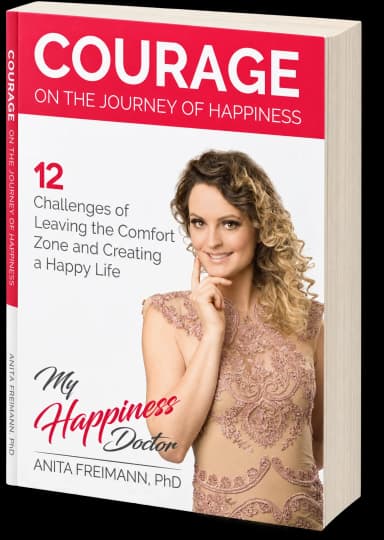
Free preview of my book
Courage on the Journey of Happiness
Get the whole introduction free: how to use the book, who it is for, and my own story of why I wrote it, plus the full table of contents with all twelve challenges. This article grows out of one of them, Healthy Selfishness and the Present Moment.
Sources
- 1.Fredrickson, B. L. (2001). The role of positive emotions in positive psychology: The broaden-and-build theory of positive emotions. American Psychologist, 56(3), 218–226. pmc.ncbi.nlm.nih.gov/articles/PMC3122271/
- 2.Diener, E., Oishi, S., & Lucas, R. E. (2003). Personality, culture, and subjective well-being: Emotional and cognitive evaluations of life. Annual Review of Psychology, 54, 403–425. doi.org/10.1146/annurev.psych.54.101601.145056
- 3.Ryan, R. M., & Deci, E. L. (2001). On happiness and human potentials: A review of research on hedonic and eudaimonic well-being. Annual Review of Psychology, 52, 141–166. doi.org/10.1146/annurev.psych.52.1.141
- 4.Huta, V., & Waterman, A. S. (2014). Eudaimonia and its distinction from hedonia: Developing a classification and terminology for understanding conceptual and operational definitions. Journal of Happiness Studies, 15(6), 1425–1456. doi.org/10.1007/s10902-013-9485-0
- 5.Kahneman, D., & Deaton, A. (2010). High income improves evaluation of life but not emotional well-being. PNAS, 107(38), 16489–16493. doi.org/10.1073/pnas.1011492107
- 6.World Happiness Report. Frequently Asked Questions. www.worldhappiness.report/faq/
- 7.Peterson, C., Park, N., & Seligman, M. E. P. (2005). Orientations to happiness and life satisfaction: The full life versus the empty life. Journal of Happiness Studies, 6(1), 25–41. doi.org/10.1007/s10902-004-1278-z
- 8.Larsen, J. T., McGraw, A. P., & Cacioppo, J. T. (2001). Can people feel happy and sad at the same time? Journal of Personality and Social Psychology, 81(4), 684–696. doi.org/10.1037/0022-3514.81.4.684
This article is for education and reflection and is not a substitute for professional help.

About Anita
Anita Freimann, PhD, the Happiness Doctor, holds a doctorate in the economics of happiness and spent more than 16 years at the Faculty of Economics in Osijek. She is the author of Courage on the Journey of Happiness and the creator of Permission for Life.
More about Anita