Inner freedom
Self-Sabotage: Why You Do It and How to Stop Without Blaming Yourself
Self-sabotage isn't a lack of willpower. It's an old way of protecting yourself from failure, disappointment or change. Here's why you do it, and seven gentle steps to break the cycle.

Anita Freimann, PhD · The Happiness Doctor
7 min read

In this article
I had just finished the first, Croatian edition of my book. Everything was arranged: the publisher, the printing, a book launch in two weeks' time. Then things unexpectedly got complicated. I came home from a meeting and started to doubt myself and the whole project. Looking back, I was slipping into postponing, quietly preparing to give up on the very thing I wanted most, just before the finish line.
Instead, I made a decision. I would publish the book myself, and I started my own company to do it, even though I knew nothing about publishing. Those were two of the craziest weeks of my life. The launch was at seven in the evening, and the copies arrived from the printer at half past six, still warm. Whenever I catch myself thinking about giving up on an idea, I remember that evening and tell myself: I can do it.
In my book Courage on the Journey of Happiness, I call this falling back into the fear zone. The very first of the twelve challenges ends with exactly this invitation: stop postponing what matters and start acting.
What is self-sabotage?
Self-sabotage means behaving in ways that undermine your own goals, relationships or happiness, often without noticing it. Psychologists have a name for one of its clearest forms: self-handicapping, putting an obstacle in your own way so that if you fail, you can blame the obstacle rather than yourself. It is not a diagnosis. It is a very human pattern, and patterns can change.
Signs of self-sabotaging behaviour
You might recognise yourself in a few of these:
- you put off the one thing that matters most and stay busy with everything else
- you lose interest, or find a reason to quit, just when something starts to work
- you don't prepare properly, so that if it goes wrong, you didn't really try
- you wait to feel ready, or for everything to be perfect, before you begin
- you pull away or start an argument when someone gets close
- you hear yourself say “not now”, “I'm too old” or “what will people say?”
Why do I self-sabotage?
Because some part of you is trying to keep you safe. If you don't really try, failure says nothing about your worth. If you never finish, nobody can judge the result. If you stay where you are, at least you know what to expect. As I wrote in my book, people often find something bad better than the unknown. Putting things off also brings instant relief: the anxious feeling fades today, and your future self pays the bill.
Many of these patterns are old. Some of us grew up being told to be humble and not to stand out, so wanting more felt ungrateful. So if you keep sabotaging yourself, there is nothing wrong with you. You are using an old strategy in a life that no longer needs it. And if these patterns seriously disrupt your work, relationships or well-being, or are tied to painful experiences, please talk to a qualified therapist; they can help in ways no article can.
Self-sabotage lives in the fear zone
In my book I describe life as a journey through zones, which I wrote about more fully in how to find yourself again. Self-sabotage lives in the fear zone. You know what isn't right, but you aren't ready to face your fears, so you hear the call and don't act. On the outside it looks like postponing, busyness and endless excuses. On the inside it is usually fear of failure, or sometimes, as I wrote, fear of success.
Fear itself is not the enemy. It can be a guide, pointing straight at the parts of your life that need attention. The worst thing you can do is deny it and push it deeper. Recognising it is the first step out.
It’s better to face fear and act, even if the result isn’t perfect, than do nothing and stagnate.
What happiness research says about self-sabotage
As an economist who has spent many years studying happiness, I find it comforting that psychologists have studied this for decades. In a classic experiment, Steven Berglas and Edward Jones told some students they had done well on puzzles that were in fact unsolvable, a success they couldn't explain. Before a retest, they could choose a drug said to improve performance or one said to impair it. Men in that situation preferred the one that would hold them back, presumably so that a likely failure could be blamed on the drug; among women the effect didn't appear1.
The protection has a price. Miron Zuckerman and Fen-Fang Tsai found that, over time, self-handicapping and poorer adjustment reinforced each other, and that self-handicappers reported feeling less competent and less intrinsically motivated at work. They suggested it serves people whose self-esteem is fragile2. Procrastination works in a similar way. Fuschia Sirois and Timothy Pychyl describe it as giving priority to feeling better now, at the expense of your future self3.
What helps is not being harder on yourself. In a study of first-year students, Michael Wohl, Timothy Pychyl and Shannon Bennett found that those who forgave themselves for procrastinating before their first exams tended to procrastinate less before the next ones4. In experiments by Juliana Breines and Serena Chen, people encouraged to treat a mistake with self-compassion were more motivated to improve, and after failing a difficult test they spent more time studying for the next one5. Kindness is not the opposite of discipline. It is what makes trying again bearable.
How to stop self-sabotaging: seven gentle steps
You don't stop self-sabotage with one heroic effort, but in small moments, repeated until a new way feels natural. These are the steps I use myself.
- Name your pattern. What do you always do the same way, even though you don't like the results? This is one of the first mini challenges in my book, because noticing alone begins to change things.
- Catch the moment just before. Self-sabotage has a starting point: the phone you reach for, the “tomorrow” you promise yourself, the sudden urge to tidy the kitchen. Notice what you feel right then: usually fear, doubt or boredom.
- Ask what it protects you from. Failing? Being seen? Succeeding and then having to keep it up? Use the fear as a guide, not a verdict.
- Keep the benefit in sight. Write down your favourite excuse, and next to it what you will gain by acting anyway. The benefit is what moves us; the excuse only keeps us where we are.
- Make an if-then plan. “If I notice I'm putting off the report, then I'll open it and write for ten minutes.” Combining 94 tests, Peter Gollwitzer and Paschal Sheeran found that plans like this had a medium-to-large effect on reaching goals6.
- Choose done over perfect. Years ago, the author John Assaraf told me in a private conversation: “Anita, remember: done is better than perfect.” Waiting for perfect is simply a more respectable way of not starting.
- Forgive yourself and begin again. You will slip. When you do, speak to yourself as you would to a good friend, and ask what you will do differently next time. Self-blame keeps you in the loop; kindness walks you out of it.
How to stop self-sabotaging in relationships
In relationships, self-sabotage often means keeping love at a safe distance: testing a partner, pulling away when things get close, starting a fight before you can be hurt, or expecting the worst so you are never surprised. In three studies with 1,365 people who had experienced relationship sabotage, Raquel Peel and Nerina Caltabiano found three recurring themes: defensiveness, difficulty trusting and a lack of relationship skills. Their conclusion sounds familiar: people sabotage their relationships mainly to protect themselves7.
So the way out is not to try harder to be perfect, but to make it safer to stay. Notice your own signal, the urge to withdraw or to attack, and name it out loud: “I'm getting defensive, give me a minute.” Then ask whether you are reacting to this person or to someone from your past. If an old story is still steering, letting go of the past may be your next step.
Self-sabotage is not proof that you don't want something enough. Often it shows how much it matters. You don't have to wait until the fear is gone; you only have to stop letting it decide. That is the heart of my programme Permission for Life: permission to live your own life, with people who walk the same path. And the next time you are about to give up, remember that the books can arrive at half past six, still warm.
Questions readers ask
Is self-sabotage a mental illness?
No. Self-sabotage is not a diagnosis but a description of a pattern of behaviour that almost everyone recognises at some point. It can, however, go together with anxiety, low mood or painful past experiences. If it seriously disrupts your life, please talk to a doctor or a qualified therapist.
Why do I self-sabotage when things are going well?
Because good things can feel unfamiliar, and the unfamiliar can feel unsafe. If you grew up believing you shouldn't stand out or want too much, happiness may feel like something you will have to pay for later. Noticing that belief is the first step to letting yourself keep what is good.
What are examples of self-sabotage?
Putting off what matters most, not preparing so you have an excuse, quitting just before the finish line, waiting for perfect conditions, saying yes to everyone so there is no time for your own goals, and pulling away from people who get close.
Is procrastination a form of self-sabotage?
Often, yes. Not every delay is a problem, but when you keep putting off something you care about while knowing it will cost you, it works like self-sabotage: you feel better now, and your future self pays later.
What is a good book on self-sabotage?
Look for a book that gives you practice, not only insight. In Courage on the Journey of Happiness I write about the fear zone, postponing and the excuses that keep us stuck, with small mini challenges along the way. You can read the introduction free.
Your turn
Take five quiet minutes with a notebook and answer honestly:
- Which dream have I kept “for later” the longest, and what am I afraid would happen if I finally went for it?
- Who taught me that it is safer not to stand out, and do I still believe it?
- How do I speak to myself after I slip, and how would I speak to a friend in the same place?
Did this article speak to you? I’d love to hear what you noticed, what you tried, or what you’re still struggling with. Write to me at anita [at] anitafreimann [.] com. I read every message.
Free preview of my book
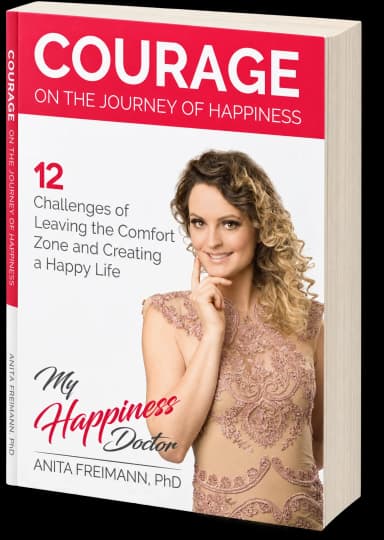
Courage on the Journey of Happiness
Get the whole introduction free: how to use the book, who it is for, and my own story of why I wrote it, plus the full table of contents with all twelve challenges. This article grows out of one of them, Healthy Selfishness and the Present Moment.
Sources
- 1.Berglas, S., & Jones, E. E. (1978). Drug choice as a self-handicapping strategy in response to noncontingent success. Journal of Personality and Social Psychology, 36(4), 405–417. doi.org/10.1037/0022-3514.36.4.405
- 2.Zuckerman, M., & Tsai, F.-F. (2005). Costs of self-handicapping. Journal of Personality, 73(2), 411–442. doi.org/10.1111/j.1467-6494.2005.00314.x
- 3.Sirois, F., & Pychyl, T. (2013). Procrastination and the priority of short-term mood regulation: Consequences for future self. Social and Personality Psychology Compass, 7(2), 115–127. doi.org/10.1111/spc3.12011
- 4.Wohl, M. J. A., Pychyl, T. A., & Bennett, S. H. (2010). I forgive myself, now I can study: How self-forgiveness for procrastinating can reduce future procrastination. Personality and Individual Differences, 48(7), 803–808. doi.org/10.1016/j.paid.2010.01.029
- 5.Breines, J. G., & Chen, S. (2012). Self-compassion increases self-improvement motivation. Personality and Social Psychology Bulletin, 38(9), 1133–1143. doi.org/10.1177/0146167212445599
- 6.Gollwitzer, P. M., & Sheeran, P. (2006). Implementation intentions and goal achievement: A meta-analysis of effects and processes. Advances in Experimental Social Psychology, 38, 69–119. doi.org/10.1016/S0065-2601%2806%2938002-1
- 7.Peel, R., & Caltabiano, N. (2021). The Relationship Sabotage Scale: An evaluation of factor analyses and constructive validity. BMC Psychology, 9, 146. doi.org/10.1186/s40359-021-00644-0
This article is for education and reflection and is not a substitute for professional help.

About Anita
Anita Freimann, PhD, the Happiness Doctor, holds a doctorate in the economics of happiness and spent more than 16 years at the Faculty of Economics in Osijek. She is the author of Courage on the Journey of Happiness and the creator of Permission for Life.
More about Anita