Courage
How to Find Yourself Again When You've Spent Years Being Who Everyone Needed
You didn't lose yourself because you failed. You lost yourself because you were needed, for years. Here's how it happens, what research says, and seven gentle steps back to you.

Anita Freimann, PhD · The Happiness Doctor
7 min read

When I talk to people about their lives, I often ask simple questions. Where are you going? Why did you choose this path? What would you do if you knew it would turn out well? At first, most of them give me the same answer: “As long as it's not worse.” But when we dig a little deeper, almost everyone admits the same thing. They work, hurry and rush, doing everything they can so as not to stop. Because when you stop, you have to face yourself.
If you have spent years being a mother, a daughter, a partner and the colleague everyone can count on, that moment can be frightening. You look in the mirror and you're not quite sure who is looking back. You know everyone's timetable, everyone's favourite food, everyone's worries. Your own wishes? You may have forgotten them, not because they were never there, but because for so long you have been doing what others expected of you. I have been there myself.
In my book Courage on the Journey of Happiness, I call this the moment of truth. It is uncomfortable, and it is also an excellent moment, because it holds great potential for change. It simply asks for the courage to pause and honestly look.
What does it mean to find yourself again?
Finding yourself again doesn't mean discovering a brand-new person. It means reconnecting with what was always yours, your values, wishes, talents and preferences, and letting them shape your choices again. When people step out of their comfort zone, they rarely meet a stranger. Much more often they rediscover abilities they had all along, kept muffled for years by routine and duty.
Signs you've lost yourself in being needed
You might recognise yourself in a few of these:
- you can't remember the last time you did something only because you enjoyed it
- when someone asks what you want, your mind goes blank, or you answer for the whole family
- you feel most like yourself when you are useful, and restless when nobody needs you
- your diary is full, yet you feel strangely absent from your own life
- you envy women who seem to “just do their own thing”, and then feel guilty for it
Why do I feel lost in life?
Usually not because you did something wrong, but because you did so much right. Roles are not masks; they are real and precious. The trouble begins when they take up all the space. When your days revolve around other people's needs, nobody asks about your preferences any more, including you, and what is never asked for slowly falls silent.
The feeling often surfaces at turning points: the children need you less, a relationship ends, a parent needs care, a job that defined you changes. One role loosens, and suddenly you notice how little was left for you. That is not a flaw in your character. It is a signal. If saying yes to everyone is part of your story, start with how to stop people pleasing.
Finding yourself again takes courage, not a new personality
In the book I describe life as a journey through zones. In the comfort zone everything is familiar and predictable, even when it no longer makes you happy. The moment you start asking questions, you move into the fear zone: you see what isn't right, but you don't act yet, so you postpone. Only when you act despite the fear do you enter the action zone, where growth happens, and with persistence what I call the magic zone, where life starts to flow.
If you are asking how to find yourself again, you have probably already left the comfort zone. You are standing in the fear zone, asking the right questions and waiting to feel ready. You will never feel completely ready. That is why the word courage is in the title of my book.
Courage means you have decided to do the thing that frightens you despite the fear.
What happiness research says about finding yourself again
As an economist who has spent many years studying happiness, I find this research reassuring: losing your sense of self when life changes is a common human experience, not a personal failure. Psychologist Jennifer Campbell and her colleagues call it self-concept clarity: how clearly and confidently you know who you are, and how consistent and stable that picture feels1.
That clarity is not fixed. Erica Slotter, Wendi Gardner and Eli Finkel studied people after a romantic breakup. Partners' selves had become intertwined, and when the relationship ended, people felt less clear about who they were, which in turn predicted their emotional distress2. The research was about couples, so I hold it carefully, but it rings true for other roles that fill a life.
Why does it matter? Combining 75 studies with more than 36,000 people, Anna Sutton found that people who feel more authentic, more able to express who they really are, also report greater well-being3. It is a link, not proof of cause.
And waiting has a cost. Thomas Gilovich and Victoria Medvec found that in the short term we regret what we did, but in the long run we regret more what we didn't do4. Later, Shai Davidai and Gilovich showed that our most enduring regrets come from not becoming our ideal self, the person we hoped to be, rather than from neglecting our duties. We repair neglected duties quickly; neglected dreams tend to stay unresolved5. For a woman who has fulfilled every duty for years, that is worth sitting with.
How to find yourself again: seven gentle steps
You lost yourself gradually, and you will find yourself gradually too. Trying to change every area of life at once usually ends in exhaustion and old habits. Small, regular steps work better.
- Stop for ten minutes a day. No phone, no tasks, no one to look after. Notice what comes. At first it may be restlessness; that is what you have been running from.
- Admit that something is missing. You can love your family, value your work and still feel that this isn't fully your life.
- Start with what you don't want. If “what do I want?” feels too big, turn it around: to find out what you want, first recognise what you don't want. Write down what drains you, and notice what is left.
- Remember who you were before you were needed. As children we were curious and loved trying new things. What did you love at twelve, or at twenty? What made you forget the time? Those are clues.
- Choose one area of life, not all of them. Work, partnership, motherhood, friendships, your body, your own time. Pick the one where you feel most lost and begin there.
- Act before your mind talks you out of it. When an idea to do something differently appears, you have only a few seconds before doubt takes over. I use a simple “three, two, one, go”.
- Be patient with the return. In one study, it took people between 18 and 254 days for a new daily behaviour to become automatic, and missing a single day didn't spoil the process6. If you slip back for a week, simply begin again.
What to do when you feel lost in life
When the feeling is strong, you don't need a five-year plan. You need the next step: one honest conversation, one evening that belongs to you, one question in your journal. Feeling lost often means the old map no longer fits the woman you are becoming.
Sometimes, though, it is more than a season of change. If feeling lost has turned into weeks of low mood, hopelessness or a sense that you can't cope, please talk to your doctor or a mental health professional, and if you ever feel unsafe, contact your local emergency services straight away.
Is it too late to find yourself again?
At a congress on healthy living, after I had spoken about the comfort zone, an 83-year-old man came slowly towards me with his walking stick. He wanted to tell me what he was researching: he was writing his PhD. Everyone asked him why so late, he said, and he answered that until then he had been collecting experience. I still think of him whenever I catch myself believing it is too late, or not the right moment.
As an economist, I can add one encouraging finding. Across 145 countries, David Blanchflower found that well-being tends to follow a U-shape over life, with a low point in midlife around the age of 507. Researchers still debate the curve, but if you feel lost in your forties or fifties, you are in large company, and on average it rises again.
Finding yourself again is a gradual rebuilding, one area of life at a time, ideally with people around you who walk the same road. That is the idea behind my programme Permission for Life, and one of its three parts is simply called Mine. You have been there for everyone. Now it is your turn.
Questions readers ask
How do I stop feeling lost?
Not by forcing a big answer. Shrink the question to the next step: ten quiet minutes a day, one thing you will stop doing, one small thing you will try. Clarity often follows action.
What causes a lack of purpose in life?
Often it is not a lack of purpose but a lack of space for it. When years are filled with other people's needs and routine, your own wishes grow quieter, and a big change can suddenly make that silence noticeable.
Can you lose yourself in motherhood?
Many women say so. Motherhood can take nearly all your time and attention for years. Finding yourself again doesn't mean loving your children less; it means making room for the woman they also need to see.
How long does it take to find yourself again?
There is no timetable. What helps most is regularity: small steps repeated week after week, in one area of life at a time, and patience when you slip back.
What are the best books to help me find myself?
Look for one that gives you practice, not only inspiration. I wrote Courage on the Journey of Happiness as twelve challenges for leaving the comfort zone, one step at a time. You can read the introduction free, the story of why I wrote it and who it is for.
Your turn
Take five quiet minutes with a notebook and answer honestly:
- Which part of me have I put on hold the longest, and why?
- If no one needed anything from me for one whole day, how would I spend it?
- Looking back in twenty years, which dream would I regret not following?
Did this article speak to you? I’d love to hear what you noticed, what you tried, or what you’re still struggling with. Write to me at anita [at] anitafreimann [.] com. I read every message.
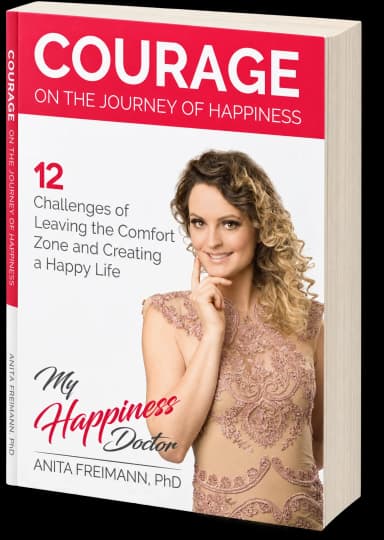
Free preview of my book
Courage on the Journey of Happiness
Get the whole introduction free: how to use the book, who it is for, and my own story of why I wrote it, plus the full table of contents with all twelve challenges. This article grows out of one of them, Healthy Selfishness and the Present Moment.
Sources
- 1.Campbell, J. D., Trapnell, P. D., Heine, S. J., Katz, I. M., Lavallee, L. F., & Lehman, D. R. (1996). Self-concept clarity: Measurement, personality correlates, and cultural boundaries. Journal of Personality and Social Psychology, 70(1), 141–156. doi.org/10.1037/0022-3514.70.1.141
- 2.Slotter, E. B., Gardner, W. L., & Finkel, E. J. (2010). Who am I without you? The influence of romantic breakup on the self-concept. Personality and Social Psychology Bulletin, 36(2), 147–160. doi.org/10.1177/0146167209352250
- 3.Sutton, A. (2020). Living the good life: A meta-analysis of authenticity, well-being and engagement. Personality and Individual Differences, 153, 109645. doi.org/10.1016/j.paid.2019.109645
- 4.Gilovich, T., & Medvec, V. H. (1995). The experience of regret: What, when, and why. Psychological Review, 102(2), 379–395. doi.org/10.1037/0033-295X.102.2.379
- 5.Davidai, S., & Gilovich, T. (2018). The ideal road not taken: The self-discrepancies involved in people's most enduring regrets. Emotion, 18(3), 439–452. doi.org/10.1037/emo0000326
- 6.Lally, P., van Jaarsveld, C. H. M., Potts, H. W. W., & Wardle, J. (2010). How are habits formed: Modelling habit formation in the real world. European Journal of Social Psychology, 40(6), 998–1009. doi.org/10.1002/ejsp.674
- 7.Blanchflower, D. G. (2021). Is happiness U-shaped everywhere? Age and subjective well-being in 145 countries. Journal of Population Economics, 34(2), 575–624. doi.org/10.1007/s00148-020-00797-z
This article is for education and reflection and is not a substitute for professional help.

About Anita
Anita Freimann, PhD, the Happiness Doctor, holds a doctorate in the economics of happiness and spent more than 16 years at the Faculty of Economics in Osijek. She is the author of Courage on the Journey of Happiness and the creator of Permission for Life.
More about Anita