Healthy selfishness
How to Love Yourself When You Were Taught to Put Everyone First
Loving yourself isn't selfishness, and it isn't a bubble bath. It's how you treat yourself on an ordinary day. Here's why it feels so hard, what research says, and seven gentle steps to begin.

Anita Freimann, PhD · The Happiness Doctor
7 min read

In this article
- What does it really mean to love yourself?
- Signs you find it hard to love yourself
- Why is it so hard to love myself?
- Loving yourself is healthy selfishness, not selfishness
- What happiness research says about loving yourself
- How to love yourself: seven gentle steps
- Learning to love yourself when it feels unnatural
- Questions readers ask
When my son was a baby, I told my mother about a simple practice I had discovered, built on a few short phrases, among them “I love you” and “thank you”. She made up a little melody for those words and sang them to him as she put him to sleep. It is so easy to say those words to a child. Say them to yourself, and for many of us something tightens.
In my book Courage on the Journey of Happiness, I ask readers a question that sounds simple: can you look in the mirror and say that you love yourself? For a woman who learned early that she is good when she gives, it is one of the hardest questions there is. Healthy selfishness, the very first challenge in the book, starts exactly there.
What does it really mean to love yourself?
Loving yourself is not a bubble bath, a shopping trip or a mantra about how amazing you are. It is the way you treat yourself on an ordinary day, and especially on a bad one. Psychologist Kristin Neff studies its close relative, self-compassion, and defines it as three things: being kind to yourself instead of harshly self-critical when you fail or suffer, seeing your struggles as part of being human rather than proof that something is wrong with you, and holding painful feelings in balanced awareness instead of drowning in them1.
Notice what is missing: feeling wonderful about yourself all the time, and putting yourself above others. Self-love is closer to friendship than to admiration. You can make a mistake, look tired in the mirror, and still be on your own side.
Signs you find it hard to love yourself
You might recognise yourself in a few of these:
- you know what everyone in your family needs, but go blank when asked what you need
- you speak to yourself in a way you would never speak to a friend
- rest feels like something you have to earn first
- a compliment makes you uncomfortable, while one critical remark stays with you for days
- spending time or money on yourself comes with a quiet sense of guilt
Why is it so hard to love myself?
Because most of us were taught otherwise, gently and for years. Many of us learned early that thinking of yourself is selfish and that wishing for more is ungrateful. Many women got an extra lesson: a good woman is the one who gives. Combining 71 studies, Lisa Yarnell, Kristin Neff and their colleagues found that women report slightly less self-compassion than men on average2. The difference is small, and the researchers caution against overstating it, but it points in the same direction.
None of this is anyone's fault. In the book I write that the people who raised us taught us the best they could, within what they understood. If they never learned to love themselves, they couldn't teach us. But the past has power over you only if you let it. And if being hard on yourself is tied to painful experiences, or has turned into lasting low mood, please don't carry it alone: talk to your doctor or a qualified therapist.
Loving yourself is healthy selfishness, not selfishness
Behind the question “how do I love myself?” there is often a quieter fear: if I start loving myself, will I stop loving them? In my book I wrote that putting yourself first doesn't mean neglecting others. You can love yourself and still take care of others and give them your time. That is what I call healthy selfishness, and it is why I believe every change begins with loving yourself.
You are capable of loving yourself and others at the same time.
Healthy selfishness also means you stop doing things only out of duty, because duty alone doesn't truly help anyone. A friend's status once made me laugh: “I don't have to do anything, I had my share of have tos.” So if loving yourself means dyeing your hair the colour you have always wanted, making time for beauty treatments or getting up a little earlier to have the morning to yourself, so be it. Let people talk; they always will. Even the bubble bath is fine, as long as it is a gift, not a reward you must earn first.
What happiness research says about loving yourself
As an economist who has spent many years studying happiness, I find it telling how clearly research separates self-compassion from self-esteem. In a study of more than 2,000 people, Kristin Neff and Roos Vonk found that self-compassion went with a steadier sense of self-worth, one that depended less on particular outcomes, and with less comparing yourself to others. Self-esteem, but not self-compassion, was linked to narcissism3. For a woman whose worth has always depended on how much she gives, that difference matters.
It is linked to well-being too. Angus MacBeth and Andrew Gumley combined 20 samples and found a large link between more self-compassion and fewer mental health difficulties4. A link is not proof of cause, but experiments point the same way. When Madeleine Ferrari and her colleagues reviewed 27 randomised controlled trials, programmes that teach self-compassion brought moderate improvements in stress, depression, anxiety and self-criticism compared with control groups5.
And no, kindness to yourself doesn't make you lazy. In four experiments, Juliana Breines and Serena Chen found that people encouraged to treat their mistakes with self-compassion studied longer for a difficult test after failing a first one, and felt more motivated to make amends for a past wrong and not repeat it6.
One finding speaks directly to the fear of becoming selfish. In a study of 104 couples, Kristin Neff and Natasha Beretvas found that more self-compassionate people were described by their partners as more affectionate, intimate and accepting, while the less self-compassionate were described as more controlling, detached and verbally aggressive7. Loving yourself, it seems, is good news for the people you love.
How to love yourself: seven gentle steps
You don't learn to love yourself in one big decision. You learn it the way you learned to put yourself last: in small, repeated moments.
- Catch your inner voice. For one week, notice how you speak to yourself when you forget something or say the wrong thing. Write down the exact words. They may surprise you.
- Ask what you would say to a friend. Then say that to yourself, in the same tone. It will feel awkward at first; you are practising a new language.
- Remember you are not the only one. When you struggle, your mind whispers that everyone else manages. They don't. Struggle is part of being human.
- Take fifteen minutes a day that belong to you. In the book I call these fifteen minutes the key to any change. If your day is full, get up fifteen minutes earlier and use the time for yourself.
- Do one thing you keep postponing. Think of something you really want to do but keep putting off. Choose one that is realistically doable, and do it tomorrow.
- Treat your body as a friend, not a project. Love it with all its flaws and virtues, and don't let others set the standards of beauty for you. For me, that also meant finding movement I enjoy: after many workouts that were too much for me, I discovered yoga and realised I didn't even know how to stand, sit or breathe properly.
- Say no to one thing that costs you yourself. Every yes to something that drains you is also a no to you. If this is hard, start with how to stop people pleasing.
Learning to love yourself when it feels unnatural
If you are learning to love yourself after decades of putting yourself last, expect it to feel strange, even fake. The first time you rest without earning it, guilt may come. That doesn't mean you are doing it wrong. It means you are doing something new.
So how do you start loving yourself in everyday life? At home, it can mean saying “I'm going for a walk, dinner will be at seven” without apologising. At work, leaving on time once a week without explaining why. And if you have lost track of who you are under all your roles, read how to find yourself again.
Loving yourself is not a destination you reach once. It is a relationship you practise every day, and it is easier with company; that is what my programme Permission for Life, with its three parts Mine, Selfish and Free, is for. But it can start tonight, with fifteen minutes and one kind sentence. You have given love to everyone for years. You are allowed to be on the list too.
Questions readers ask
Do you have to love yourself first before someone else can love you?
No. You can be loved at any stage, and nobody has to master self-love first. But how you treat yourself shapes what you accept from others and how you show up in a relationship, which is why it is worth practising alongside loving others, not instead of it.
What is the difference between self-love and self-esteem?
Self-esteem is how positively you judge yourself, and it often rises and falls with success, praise and comparison. Self-compassion is about how you treat yourself, especially when you fail. In one large study it went with a steadier sense of self-worth3.
How do I start loving my body?
Begin with care rather than criticism: rest, movement you enjoy, clothes you feel good in. Ask who set the beauty standard you measure yourself against. If your relationship with food or your body causes you serious distress, please talk to your doctor or a specialist.
Is self-love the same as self-care?
Not quite. Self-care is what you do: sleep, a walk, a quiet evening. Self-love is the belief behind it, that your needs count. Without it, even a bubble bath becomes one more task.
What are the best books on how to love yourself?
Look for a book that gives you practice, not only inspiration. Kristin Neff's work on self-compassion is a good research-based start. I wrote Courage on the Journey of Happiness as twelve challenges, and the first one, healthy selfishness, is about exactly this. You can read the introduction free.
Your turn
Take five quiet minutes with a notebook and answer honestly:
- Whose voice do I hear when I criticise myself, and would I ever speak like that to someone I love?
- What did I learn as a girl about women who put themselves first?
- What would change in my week if my needs counted as much as everyone else's?
Did this article speak to you? I’d love to hear what you noticed, what you tried, or what you’re still struggling with. Write to me at anita [at] anitafreimann [.] com. I read every message.
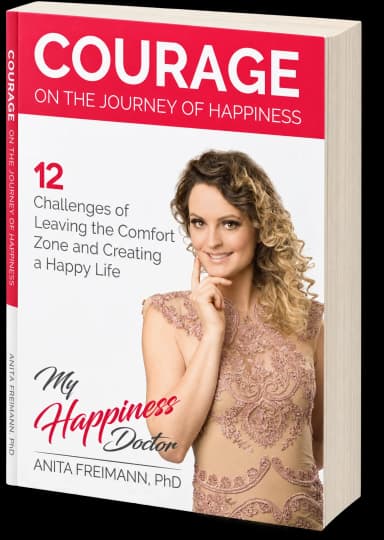
Free preview of my book
Courage on the Journey of Happiness
Get the whole introduction free: how to use the book, who it is for, and my own story of why I wrote it, plus the full table of contents with all twelve challenges. This article grows out of one of them, Healthy Selfishness and the Present Moment.
Sources
- 1.Neff, K. D. (2003). Self-compassion: An alternative conceptualization of a healthy attitude toward oneself. Self and Identity, 2(2), 85–101. doi.org/10.1080/15298860309032
- 2.Yarnell, L. M., Stafford, R. E., Neff, K. D., Reilly, E. D., Knox, M. C., & Mullarkey, M. (2015). Meta-analysis of gender differences in self-compassion. Self and Identity, 14(5), 499–520. doi.org/10.1080/15298868.2015.1029966
- 3.Neff, K. D., & Vonk, R. (2009). Self-compassion versus global self-esteem: Two different ways of relating to oneself. Journal of Personality, 77(1), 23–50. doi.org/10.1111/j.1467-6494.2008.00537.x
- 4.MacBeth, A., & Gumley, A. (2012). Exploring compassion: A meta-analysis of the association between self-compassion and psychopathology. Clinical Psychology Review, 32(6), 545–552. doi.org/10.1016/j.cpr.2012.06.003
- 5.Ferrari, M., Hunt, C., Harrysunker, A., Abbott, M. J., Beath, A. P., & Einstein, D. A. (2019). Self-compassion interventions and psychosocial outcomes: A meta-analysis of RCTs. Mindfulness, 10(8), 1455–1473. doi.org/10.1007/s12671-019-01134-6
- 6.Breines, J. G., & Chen, S. (2012). Self-compassion increases self-improvement motivation. Personality and Social Psychology Bulletin, 38(9), 1133–1143. doi.org/10.1177/0146167212445599
- 7.Neff, K. D., & Beretvas, S. N. (2013). The role of self-compassion in romantic relationships. Self and Identity, 12(1), 78–98. doi.org/10.1080/15298868.2011.639548
This article is for education and reflection and is not a substitute for professional help.

About Anita
Anita Freimann, PhD, the Happiness Doctor, holds a doctorate in the economics of happiness and spent more than 16 years at the Faculty of Economics in Osijek. She is the author of Courage on the Journey of Happiness and the creator of Permission for Life.
More about Anita