Relationships
Signs of a Healthy Relationship: What Love Looks Like When It's Good for You
A good relationship isn't one where nothing is wrong. It's one where you can be fully yourself. Here are the signs to look for with a partner, friends and family, what research says, and seven gentle steps to build them.

Anita Freimann, PhD · The Happiness Doctor
7 min read

In this article
- What does a healthy relationship look like?
- Signs of a healthy relationship: nine things to look for
- Healthy vs unhealthy relationships: what's the difference?
- True partnership: a compromise, not a concession
- What happiness research says about healthy relationships
- How to have a healthy relationship: seven gentle steps
- Signs of a healthy friendship and family relationship
- Questions readers ask
There is one small thing in my relationship today that tells me more than any grand gesture. We don't check each other's phones, and we don't hide them either; there is simply nothing to hide. I didn't have that kind of bond in all my earlier relationships, and only later did I understand why it matters: when you don't have to guard anything, you can finally rest.
Years ago, when I tried to tell the people close to me that something in my marriage didn't feel right, I kept hearing the same answer: be content, nothing is really wrong, everybody has it the same or worse. It took me a long time to see that nothing being wrong is not the same as something being right. That marriage ended quietly, without drama, and we remained friends.
In my book Courage on the Journey of Happiness, one challenge is devoted to true partnership, and it opens with a thought that holds for every bond: each relationship is made of two people, you and someone else, whether a partner, a parent, a child or a friend. So this article is about all of them, with a little more room for your partner.
What does a healthy relationship look like?
A healthy relationship is one in which both people feel safe, respected and free to be themselves, and each wants the other to grow. It is not a perfect relationship; you will still have bad days and misunderstandings. Researchers have a useful word for what makes the difference: responsiveness, the feeling that the other person leaves you understood, validated and cared for1.
Signs of a healthy relationship: nine things to look for
You won't see all nine every day. But if you recognise most of them most of the time, you are in good hands:
- you can say what you think and feel without fear
- you disagree, and then find your way back to each other
- they are genuinely glad when good things happen to you
- you trust each other, so nobody needs to check, control or test
- you each have your own friends, interests and time
- decisions and everyday chores are shared
- you still laugh and have fun together
- you both keep growing, and want that for each other
- after time together you feel calmer and more like yourself, not smaller
Healthy vs unhealthy relationships: what's the difference?
An unhealthy relationship is not simply one with problems. It is one where the same pattern keeps costing you yourself: you walk on eggshells, hide things to keep the peace, jealousy passes for love, criticism turns into contempt, or your mood depends entirely on theirs. Sometimes it is a friend who drains you; I wrote about that in energy vampires. Sometimes it is family, where the oldest patterns live: see how to set boundaries with toxic family members. An emotionally unavailable partner or codependency deserves its own careful look.
One thing is not a matter of better communication at all. If a partner or anyone close to you hurts, threatens, controls or frightens you, your safety comes first. Please contact local domestic abuse services, your doctor or a qualified professional, and in immediate danger, your local emergency number.
True partnership: a compromise, not a concession
One distinction changed how I see every relationship: the difference between a compromise, in which two people meet somewhere in the middle, and a concession, in which one of them quietly gives up a piece of themselves to keep the peace. Healthy relationships are full of compromises. Unhealthy ones are built on concessions, usually made by the same person, again and again.
That is why the motto I offer in my book for any partnership is to grow together. Who we become depends a great deal on the people closest to us, and a partner who stands behind your growth, even a career change at 40, is one of the quietest signs of a healthy relationship. And it all begins with us: if you have spent years putting everyone else first, start with how to stop people pleasing. Love, in the end, is freedom, with no need for jealousy, control or secrets.
Living with someone in truth implies that you can openly say anything that is happening without fear.
What happiness research says about healthy relationships
As an economist who has spent many years studying happiness, I know few findings as consistent as this one. When Ed Diener and Martin Seligman compared the happiest 10% of students with everyone else, the very happy had stronger romantic and other relationships. No single factor was enough for happiness, but good relationships appeared to be necessary2.
The Harvard Study of Adult Development, now directed by Robert Waldinger, has followed a group of men since their student years in 1939–1942. When Waldinger and Marc Schulz asked 47 of them, by then in their eighties, and their partners to report on their days, those in more satisfying marriages stayed happier on days with more physical pain3. Love doesn't remove pain, but it seems to soften it.
John Gottman and Robert Levenson watched couples talk through a disagreement and followed them for years: more negative and less positive emotion went with a greater risk of separating4. The Gottman Institute puts it as a ratio: about five positive interactions for every negative one during conflict in stable, happy couples, and one to one or less in couples near divorce5. It is a rule of thumb, not a formula: surround conflict with warmth.
Shelly Gable, Harry Reis and their colleagues looked at what happens when things go right. Sharing good news went with a better mood, especially when the listener responded actively and with real interest6. In 79 dating couples, how partners responded to good news was more closely linked to the relationship's health, and to break-ups two months later, than how they responded to bad news1.
None of this is only about romance. In a survey of more than 271,000 adults, William Chopik found that valuing friendships went with better health and well-being, especially in older age7. Across 148 studies, Julianne Holt-Lunstad and her colleagues found that people with stronger social relationships had about a 50% greater likelihood of survival over the years they were followed8. These are links, not proof of cause, and quality matters: in a review of 126 studies, better marital quality went with better health, though the effects were small9.
How to have a healthy relationship: seven gentle steps
Healthy relationships are practised in ordinary moments. You can only do your half, but your half is enough to begin.
- Start with yourself. Everything, including love, begins with us. Say what you need instead of waiting for someone to guess.
- Tell the truth in small things. Secrets rarely start big; they start with a message you would rather not show. The less you hide, the less room there is for jealousy and doubt.
- Be glad out loud. When your partner, friend or sister shares good news, stop, ask questions and let your joy show.
- Calm yourself before you speak. Master your own reaction first, whatever the other person does. The book I recommend here, ScreamFree Marriage by Hal Edward Runkel and Jenny Runkel, is built on exactly this.
- Repair, don't win. After an argument, be the first to come back: “I'm sorry I raised my voice. Can we try again?”
- Share the everyday load. Chores are not something a woman does and her partner “helps” with. Agree who does what, then let the other person do it their way.
- Keep having fun. Boredom and life on autopilot are among the greatest enemies of a long relationship. Put one thing you would love to do together in the diary this month.
Signs of a healthy friendship and family relationship
The same signs apply beyond romance. A healthy friendship feels mutual: nobody keeps score, but both of you give, both of you receive, and you can tell each other the truth. A healthy family relationship is not closeness at any price, but respect for the fact that you are an adult living her own life. If your circle has shrunk over the years, you are not alone; friendships in midlife need more intention. And if you feel lonely even inside a relationship, treat it as a signal, not a failure. Positive relationships are measured not by how many people surround you, but by how many you can truly be yourself with.
Changing how you love after decades of habit is easier with people around you who walk the same path. That is what my programme Permission for Life is for: permission to live, and to love, your own way. You deserve love that is good for you.
Questions readers ask
What is the 5:1 rule in relationships?
It comes from John Gottman and Robert Levenson's research on couples discussing disagreements. The Gottman Institute describes stable, happy couples as having about five positive interactions for every negative one during conflict5. It is a rule of thumb, not a precise formula.
Is it normal to argue in a healthy relationship?
Yes. What matters is how you argue: without contempt, with the ability to calm down, and with a way back to each other. If arguments involve fear, threats or violence, that is no longer ordinary conflict; put your safety first and contact local support services.
What are the signs a relationship is falling apart?
You stop sharing your inner life, conversations turn into criticism or cold silence, you feel relief when you are apart, and you keep making concessions just to keep the peace. These are signals to look at honestly, together or with a couples therapist, not proof that it's over.
Can my relationship be saved?
Often, yes, when both people want it and are willing to change their own half; a qualified couples therapist can help a great deal. If you feel afraid or controlled, the first step is your safety, not saving the relationship.
What are the key elements of a healthy relationship?
Research keeps returning to trust, respect and responsiveness: feeling understood, valued and cared for. In my book Courage on the Journey of Happiness I add a fourth, freedom; you can read the introduction free.
Your turn
Take five quiet minutes with a notebook and answer honestly:
- In which relationship do I feel most like myself, and what makes that possible?
- Where in my life am I making a concession and calling it a compromise?
- What did I learn as a child about what love looks like, and do I still want to live by it?
Did this article speak to you? I’d love to hear what you noticed, what you tried, or what you’re still struggling with. Write to me at anita [at] anitafreimann [.] com. I read every message.
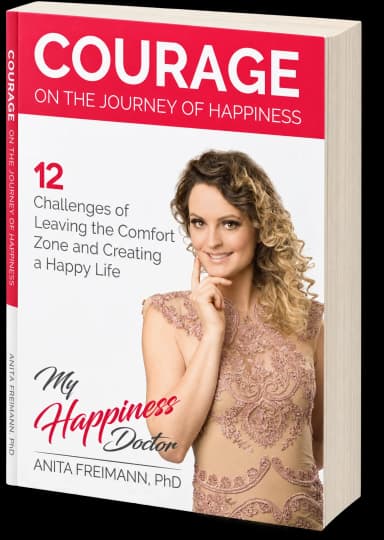
Free preview of my book
Courage on the Journey of Happiness
Get the whole introduction free: how to use the book, who it is for, and my own story of why I wrote it, plus the full table of contents with all twelve challenges. This article grows out of one of them, True Partnership.
Sources
- 1.Gable, S. L., Gonzaga, G. C., & Strachman, A. (2006). Will you be there for me when things go right? Supportive responses to positive event disclosures. Journal of Personality and Social Psychology, 91(5), 904–917. doi.org/10.1037/0022-3514.91.5.904
- 2.Diener, E., & Seligman, M. E. P. (2002). Very happy people. Psychological Science, 13(1), 81–84. doi.org/10.1111/1467-9280.00415
- 3.Waldinger, R. J., & Schulz, M. S. (2010). What's love got to do with it? Social functioning, perceived health, and daily happiness in married octogenarians. Psychology and Aging, 25(2), 422–431. pmc.ncbi.nlm.nih.gov/articles/PMC2896234/
- 4.Gottman, J. M., & Levenson, R. W. (1992). Marital processes predictive of later dissolution: Behavior, physiology, and health. Journal of Personality and Social Psychology, 63(2), 221–233. doi.org/10.1037/0022-3514.63.2.221
- 5.Benson, K. The Magic Relationship Ratio, According to Science. The Gottman Institute (2017, updated 2026). www.gottman.com/blog/the-magic-relationship-ratio-according-science/
- 6.Gable, S. L., Reis, H. T., Impett, E. A., & Asher, E. R. (2004). What do you do when things go right? The intrapersonal and interpersonal benefits of sharing positive events. Journal of Personality and Social Psychology, 87(2), 228–245. doi.org/10.1037/0022-3514.87.2.228
- 7.Chopik, W. J. (2017). Associations among relational values, support, health, and well-being across the adult lifespan. Personal Relationships, 24(2), 408–422. doi.org/10.1111/pere.12187
- 8.Holt-Lunstad, J., Smith, T. B., & Layton, J. B. (2010). Social relationships and mortality risk: A meta-analytic review. PLoS Medicine, 7(7), e1000316. doi.org/10.1371/journal.pmed.1000316
- 9.Robles, T. F., Slatcher, R. B., Trombello, J. M., & McGinn, M. M. (2014). Marital quality and health: A meta-analytic review. Psychological Bulletin, 140(1), 140–187. pmc.ncbi.nlm.nih.gov/articles/PMC3872512/
This article is for education and reflection and is not a substitute for professional help.

About Anita
Anita Freimann, PhD, the Happiness Doctor, holds a doctorate in the economics of happiness and spent more than 16 years at the Faculty of Economics in Osijek. She is the author of Courage on the Journey of Happiness and the creator of Permission for Life.
More about Anita