Relationships
Energy Vampires: How to Protect Your Energy Without Guilt
Some people leave you lighter, others leave you empty. Here's how to recognise the people who drain you, what to do when the energy vampire is you, and seven gentle steps to protect your energy without guilt.

Anita Freimann, PhD · The Happiness Doctor
7 min read

In this article
- What is an energy vampire?
- Signs of an energy vampire
- Why do some people drain our energy?
- Am I the energy vampire?
- You don't owe anyone your energy out of duty
- What happiness research says about energy vampires
- How to protect your energy from energy vampires: seven gentle steps
- How to protect your energy without guilt
- Questions readers ask
A friend of mine was getting married, and her maid of honour arrived at the very last moment, late as always. She is so disorganised that my friend had chosen a quiet “reserve” from the start and done all the wedding preparations with her. Surprised, I asked why she had chosen this maid of honour at all. She was returning the favour, she said. They had agreed on it back in primary school.
To whom are we adapting? Where is it written that you have to return the honour to someone who doesn't respect your time? Most of us keep at least one relationship like that, out of habit, history or duty, and leave every meeting a little more tired.
In my book Courage on the Journey of Happiness, this belongs to the challenge about friendships, because the people around us shape our energy more than we admit. Here is how to recognise who drains you, and how to protect your energy without guilt.
What is an energy vampire?
“Energy vampire” is not a psychological or medical term. It is an everyday expression, like “emotional vampire”, for someone whose behaviour regularly leaves you drained. The key word is regularly. Everyone has hard weeks and needs a friend to lean on. With an energy vampire, exhaustion is the rule, not the exception.
Calling someone a narcissist won't protect your energy, and only a qualified professional can make a diagnosis anyway. What helps is noticing the pattern and what it does to you.
Signs of an energy vampire
You might recognise someone, or a whole relationship, in a few of these:
- you feel tired or heavy after time with them, even when nothing bad happened
- you hesitate when their name lights up your phone
- every conversation returns to their problems, and every solution you offer is ignored
- there is always a new drama, and you are expected to take a side
- they need you often, but disappear when you need them
- you leave feeling smaller, guiltier or more anxious than when you arrived
Why do some people drain our energy?
Most energy vampires are not villains. In my book I put it this way: people who drain others are very often drained themselves. With no energy of their own, they look for it in others, usually without realising it. These patterns are common between parents and children too: the closer the bond, the easier it is to lean on it too heavily. And moods are catching. If the people you see most keep complaining, it takes real effort not to join in.
Am I the energy vampire?
This is the question almost nobody asks, and maybe the most useful one. In my book I wrote that even if you are the victim in one relationship, you can be the vampire in another, because once you are drained, you start drawing energy from others. Friends are also our mirrors: if something in a friend bothers you, take a quiet look at yourself.
Ask yourself gently: Do I mostly call when I need something? Do I tell the same painful story again and again without wanting to change anything? Do I really listen? If you recognise yourself, you are not a bad person. You are probably running on empty, and the answer is not shame, but refilling your own energy instead of borrowing it.
You don't owe anyone your energy out of duty
Friendships have their comfort zone too. Some people stay in our lives only because we lack the courage to let them go. We go to the coffee we didn't want and the party we dreaded, because we promised or feel obliged. In my book I call it lying to ourselves. When you put yourself first, you stop going anywhere out of duty when you truly don't want to go.
That is not coldness. It is honesty, and my test for a real friendship is simple:
Friendship should be based on reciprocity, that is, both parties should be equally willing to receive and give.
Not equal every week; life brings seasons when one friend carries more. But a friendship in which only one person ever gives is not a friendship. It is a service.
What happiness research says about energy vampires
As an economist who has spent many years studying happiness, I was glad to find that the energy we feel around people is more than a feeling. Researchers Rob Cross, Wayne Baker and Andrew Parker mapped energy in workplace networks and described de-energizers, people who drain those they meet1. Later, Bradley Owens, Wayne Baker and colleagues measured this relational energy: the energy employees felt with their leaders predicted how engaged they were a month later2.
Why does one draining person weigh so much? In a study of 120 widowed women aged 60 to 89, psychologist Karen Rook found that negative social interactions were more consistently and more strongly linked to well-being than positive ones3. Reviewing a large body of research, Roy Baumeister and colleagues concluded that bad is stronger than good, close relationships included4. And the most mixed feelings are kept for those closest to us: in Karen Fingerman's research, people felt more ambivalent towards a spouse, child, parent or sibling than towards friends5.
Moods travel, too. Following 4,739 people over twenty years, James Fowler and Nicholas Christakis found clusters of happy and unhappy people, linked as far as the friends of one's friends' friends6. Others caution that part of this similarity comes from a shared environment rather than contagion7. Even closeness can drain when it becomes endless complaining. Psychologist Amanda Rose called it co-rumination: revisiting problems over and over. In her study of 608 children and teenagers, it went with close friendships, but also with more signs of anxiety and low mood8.
How to protect your energy from energy vampires: seven gentle steps
Protecting your energy doesn't mean building walls. It means choosing, consciously, where your time and attention go.
- Notice how you feel after, not during. For one week, after every meeting or call that matters, ask: do I feel lighter or heavier? Your body often knows before your mind admits it.
- Stop going anywhere out of duty. Before the next coffee, party or long call, ask whether you want to go or only feel you should. A kind “not this time” beats a resentful yes.
- Name the behaviour, not the person. “She complains for an hour and doesn't want solutions” is something you can respond to. “She's toxic” is a label that keeps you stuck in judgement.
- Limit the complaints, not the care. As I wrote in my book, once or twice is fine; the third time, I draw the line. Ask: “Do you want me to listen, or shall we look for a solution together?”
- Shorten and shape your time together. Choose a walk or a coffee with a natural end instead of a whole evening. You don't have to answer every message straight away.
- Say it once, honestly. When a relationship has changed, put your cards on the table, calmly and without blame. An honest person will understand. If someone answers with anger or plays the victim, that tells you something too.
- Give your best energy to those who give it back. Oxford psychologist Robin Dunbar notes that friendships cost a great deal of time and mental effort, which is why our circles have natural limits9. Every hour given to a draining relationship is an hour taken from one that nourishes you.
How to protect your energy without guilt
Guilt is the price many of us pay for every boundary. I was an only child with a house full of friends; I helped them with maths, did their nails and drove them wherever they needed to go. Giving was never hard for me, and it took me time to accept that people come and go, and that this is perfectly normal. Realising it was liberating.
Guilt means you are breaking an old rule, not that the new one is wrong. Protecting your energy is responsibility for what you bring to your children, your work and the people who need the best of you. If guilt follows every no, read how to stop people pleasing; if the person draining you is family, see how to set boundaries with toxic family members.
If someone threatens, controls or hurts you, it is no longer about energy. Please talk to a professional or contact local support services.
When you start taking yourself seriously, your circle changes, sometimes on its own. It happened to me: some people stepped away, others stayed and we grew closer, and new people came who share my path. Putting yourself first, gently, is what the Selfish part of my programme Permission for Life is about. But it begins with one honest question: who gives me energy, and who takes it?
Questions readers ask
Is “energy vampire” a real psychological term?
No. It is an everyday expression, not a diagnosis or a scientific category. Researchers speak of negative social interactions, ambivalent relationships or de-energizing relationships. The word helps if it shows you a pattern, as long as you don't use it to label people.
How do I shut down an energy vampire?
Shut down the pattern, not the person. Keep conversations shorter, don't take the bait of every drama, ask whether they want listening or solutions, and end calmly: “I need to go now, let's talk another time.” If someone threatens or harasses you, please seek professional or local support.
What are the types of energy vampires?
Popular lists name the eternal victim, the drama lover, the critic, the controller and the one who only talks about themselves. These are not scientific categories, and people behave differently in different relationships. It is more useful to notice which behaviours drain you.
Can a family member or partner be an energy vampire?
Yes, and that is often where it hurts most, because we can't simply walk away. As I wrote in my book, between not talking at all and energy vampirism there is a wide range of possibilities. You can love someone and still decide how much energy you give.
Do energy vampires know what they are doing?
Usually not. Many are tired, lonely or overwhelmed and lean on others without noticing how heavily. That explains the behaviour, but you are not responsible for fixing it. You can be kind and still protect your energy.
Your turn
Take five quiet minutes with a notebook and answer honestly:
- Who do I feel most like myself with, and when did I last make time for them?
- Which relationship am I keeping out of habit, duty or an old promise?
- When did I last take more than I gave, and what did I really need in that moment?
Did this article speak to you? I’d love to hear what you noticed, what you tried, or what you’re still struggling with. Write to me at anita [at] anitafreimann [.] com. I read every message.
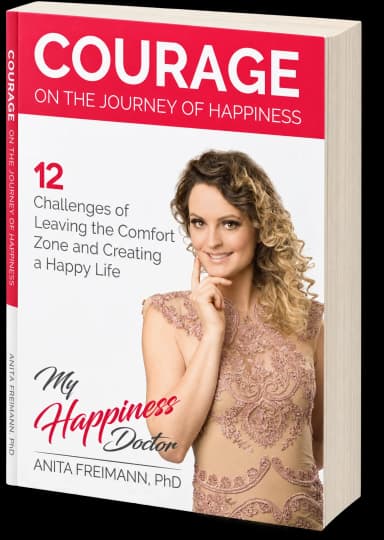
Free preview of my book
Courage on the Journey of Happiness
Get the whole introduction free: how to use the book, who it is for, and my own story of why I wrote it, plus the full table of contents with all twelve challenges. This article grows out of one of them, Stimulating Friendships and Acquaintances.
Sources
- 1.Cross, R., Baker, W., & Parker, A. (2003). What creates energy in organizations? MIT Sloan Management Review, 44(4), 51–56. sloanreview.mit.edu/article/what-creates-energy-in-organizations/
- 2.Owens, B. P., Baker, W. E., Sumpter, D. M., & Cameron, K. S. (2016). Relational energy at work: Implications for job engagement and job performance. Journal of Applied Psychology, 101(1), 35–49. doi.org/10.1037/apl0000032
- 3.Rook, K. S. (1984). The negative side of social interaction: Impact on psychological well-being. Journal of Personality and Social Psychology, 46(5), 1097–1108. doi.org/10.1037/0022-3514.46.5.1097
- 4.Baumeister, R. F., Bratslavsky, E., Finkenauer, C., & Vohs, K. D. (2001). Bad is stronger than good. Review of General Psychology, 5(4), 323–370. doi.org/10.1037/1089-2680.5.4.323
- 5.Fingerman, K. L., Hay, E. L., & Birditt, K. S. (2004). The best of ties, the worst of ties: Close, problematic, and ambivalent social relationships. Journal of Marriage and Family, 66(3), 792–808. doi.org/10.1111/j.0022-2445.2004.00053.x
- 6.Fowler, J. H., & Christakis, N. A. (2008). Dynamic spread of happiness in a large social network: Longitudinal analysis over 20 years in the Framingham Heart Study. BMJ, 337, a2338. doi.org/10.1136/bmj.a2338
- 7.Cohen-Cole, E., & Fletcher, J. M. (2008). Detecting implausible social network effects in acne, height, and headaches: Longitudinal analysis. BMJ, 337, a2533. doi.org/10.1136/bmj.a2533
- 8.Rose, A. J. (2002). Co-rumination in the friendships of girls and boys. Child Development, 73(6), 1830–1843. doi.org/10.1111/1467-8624.00509
- 9.Dunbar, R. I. M. (2018). The anatomy of friendship. Trends in Cognitive Sciences, 22(1), 32–51. doi.org/10.1016/j.tics.2017.10.004
This article is for education and reflection and is not a substitute for professional help.

About Anita
Anita Freimann, PhD, the Happiness Doctor, holds a doctorate in the economics of happiness and spent more than 16 years at the Faculty of Economics in Osijek. She is the author of Courage on the Journey of Happiness and the creator of Permission for Life.
More about Anita