Courage
Comfort Zone: What It Really Is and How to Step Out of It Gently
Your comfort zone isn't a cage, and you don't need to leap out of it. Here's what it really is, why leaving it feels so hard, and seven gentle steps to stretch it, one small challenge at a time.

Anita Freimann, PhD · The Happiness Doctor
7 min read

In this article
- What does comfort zone mean?
- Signs you're stuck in your comfort zone
- Why is it so hard to leave your comfort zone?
- Magic happens outside your comfort zone: the four zones of change
- What happiness research says about the comfort zone
- How to step out of your comfort zone: seven gentle steps
- Stepping out of your comfort zone gently: stretch, don't panic
- Questions readers ask
Whenever I talk with friends, acquaintances or the people I work with, I notice the same small moment. When the conversation turns to marriage, people hesitate. I got divorced and stepped out of what is considered normal, and they know how I think. In that pause many of them realise something they would rather not say out loud: in this part of their life, they are living in a comfort zone.
Intimate relationships are among the most common comfort zones, but so are work, friendships and the way we treat our bodies. I am not telling anyone to leave a marriage or a job. I am asking the question I once asked myself: am I truly happy here, and am I living the life I want?
In my book Courage on the Journey of Happiness, the comfort zone is where the whole journey begins; its subtitle is “12 Challenges of Leaving the Comfort Zone and Creating a Happy Life”.
What does comfort zone mean?
Your comfort zone is the set of situations, habits and roles in which you feel safe and in control, because nothing in them tests your abilities or your determination. It can be your whole life or just one area of it, even the way you spend your evenings.
In the book I wrote that the name is misleading. It suggests you are doing well, when often it is simply a zone of inertia, even boredom. I picture it as sitting in your favourite armchair, watching the film of your own life as a passive observer, as if you weren't its lead and its writer.
Signs you're stuck in your comfort zone
Comfort itself is not the problem. Being stuck is. You might recognise a few of these:
- you can't remember what you were doing this time last year
- you say “it's fine” about a part of life that hasn't felt fine for years
- you keep postponing a wish until the children are older or work calms down
- you blame circumstances or other people for things you know you could change
- new things make you tired before you have even tried them
That first sign comes from a question I ask in my book. Most of us remember only the big events and the days that broke the routine. A life lived entirely in the comfort zone quietly becomes hard to remember.
Why is it so hard to leave your comfort zone?
Because your comfort zone is doing its job. Fear of the unknown has always protected us. As I wrote in the book, it would not be wise to stand bare-handed in front of a bear; that fear saves your life. But most fears that keep us in the comfort zone today are different. There is no bear, only the chance of looking foolish, failing or disappointing someone, and the mind reacts as if there were one.
And many of us want change and safety at the same time. In the book I compare it to pressing the accelerator with one foot and the brake with the other: lots of energy, no movement. That is not weakness. Fear of failure, fear of change and “what will people say?” are the comfort zone's strongest anchors, and knowing that the pull back is normal already makes it weaker.
Magic happens outside your comfort zone: the four zones of change
In my book I describe change as a journey through four zones. I draw the comfort zone as a drop that is open at the top, because at the top there are questions. The moment you ask them honestly, is this what I want, could it be different, you step into the fear zone. You see what isn't right, but you postpone. I also call it the procrastination phase.
When you act despite the fear, you enter the action zone, which you could also call the learning zone. You try, you stumble, you learn, and what once frightened you becomes normal. Keep going in one area of life and you reach the magic zone, where most challenges in that area are behind you and life simply flows. Every brave step brings a little more happiness, and every bit of happiness brings courage for the next step.
That is what “magic happens outside your comfort zone” means to me: the days you will remember, and the woman you are becoming, are waiting there. If you feel you have lost yourself along the way, read how to find yourself again.
True happiness isn’t in the comfort zone; the bursts of true happiness start in the procrastination phase, and the happiness grows with the progress.
What happiness research says about the comfort zone
As an economist who has spent many years studying happiness, I'll start with my own field. In experiments and in real decisions, such as university staff choosing health and retirement plans, William Samuelson and Richard Zeckhauser found that people stick with the existing option disproportionately often: status quo bias1.
Honesty matters too: the comfort zone is a useful picture, not a proven law. Reviewing the research behind the model in outdoor education, Mike Brown summed up its contribution as “very little”, suggested treating it as a metaphor, and pointed to researchers who argue that people change most when they feel safe and accepted2.
What research does support is the right challenge. Mihaly Csikszentmihalyi and Judith LeFevre followed 78 working adults for a week. Most aspects of how they felt depended more on flow, high challenge matched by high skill, than on whether they were working or at leisure. Most flow happened at work, yet people felt more motivated in their free time3. We long for the armchair, but we often feel better when stretched.
In five experiments with over 2,000 adults, including improvisation classes and expressive writing, Kaitlin Woolley and Ayelet Fishbach found that people encouraged to seek discomfort as a sign of growth engaged more and felt they achieved more4. And tracking 122 people for three to four months, Aaron Heller and colleagues found that days with more variety in where people went tended to come with more positive feelings5. A link, not proof, but it suggests that variety in everyday life matters.
How to step out of your comfort zone: seven gentle steps
You don't leave the comfort zone with one heroic leap. You stretch it, a little at a time, until its edge moves.
- Find your edge. Where in your life do you feel quietly bored or dissatisfied, and which one thing there makes you a little nervous, not terrified? That feeling marks the edge.
- Start with mini challenges. Say yes to an invitation you would normally decline, call a friend you have lost touch with, order something you have never tried. Each one shows you that the unknown is survivable.
- Read discomfort as a signal, not a stop sign. When you feel awkward, tell yourself: this is what growing feels like.
- Make the step smaller, not the dream. If a challenge leaves you frozen, courage isn't missing; the step is too big. Cut it in half rather than giving up.
- Remember yesterday's worries. A sentence from my book helps me before every new step: today is the tomorrow I was worried about yesterday.
- Find one person who believes in your next step. In the book I suggest having at least one person who constantly encourages you to act. Tell her what you are trying.
- Protect your energy first. You can't stretch from an empty cup, which is why my book begins with healthy selfishness. If saying yes to everyone is part of your story, start with how to stop people pleasing.
Stepping out of your comfort zone gently: stretch, don't panic
You may have heard that a little stress helps us perform and too much makes us fall apart. The idea is traced to Robert Yerkes and John Dodson, but their 1908 experiment was with mice learning to choose between a white and a black box, with electric shocks of different strength; for the hardest task, a medium stimulus worked best6.
Later authors turned it into a law about anxiety and performance that Yerkes and Dodson never wrote7, and one management researcher argues it has no solid empirical basis for stress at work8. So don't use it to pile pressure on yourself.
In the book I wrote that when new challenges are too big, we become even more frightened and return to the comfort zone. Children show the gentle way: a child who refuses to go down the slide, once she dares, can't be taken off it. Small challenges, repeated, move the edge.
Leaving the comfort zone is not a one-off event but a way of living, ideally with people who walk the same road. That is the idea behind my programme Permission for Life. Start small, and start this week.
Questions readers ask
What is it called when you go out of your comfort zone?
Many models call it the stretch, learning or growth zone, with a panic zone beyond. In my book the journey goes through the fear zone, where you postpone, the action zone, where you learn by doing, and the magic zone, where life starts to flow.
Is it bad to stay in your comfort zone?
Not as a place to rest; everyone needs familiar ground. It becomes a problem when you stay out of fear in an area of life that no longer makes you happy, and stop asking whether it could be different.
Is it normal to feel anxious when stepping out of your comfort zone?
Some nervousness is normal when you try something new. If anxiety is intense, lasts a long time or stops you from living your daily life, please talk to your doctor or a mental health professional.
What are examples of stepping out of your comfort zone?
Small ones: speaking first in a meeting, eating alone in a café, taking a class. Bigger ones: changing career, ending a relationship that no longer fits. The small ones build courage for the big ones.
What are the best books about leaving your comfort zone?
Look for one that gives you practice, not only motivation. I wrote Courage on the Journey of Happiness as twelve challenges of leaving the comfort zone. You can read the introduction free, the story of why I wrote it and who it is for.
Your turn
Take five quiet minutes with a notebook and answer honestly:
- In which area of my life am I most comfortable, and is it real comfort or just habit?
- What would I try if I knew nobody would laugh at me?
- When did I last do something for the first time, and how did I feel afterwards?
Did this article speak to you? I’d love to hear what you noticed, what you tried, or what you’re still struggling with. Write to me at anita [at] anitafreimann [.] com. I read every message.
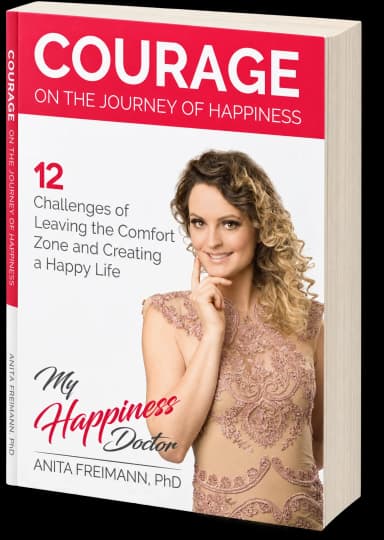
Free preview of my book
Courage on the Journey of Happiness
Get the whole introduction free: how to use the book, who it is for, and my own story of why I wrote it, plus the full table of contents with all twelve challenges. This article grows out of one of them, Healthy Selfishness and the Present Moment.
Sources
- 1.Samuelson, W., & Zeckhauser, R. (1988). Status quo bias in decision making. Journal of Risk and Uncertainty, 1(1), 7–59. doi.org/10.1007/BF00055564
- 2.Brown, M. (2008). Comfort zone: Model or metaphor? Australian Journal of Outdoor Education, 12(1), 3–12. doi.org/10.1007/BF03401019
- 3.Csikszentmihalyi, M., & LeFevre, J. (1989). Optimal experience in work and leisure. Journal of Personality and Social Psychology, 56(5), 815–822. doi.org/10.1037/0022-3514.56.5.815
- 4.Woolley, K., & Fishbach, A. (2022). Motivating personal growth by seeking discomfort. Psychological Science, 33(4), 510–523. doi.org/10.1177/09567976211044685
- 5.Heller, A. S., Shi, T. C., Ezie, C. E. C., Reneau, T. R., Baez, L. M., Gibbons, C. J., & Hartley, C. A. (2020). Association between real-world experiential diversity and positive affect relates to hippocampal–striatal functional connectivity. Nature Neuroscience, 23(7), 800–804. doi.org/10.1038/s41593-020-0636-4
- 6.Yerkes, R. M., & Dodson, J. D. (1908). The relation of strength of stimulus to rapidity of habit-formation. Journal of Comparative Neurology and Psychology, 18(5), 459–482. doi.org/10.1002/cne.920180503
- 7.Teigen, K. H. (1994). Yerkes-Dodson: A law for all seasons. Theory & Psychology, 4(4), 525–547. doi.org/10.1177/0959354394044004
- 8.Corbett, M. (2015). From law to folklore: Work stress and the Yerkes-Dodson Law. Journal of Managerial Psychology, 30(6), 741–752. doi.org/10.1108/JMP-03-2013-0085
This article is for education and reflection and is not a substitute for professional help.

About Anita
Anita Freimann, PhD, the Happiness Doctor, holds a doctorate in the economics of happiness and spent more than 16 years at the Faculty of Economics in Osijek. She is the author of Courage on the Journey of Happiness and the creator of Permission for Life.
More about Anita