Relationships
Conscious Parenting: How to Be Present, Warm and Firm Without Trying to Be Perfect
You don't have to be a perfect mother to be a conscious one. You need to notice what your child sees in you, and to come back after the hard moments. Here's what conscious parenting really means, what research says, and seven gentle steps for ordinary, tired days.

Anita Freimann, PhD · The Happiness Doctor
7 min read

In this article
- What is conscious parenting?
- Conscious parenting vs gentle parenting vs permissive parenting
- Your children are your mirror
- What happiness research says about conscious parenting
- How to practise conscious parenting on tired days: seven gentle steps
- Conscious parenting and discipline: kind, but firm
- Questions readers ask
When my son was about two, I had just taken responsibility for my own life and moved with him into another apartment, and the first truly challenging phase of parenting arrived. I went looking for help, found “1-2-3 Magic” by the clinical psychologist Thomas Phelan, and read it with a pen in my hand.
What stayed with me most was a truth I later wrote into my own book: for little children we are like gods they imitate. They watch us; they don't listen to us. On a tired evening that can sound like one more reason to feel guilty. To me it is hopeful: change can start with you, at any age of your child.
In my book Courage on the Journey of Happiness, I call this inspirational parenting: parents as inspiration and mentors, not flawless role models. Today most people would call it conscious parenting.
What is conscious parenting?
Conscious parenting means paying as much attention to yourself as to your child's behaviour: your reactions, moods and the habits you carry from childhood. Instead of reacting on autopilot, you pause and choose how to respond. The term was made popular by clinical psychologist Shefali Tsabary, who describes herself as the founder of the conscious parenting movement1.
Plainly put, conscious parenting is a popular term, not a scientific one. But almost everything it asks of you (awareness, warmth, listening and clear limits) has been studied for decades under other names. And it doesn't ask you to have been ready. As I admit in my book, we are hardly ever fully ready for a child.
Conscious parenting vs gentle parenting vs permissive parenting
Gentle parenting is another popular label, usually used for respectful, empathic parenting without shouting or harsh punishment. The two overlap a lot; conscious parenting simply starts with your own reactions.
The line that really matters runs elsewhere. In the 1960s psychologist Diana Baumrind described three models of parental control: authoritarian, built on obedience; permissive, with few demands and little control; and authoritative, which keeps firm control but explains its reasons and affirms the child's qualities. She argued that authoritative control can raise children who are well socialised yet independent and strong-willed2.
Conscious parenting, done well, belongs in that third group. Done badly, it slides into permissiveness: endless explaining, no limits, a child running the house. Being kind to your child's feelings doesn't mean saying yes to every behaviour.
Your children are your mirror
The parenting chapter of my book opens with one short sentence: your children are your mirror. I don't mean it as blame, but as an invitation. We all show our children how to live, whether we intend to or not. The question I keep asking myself is whether I want my son to live the life I am living right now.
I don't lie to my son, and I show him my feelings openly. We hug a lot and say “I love you” often. Children also watch how the adults around them treat each other, which is one more reason a healthy relationship matters for the whole family.
To be completely present, to raise children by examples you give and out of love (not fear), to be life coach and available when they need your support – those are the main tasks of parenting.
The mirror works backwards too: many of us parent the way we were parented, without deciding to. If something from your childhood still hurts, don't nurture the anger; ask how you want to do it differently. Making peace with your own parents is a journey I wrote about in how to let go of the past; breaking generational patterns will get its own article.
What happiness research says about conscious parenting
As an economist who has spent many years studying happiness, I look for data. In a meta-analysis of 1,435 studies, Martin Pinquart found that warmth, clear rules and supervision, granting autonomy and an authoritative style were linked to fewer behaviour problems in children, while harsh or psychologically controlling, authoritarian, permissive or neglectful parenting was linked to more3. The links were very small to small, and several ran both ways: children shape their parents too. You matter, but you are not the only force in your child's life.
Following families from when the children were five until they were eight, John Gottman, Lynn Katz and Carole Hooven studied meta-emotion: how parents feel and think about emotions, their own and their children's4. From that work came emotion coaching: noticing your child's emotion, listening with empathy, helping them name it, and setting limits while you solve the problem together5. It can be learned: in a trial with 216 parents of preschoolers, a short programme increased emotion coaching and reduced reported behaviour problems6.
Researchers Larissa Duncan, Douglas Coatsworth and Mark Greenberg described mindful parenting in five dimensions, from listening with full attention to compassion for yourself and your child7. A meta-analysis of 25 studies found that mindfulness programmes for parents brought small to moderate reductions in parenting stress and small benefits for children, but the authors rated the risk of bias as serious and drew no firm conclusions8. Promising, not proven.
Paediatrician and psychoanalyst Donald Winnicott wrote about the good-enough mother, who at first adapts almost completely to her baby's needs and then, gradually, less and less, as the child grows able to cope9. Infant researcher Edward Tronick later observed that mothers and babies are in sync for only a small part of their time together10, and linked healthy development to the frequent repair of everyday mismatches11. Perfection was never the point. Repair is.
How to practise conscious parenting on tired days: seven gentle steps
You don't need a free afternoon or a calm temperament, only a few small habits you can keep when you have almost nothing left.
- Pause before you react. When you feel the heat rising, take one breath and ask: is this about my child, or about my day? That breath is conscious parenting in miniature.
- Give ten minutes of full attention. Small children live in the present moment; to be close to them, we have to meet them there. Ten phone-free minutes on the floor beat an afternoon of half-presence. If that is hard, start with how to live in the present moment.
- Name the feeling, hold the limit. “You're angry because we have to leave the park. You're allowed to be angry. We are still going home.” Every feeling is welcome; not every behaviour is.
- Live what you want them to learn. If you want a child who apologises, reads, rests and puts the phone down, let them see you do it.
- Praise more than you correct. Since those early notes I have kept a simple rule: for every correction, at least five moments of praise, warmth or real listening. It isn't a scientific formula, just a reminder of where most of our time should go.
- Watch your sentences. Don't belittle what worries your child because it looks small to you, and catch careless labels. A throwaway “You, a ballerina? Don't make me laugh” can quietly close a door for years.
- Repair, and forgive yourself. You will shout sometimes. Come back: “I shouted, and I'm sorry. It wasn't your fault.” Then give yourself the kindness you are learning to give your child; learning to love yourself is part of this work.
Conscious parenting and discipline: kind, but firm
Many mothers come to conscious parenting tired of shouting, then feel lost at the first tested limit. Does conscious mean no discipline? No. The book that helped me most is about consistency: children need clear guidance and parental authority, given gently, but firmly. Discipline is not revenge for making you angry; it is a calm, predictable answer that helps a child feel safe.
Consistency is the hard part. I often hear parents say “this is the last time” and repeat it fifteen times in two minutes. Choose fewer rules and keep them, even if it means leaving the shop halfway through. Once your child sees you mean it, the battles become fewer.
If parenting stress or your child's difficulties ever feel overwhelming, a paediatrician, family therapist or other qualified professional can help. Asking for help is part of conscious parenting, not a failure of it.
I know parents have a hundred questions every day. Being an inspiring parent isn't always easy, but it is far from impossible. Your children aren't waiting for a perfect mother; they are watching how you live, fall and get back up. If you would like company on the way to a life that is truly yours, my programme Permission for Life was made for exactly that.
Questions readers ask
Is conscious parenting the same as mindful parenting?
They are close cousins. Mindful parenting is the term researchers use, with five described dimensions, from full attention to compassion. Conscious parenting is a popular term that puts more weight on your own childhood and reactions. Both ask you to respond rather than react.
What is a good enough parent?
The idea comes from paediatrician Donald Winnicott: a parent who meets a baby's needs closely at first and then, gradually, less perfectly, so the child learns to cope with small frustrations. It is a concept, not a measurement: your child needs a loving parent who repairs, not a flawless one.
Is it too late for conscious parenting if my children are older?
No. You can still grow together. With older children, choose support and praise over pressure or emotional blackmail. Encourage them to live authentically, tell them you love them, and let them know they always have a refuge in you.
How can I be a calmer mum when I'm exhausted?
Choose one or two limits that really matter and let small things go. Breathe once before you answer, and ask for practical help. Calm is rarely a personality trait; it grows from rest, support and fewer battles.
What are the best books on conscious parenting?
The book that helped me most in the early years was “1-2-3 Magic” by Thomas Phelan, for its gentle firmness and consistency. For the inner side, I wrote Courage on the Journey of Happiness; one of its twelve challenges is about parenting. You can read the introduction free.
Your turn
Take five quiet minutes with a notebook and answer honestly:
- What do I want my child to learn from the way I live, not from what I say?
- Which sentence from my own childhood still echoes in me, and which sentence would I like my child to remember from me?
- In which moments do I most often react on autopilot, and what do I need in those moments?
Did this article speak to you? I’d love to hear what you noticed, what you tried, or what you’re still struggling with. Write to me at anita [at] anitafreimann [.] com. I read every message.
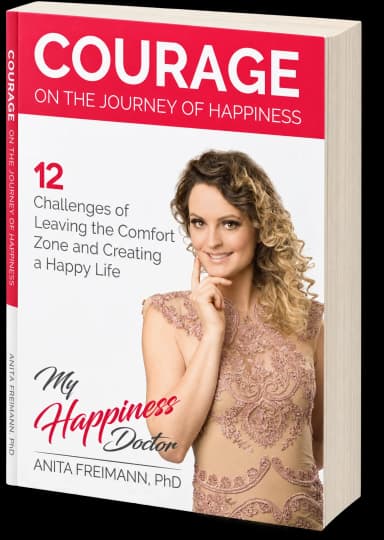
Free preview of my book
Courage on the Journey of Happiness
Get the whole introduction free: how to use the book, who it is for, and my own story of why I wrote it, plus the full table of contents with all twelve challenges. This article grows out of one of them, Inspirational Parenting.
Sources
- 1.Tsabary, S. About Dr. Shefali. drshefali.com. drshefali.com/about/
- 2.Baumrind, D. (1966). Effects of authoritative parental control on child behavior. Child Development, 37(4), 887–907. doi.org/10.2307/1126611
- 3.Pinquart, M. (2017). Associations of parenting dimensions and styles with externalizing problems of children and adolescents: An updated meta-analysis. Developmental Psychology, 53(5), 873–932. doi.org/10.1037/dev0000295
- 4.Gottman, J. M., Katz, L. F., & Hooven, C. (1996). Parental meta-emotion philosophy and the emotional life of families: Theoretical models and preliminary data. Journal of Family Psychology, 10(3), 243–268. doi.org/10.1037/0893-3200.10.3.243
- 5.Wilde, E. An Introduction to Emotion Coaching. The Gottman Institute (2012, updated 2026). www.gottman.com/blog/an-introduction-to-emotion-coaching/
- 6.Havighurst, S. S., Wilson, K. R., Harley, A. E., Prior, M. R., & Kehoe, C. (2010). Tuning in to Kids: Improving emotion socialization practices in parents of preschool children – findings from a community trial. Journal of Child Psychology and Psychiatry, 51(12), 1342–1350. doi.org/10.1111/j.1469-7610.2010.02303.x
- 7.Duncan, L. G., Coatsworth, J. D., & Greenberg, M. T. (2009). A model of mindful parenting: Implications for parent–child relationships and prevention research. Clinical Child and Family Psychology Review, 12(3), 255–270. doi.org/10.1007/s10567-009-0046-3
- 8.Burgdorf, V., Szabó, M., & Abbott, M. J. (2019). The effect of mindfulness interventions for parents on parenting stress and youth psychological outcomes: A systematic review and meta-analysis. Frontiers in Psychology, 10, 1336. doi.org/10.3389/fpsyg.2019.01336
- 9.Winnicott, D. W. (1953). Transitional objects and transitional phenomena: A study of the first not-me possession. International Journal of Psycho-Analysis, 34, 89–97. pep-web.org/browse/document/IJP.034.0089A
- 10.Tronick, E. Z., & Cohn, J. F. (1989). Infant-mother face-to-face interaction: Age and gender differences in coordination and the occurrence of miscoordination. Child Development, 60(1), 85–92. doi.org/10.2307/1131074
- 11.Tronick, E. Z. (1989). Emotions and emotional communication in infants. American Psychologist, 44(2), 112–119. doi.org/10.1037/0003-066X.44.2.112
This article is for education and reflection and is not a substitute for professional help.

About Anita
Anita Freimann, PhD, the Happiness Doctor, holds a doctorate in the economics of happiness and spent more than 16 years at the Faculty of Economics in Osijek. She is the author of Courage on the Journey of Happiness and the creator of Permission for Life.
More about Anita