Inner freedom
How to Let Go of the Past Without Forgetting or Excusing It
Letting go doesn't mean forgetting what happened or pretending it was fine. It means the past stops making your decisions. Here's why it's so hard, and seven gentle steps to begin.

Anita Freimann, PhD · The Happiness Doctor
7 min read

My past was not a painful one. I had a happy childhood and parents who supported almost everything I did. And yet I carried something from it well into adult life: a deep belief that I needed their approval for every decision, big or small. I told my mother everything and asked for her approval all the time. Whenever I chose differently from what she expected, it took enormous effort and a lot of doubt. One day my father told me he couldn't believe how much I worried. I was constantly in some kind of fear, he said, and I had to live my life.
That was a small turning point. I began to see that I was living in a golden cage, a sweet, comfortable one I had built myself, in my own head. It is good to know there is a way out, but you start to panic when you discover the keys are in your hands. I don't blame my parents; they did their best. Letting go of that past didn't mean rejecting them. It meant noticing that an old pattern was still making my choices, and taking the keys.
In my book Courage on the Journey of Happiness, this belongs to the challenge of healthy relationships with your family of origin, where so much of what we carry begins. But the same works for any past: an old hurt, a relationship that ended badly, a mistake you still replay.
What does it mean to let go of the past?
Letting go of the past means changing your relationship with what happened, so that it no longer decides how you feel and what you choose today. It is not forgetting: your memories are part of you. It is not excusing: what was wrong can stay wrong. And it doesn't require you to reconcile with anyone. Forgiveness researchers draw the same line between forgiving and excusing, forgetting or reconciling1.
Signs you're still carrying the past into the present
You might recognise yourself in a few of these:
- you replay the same conversation or mistake years later, as if it could still end differently
- a small remark today sets off a reaction much bigger than the moment deserves
- you still make decisions by asking what someone from your past would think
- you avoid people, places or dreams because of something that happened long ago
- you tell the same story about what was done to you, and it still feels like yesterday
Why can't I let go of the past?
Partly because your mind is trying to protect you. Replaying a painful memory feels like working something out, as if one more replay might finally make sense of it. Most of the time it only makes you live it once more.
And partly because much of what we carry was learned when we were small. A belief like “I must be good to be loved” once helped us stay close to the people we depended on, and as adults we keep using it without noticing. So there is nothing wrong with you. And if what you carry comes from experiences that still overwhelm you, please don't walk that road alone: a qualified therapist can help in ways no article can.
Putting down the burden of the past
In my book I call it the burden of the past, and I like the image because a burden is something you carry, not something you are. You can put it down without throwing away the memories inside it. The way I suggest putting it down is forgiveness: not as proof that it didn't matter, but as a decision to stop paying, again and again, for something that is already over. As I wrote about forgiving our parents, you do it for yourself, not for them.
You have to free yourselves from the burdens of your past.
Today I can honestly say I wouldn't change a single thing in my past, because it made me who I am. I am grateful to my parents for everything they have done for me, and letting go didn't mean losing them. It meant that our relationship could finally rest on love rather than on fear.
What happiness research says about letting go of the past
As an economist who has spent many years studying happiness, I find it reassuring that research points the same way. Psychologists Susan Nolen-Hoeksema, Blair Wisco and Sonja Lyubomirsky reviewed years of studies on rumination, going over and over what went wrong. It feeds negative thinking, makes problem solving harder and can wear down the support of people around us2. The same review separates rumination from healthier self-reflection. Looking back is not the problem. How you look back is.
Ethan Kross, Ozlem Ayduk and Walter Mischel asked people to recall a conflict that had made them angry. Those who looked at it from a distance, as an observer, and asked why they felt as they did, could think it through with less of the old anger flaring up, even when the conflict still felt unresolved3. Writing helps a little too. James Pennebaker spent years studying what happens when people write about emotional experiences4, and when Joanne Frattaroli combined 146 randomised studies of this kind of disclosure, she found a real but small benefit5.
And forgiveness? In the Global Flourishing Study, with more than 200,000 people in 23 countries, Richard Cowden, Everett Worthington, Tyler VanderWeele and colleagues found some evidence that people who often forgive those who hurt them report higher well-being about a year later, although the links were mostly very small6. Forgiveness can also be learned. Combining 54 studies, Nathaniel Wade and colleagues found that forgiveness programmes led by professionals helped people forgive more and feel more hopeful7. In a trial with 4,598 adults on four continents, even a free self-guided workbook of two to three hours lowered unforgiveness within two weeks, compared with people still waiting for it1.
How to let go of the past: seven gentle steps
You don't let go once. You let go the way you learned to hold on: in small moments, again and again. These are the steps I use myself.
- Name what you are still carrying. One sentence is enough: “I still need my mother's approval.” “I can't forgive myself for that year.” What has a name is easier to put down.
- Find where it still decides for you. In my book I ask: what do you still do the way you learned it at home, even though you have long wanted to do it your own way?
- Feel it, then write it out. Give the anger or sadness a few minutes of honest attention. Then write about what happened and how it felt, and close the notebook.
- Look at it from a distance. Watch the scene as an observer, or ask what you would say to a friend who had lived through it. Ask why it hurt, not only what happened.
- Decide to forgive, for your own sake. Forgiving means letting go of the wish for revenge or for a different past. It doesn't mean the other person was right or that you must let them back into your life. If you aren't ready, be willing to become ready.
- Forgive yourself too. Many of us carry our own mistakes the longest. Blaming yourself is just another way of going back to the past. Ask instead what you can do differently from today.
- Come back to the present, many times a day. In my book I ask how many of your thoughts are about the past, how many about the future, and how much of your day you actually spend in the present. Notice it for one day, and each time you find yourself back in the past, look around at where you really are.
How to let go of resentment
Resentment is often the hardest part to put down, because it feels like justice. If I let go, it seems, I'm saying it was fine. But resentment rarely reaches the person who hurt you. It stays with you, and you keep paying.
Two things help me. The first is to separate the person from the pattern: very often the people who hurt us were doing the best they could with what they had been taught. That explains what happened; it doesn't excuse it. The second is boundaries. You can forgive someone and still decide how close they get. Forgiveness researchers agree: it can happen while you still seek a just outcome, and without necessarily restoring the relationship1.
Letting go is something you can learn, but rarely in one evening and rarely alone. It is no accident that one of the three parts of my programme Permission for Life is called Free. And if much of what you carry is about keeping others happy, read how to stop people pleasing. The keys were in my hands all along. Yours are in yours.
Questions readers ask
How do I let go of the past and move forward?
Start with one thing, not your whole history. Name it, notice where it still decides for you, then take one small step today. Moving forward comes from new experiences, not only from thinking about old ones.
Do I have to forgive to let go of the past?
Not in the sense of excusing anyone or reconciling. Forgiveness means putting down the wish for revenge or for a different past. You also set the pace. Forgiveness can't be rushed.
How do I let go of past trauma?
Trauma is different from ordinary painful memories, and no article can replace proper support. If memories overwhelm you, return uninvited or stop you from living your life, please talk to your doctor or a qualified therapist who works with trauma.
How long does it take to let go of the past?
There is no fixed timeline. Some things soften in weeks, others take years, and some return at a new stage of life. What matters is the direction: whether the past takes up a little less space this month than last.
Can a book help me let go of the past?
A book can't do the work for you, but it can give you structure. I wrote Courage on the Journey of Happiness as twelve challenges, and one of them is about healthy relationships with your family of origin. You can read the introduction free.
Your turn
Take five quiet minutes with a notebook and answer honestly:
- What from my past still makes decisions for me today?
- Whose approval am I still waiting for, and what would I choose if I no longer needed it?
- What would I gain if I put this burden down, and what am I afraid I would lose?
Did this article speak to you? I’d love to hear what you noticed, what you tried, or what you’re still struggling with. Write to me at anita [at] anitafreimann [.] com. I read every message.
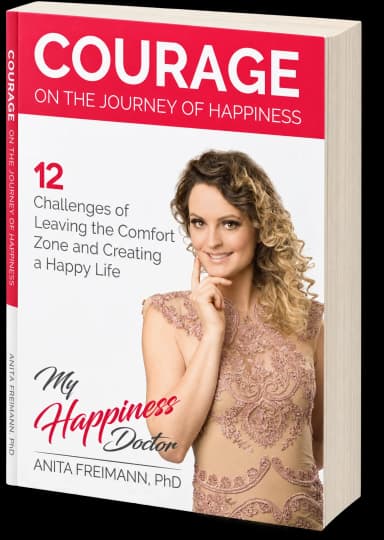
Free preview of my book
Courage on the Journey of Happiness
Get the whole introduction free: how to use the book, who it is for, and my own story of why I wrote it, plus the full table of contents with all twelve challenges. This article grows out of one of them, Healthy Relationships with Your Family of Origin.
Sources
- 1.Ho, M. Y., Worthington, E. L., Jr., Cowden, R. G., et al. (2024). International REACH forgiveness intervention: A multisite randomised controlled trial. BMJ Public Health, 2(1), e000072. doi.org/10.1136/bmjph-2023-000072
- 2.Nolen-Hoeksema, S., Wisco, B. E., & Lyubomirsky, S. (2008). Rethinking rumination. Perspectives on Psychological Science, 3(5), 400–424. doi.org/10.1111/j.1745-6924.2008.00088.x
- 3.Kross, E., Ayduk, O., & Mischel, W. (2005). When asking “why” does not hurt: Distinguishing rumination from reflective processing of negative emotions. Psychological Science, 16(9), 709–715. doi.org/10.1111/j.1467-9280.2005.01600.x
- 4.Pennebaker, J. W. (1997). Writing about emotional experiences as a therapeutic process. Psychological Science, 8(3), 162–166. doi.org/10.1111/j.1467-9280.1997.tb00403.x
- 5.Frattaroli, J. (2006). Experimental disclosure and its moderators: A meta-analysis. Psychological Bulletin, 132(6), 823–865. doi.org/10.1037/0033-2909.132.6.823
- 6.Cowden, R. G., Worthington, E. L., Jr., Padgett, R. N., et al., & VanderWeele, T. J. (2026). Longitudinal associations of dispositional forgivingness with multidimensional well-being: A two-wave outcome-wide analysis in the Global Flourishing Study. npj Mental Health Research, 5, 3. doi.org/10.1038/s44184-026-00187-5
- 7.Wade, N. G., Hoyt, W. T., Kidwell, J. E. M., & Worthington, E. L., Jr. (2014). Efficacy of psychotherapeutic interventions to promote forgiveness: A meta-analysis. Journal of Consulting and Clinical Psychology, 82(1), 154–170. doi.org/10.1037/a0035268
This article is for education and reflection and is not a substitute for professional help.

About Anita
Anita Freimann, PhD, the Happiness Doctor, holds a doctorate in the economics of happiness and spent more than 16 years at the Faculty of Economics in Osijek. She is the author of Courage on the Journey of Happiness and the creator of Permission for Life.
More about Anita