Healthy selfishness
Healthy Selfishness: What It Is and How to Practise It Without Guilt
Taking care of yourself isn't the opposite of loving others. It's what keeps your love from running dry. Here's the difference, what research says, and seven gentle steps to practise it without guilt.

Anita Freimann, PhD · The Happiness Doctor
7 min read

In this article
- What is healthy selfishness?
- Healthy selfishness vs selfishness: what's the difference?
- Signs you need more healthy selfishness
- Why does putting yourself first feel so selfish?
- Nobody else can live your life for you
- What happiness research says about healthy selfishness
- How to practise healthy selfishness without guilt: seven gentle steps
- Is putting yourself first selfish? Self-care vs selfishness
- Questions readers ask
When my son was small, I wrote him a letter of gratitude. It is a long list of thank-yous: for dancing and singing with me, for teaching me how to play. In the middle is this line: thank you for teaching me to fight for myself. Near the end, thanking him for being stubborn sometimes, I wrote that I am proud to know he has himself.
That is exactly what we want for our children: to know what they need, to say no, not to live by what other people say. Then we grow up and call the same thing selfish when we do it ourselves. It took me a long time to realise what I later wrote in the book: taking care of yourself and not letting anybody use you is not a flaw. It's a virtue.
In my book Courage on the Journey of Happiness, this is the very first of twelve challenges, the step every other change stands on. Here is what it is, how it differs from selfishness, and how to practise it without guilt.
What is healthy selfishness?
Healthy selfishness is taking your own needs, time and wishes as seriously as you take other people's, and acting on them without harming anyone. The psychologist Abraham Maslow described it as a healthy respect for your own health, growth, happiness, joy and freedom1.
In my own words: you are responsible to yourself and to others, and you can't truly care for others when nothing of you is left. It is the practical side of loving yourself: not only believing that you matter, but living as if you do.
Healthy selfishness vs selfishness: what's the difference?
From the outside they look alike: you say no, take time for yourself, choose what you want. The difference is what happens to other people:
- Selfishness takes; healthy selfishness keeps. One takes what belongs to others; the other keeps what you need to stay well.
- Selfishness makes others responsible for your happiness; healthy selfishness takes responsibility for your own.
- Selfishness doesn't care how others feel; healthy selfishness cares, and still doesn't abandon you.
- Selfishness says “me instead of you”; healthy selfishness says “me as well as you”.
When guilt is loud, one simple question helps: has anyone lost something they had a right to? If someone is only disappointed that you are no longer available for everything, that isn't harm. It's change.
Signs you need more healthy selfishness
You might recognise yourself in a few of these:
- you feel guilty resting while anyone around you still needs something
- you say “I have to” far more often than “I want to”
- you keep helping when you are running on empty, and then quietly resent it
- you wait for someone's approval before doing something just for yourself
- you know everyone's plans for the week, but not one thing you are looking forward to
Why does putting yourself first feel so selfish?
Because most of us were taught that it is. Back in 1939 the psychoanalyst Erich Fromm opened an essay with the words “Modern culture is pervaded by a taboo on selfishness”2. We learn that loving others is a virtue and loving ourselves a sin, he argued, while the greedy selfishness we rightly dislike is in fact the opposite of self-love.
The taboo is still alive. In the book I noticed how often younger people who care more about their own happiness, and value their career more than money, are called selfish for it. So if putting yourself first feels wrong, nothing is wrong with you; you are breaking an old rule. If the guilt or fear overwhelms you, or someone punishes you for your choices, please talk to a qualified therapist.
Nobody else can live your life for you
In my book I wrote that only you know what suits you: what you will do, how and when. Nobody else can take responsibility for your life, even if they want to. While we are young, we need limits; later, we live our own life. You are not obliged to do something just because it is expected, especially on other people's terms, and you don't need their approval for your values.
Trying to please everyone doesn't even work: you give yourself up, and others are often still not satisfied with the result. Freeing yourself from the things that supposedly must be done against your wishes is a real relief. But where exactly the line lies, nobody can draw for you.
It’s a thin line between healthy and unhealthy selfishness, but I believe you will eventually find it, each of you in your own time.
What happiness research says about healthy selfishness
As an economist who has spent many years studying happiness, I was glad to see it finally measured. Scott Barry Kaufman and Emanuel Jauk built a short questionnaire with statements like “I have healthy boundaries” and “Even though I give a lot to others, I know when to recharge”, and tested it with more than 1,200 adults1. People who scored higher reported more well-being and life satisfaction, better relationships and higher self-esteem, and they more often helped others for genuine reasons. Its opposite, which the authors call pathological altruism, sacrificing your own needs to the point of harm, went with poorer well-being and with helping to win approval or avoid rejection. These are self-reports, so they show links, not causes.
Two decades earlier, Heidi Fritz and Vicki Helgeson described a similar trap, unmitigated communion: focusing on others to the exclusion of yourself. In four studies, caring itself wasn't the problem. Depending on others for your sense of worth was: it led to over-involvement in their problems and neglect of yourself, which explained the higher distress3.
Why you give matters too. In a two-week diary study of 138 students, Netta Weinstein and Richard Ryan found that people felt best on days they helped because they wanted to, and worst on days they helped because they felt they had to, worse even than on days without helping. The differences were modest, but in a later experiment even the people receiving help felt better when it was freely given4.
And kindness to yourself doesn't make you care less about others. In a study of nearly 1,000 students, community adults and meditators, Kristin Neff and Elizabeth Pommier found that more self-compassionate people were better at seeing others' point of view and more forgiving, and among the adults outside university, also more empathic and altruistic5.
How to practise healthy selfishness without guilt: seven gentle steps
Don't wait until the guilt disappears. Practising without guilt means treating yourself kindly while it is still there, until it grows quieter. These are the steps I return to myself.
- Ask yourself first. Before the day pulls you in, ask: what do I need today? You can't take care of a need you never name.
- Check your why before you help. Am I doing this because I want to, or because I'm afraid of what they'll think? Help given out of fear quietly empties you.
- Say one honest no. If no is the hardest word you know, start with how to stop people pleasing.
- Keep a little time that is only yours. Even twenty minutes a day that you don't have to earn or explain.
- Stop waiting for permission. Do one small thing your way this week without asking anyone first.
- Let their reaction be theirs. You can be kind about someone's disappointment without changing your choice. Their feelings are real, but they are not instructions.
- Aim for balance, not perfection. At the end of the week, ask: did I give, and did I also receive?
Is putting yourself first selfish? Self-care vs selfishness
Putting yourself first is selfish only if it means putting others last, for good. Most of the time it simply means you count too. Self-care is the everyday face of healthy selfishness: sleep, rest, movement, a quiet hour. It turns into selfishness only when your comfort is paid for by someone else's harm.
Leaving work on time so you can rest is self-care; leaving your share of the work to a colleague, again and again, is not. When relatives make you pay for every choice of your own, read how to set boundaries with toxic family members.
Healthy selfishness is the first step, not the whole path. Once you take your needs seriously, the next question comes naturally: which old beliefs taught you to put yourself last? That is where how to change your mindset begins. And if you'd like company on the way, one of the three parts of my programme Permission for Life is called Selfish, with the motto “I choose myself without guilt”. Be selfish in a healthy way, then share what fills you with the people you love.
Questions readers ask
What is an example of healthy selfishness?
Saying “I can't take that on this month” at work. Spending a Saturday morning on something you love while the household manages without you. In each case you meet a real need, and nobody loses anything they had a right to.
What is the difference between selfish and self-centred?
Self-centred describes attention: everything revolves around you, your feelings and your story. Selfish describes action: taking what you want even when it costs others. Healthy selfishness is neither. It means taking your own needs seriously while still seeing and respecting other people's.
What is pathological altruism?
Helping that ends up doing harm. Researcher Barbara Oakley uses the term for altruism where trying to help others ends up causing harm nobody intended6. Kaufman and Jauk's questionnaire includes statements like “I need to be needed” and “I have little time to myself because I am too busy helping everyone”. It is a description of a pattern, not a diagnosis.
How do I stop feeling guilty for putting myself first?
Ask what the guilt is about. If you have harmed someone, make it right. If you have only disappointed someone's expectations, it is an old rule speaking, and it tends to grow quieter each time you choose yourself anyway. Start with small choices, not with your hardest relationship.
What are the best books about healthy selfishness?
Erich Fromm's essay on selfishness and self-love, later part of his book Man for Himself, is still worth reading. I wrote Courage on the Journey of Happiness as twelve challenges that begin with healthy selfishness, with small exercises for every step. You can read the introduction free.
Your turn
Take five quiet minutes with a notebook and answer honestly:
- Where in my life am I still waiting for someone's permission to choose what I want?
- If I truly had myself, the way I wish the people I love would have themselves, what would I do differently this month?
- Whose disappointment am I most afraid of, and what would happen if I let it be theirs?
Did this article speak to you? I’d love to hear what you noticed, what you tried, or what you’re still struggling with. Write to me at anita [at] anitafreimann [.] com. I read every message.
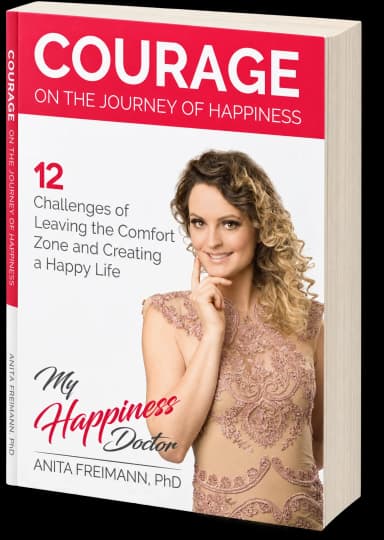
Free preview of my book
Courage on the Journey of Happiness
Get the whole introduction free: how to use the book, who it is for, and my own story of why I wrote it, plus the full table of contents with all twelve challenges. This article grows out of one of them, Healthy Selfishness and the Present Moment.
Sources
- 1.Kaufman, S. B., & Jauk, E. (2020). Healthy selfishness and pathological altruism: Measuring two paradoxical forms of selfishness. Frontiers in Psychology, 11, 1006. doi.org/10.3389/fpsyg.2020.01006
- 2.Fromm, E. (1939). Selfishness and self-love. Psychiatry, 2(4), 507–523. doi.org/10.1080/00332747.1939.11022262
- 3.Fritz, H. L., & Helgeson, V. S. (1998). Distinctions of unmitigated communion from communion: Self-neglect and overinvolvement with others. Journal of Personality and Social Psychology, 75(1), 121–140. doi.org/10.1037/0022-3514.75.1.121
- 4.Weinstein, N., & Ryan, R. M. (2010). When helping helps: Autonomous motivation for prosocial behavior and its influence on well-being for the helper and recipient. Journal of Personality and Social Psychology, 98(2), 222–244. doi.org/10.1037/a0016984
- 5.Neff, K. D., & Pommier, E. (2013). The relationship between self-compassion and other-focused concern among college undergraduates, community adults, and practicing meditators. Self and Identity, 12(2), 160–176. doi.org/10.1080/15298868.2011.649546
- 6.Oakley, B. A. (2013). Concepts and implications of altruism bias and pathological altruism. Proceedings of the National Academy of Sciences, 110(Suppl. 2), 10408–10415. doi.org/10.1073/pnas.1302547110
This article is for education and reflection and is not a substitute for professional help.

About Anita
Anita Freimann, PhD, the Happiness Doctor, holds a doctorate in the economics of happiness and spent more than 16 years at the Faculty of Economics in Osijek. She is the author of Courage on the Journey of Happiness and the creator of Permission for Life.
More about Anita