Inner freedom
Limiting Beliefs: Where They Come From and How to Loosen Their Grip
The sentences that hold you back were rarely chosen by you. Most were handed to you long before you could question them. Here's how to recognise them, where they come from, and seven gentle steps to loosen one.

Anita Freimann, PhD · The Happiness Doctor
7 min read

In this article
- What are limiting beliefs?
- What are core beliefs?
- Limiting beliefs and core beliefs: examples
- Where do limiting beliefs come from?
- Most limiting beliefs come wrapped in good intentions
- What happiness research says about limiting beliefs
- How to overcome limiting beliefs: seven gentle steps
- Can you change negative core beliefs?
- Questions readers ask
I was brought up a Christian and sang in a church choir for more than twenty years. In 2011 I travelled to Thailand, and in every temple I felt how deeply people lived their faith. I kept asking a friend born in Bangkok how she knew what to do, when to pray and for how long. Her answer was always the same: “It's complicated, but in short, everything is up to you.” Back home, a colleague from the choir told me this was all fine, but ours was the only true God. One thought stayed with me: if I had been born in Bangkok, I would most probably have been Buddhist or Hindu.
This is not a story about which faith is right. It is about how much of what we call truth was decided before we could choose. Within the first five minutes of life we are given a name, a nationality and a religion, and nobody asks us about any of it. Many beliefs about who we are arrive the same way.
In my book Courage on the Journey of Happiness, this sits at the heart of the challenge about our family of origin. And if you have read how to change your mindset, this is the layer underneath: the beliefs a mindset is made of.
What are limiting beliefs?
A limiting belief is a conclusion you once drew, or someone drew for you, that you now treat as a fact: “I'm not creative”, “I'm too old to start again”, “women like me don't earn that much”. They are also called self-limiting beliefs, because they stop you before anyone else has to. You don't apply, don't speak up, don't begin, and because you never try, the belief is never tested. In my book I wrote about people who count their years instead of filling them with life, held back by the belief that change is not possible.
What are core beliefs?
If limiting beliefs are the branches you can see, core beliefs are the roots. Psychiatrist Aaron Beck, whose cognitive model has shaped psychology for more than fifty years, placed beliefs at its centre: what we expect, how we judge ourselves and which rules we live by1. Judith Beck of the Beck Institute describes core beliefs as the fundamental ways we see ourselves, other people and the world2. A core belief rarely sounds dramatic. It sounds like the weather, so you don't question it; you organise your life around it.
Limiting beliefs and core beliefs: examples
Here are some of the most common. You might recognise a few:
- “I'm not good enough, clever enough or talented enough.”
- “It's too late for me.”
- “Other people's needs come first.”
- “If I rest, I'm lazy.”
- “I have to be perfect, or I'll be rejected.”
- “Wanting more money is greedy.”
- “People like me don't do things like that.”
- “This is just who I am. I can't change.”
Beneath them usually sits a negative core belief about the self, such as “I'm not enough”, “I'm unlovable as I am” or “I'm on my own with everything”. Core beliefs can be positive too, and those are worth growing: I am worthy, I can learn, most people mean well, there is enough for me.
Where do limiting beliefs come from?
Mostly from the people who loved us and the culture we grew up in. Our parents shape the course of our lives more than anyone else, and they are often the source of our biggest life lessons. Many sentences we now call “just who I am” were first said at the kitchen table.
Some came as warnings. In the book I listed phrases many of us grew up with: you are still green, you don't know anything about life, you can't change anything, we told you so. Others came from the culture: what a good woman or a serious professional should be. Hear them often enough and they stop sounding like opinions. They start sounding like you.
If a belief about yourself feels deeply painful, or keeps you stuck despite your efforts, a qualified therapist can help in ways no article can.
Most limiting beliefs come wrapped in good intentions
This is what makes them so hard to see: most were given with love. “Don't get your hopes up” was meant to spare you disappointment. “Get a secure job” was meant to keep you safe. In the chapter on our family of origin I wrote:
Numerous things between parent and child are wrapped up in a wrapping paper called good intentions.
You don't have to prove anyone wrong to put down a belief that no longer fits. As I wrote in the book, we are constantly served all sorts of bait, and we choose whether to take it. As a child you rarely knew you were choosing. Now you do. If some of what you were handed still hurts, read how to let go of the past.
What happiness research says about limiting beliefs
As an economist who has spent many years studying happiness, I find this research both hopeful and patient. Beliefs are learned early, through ordinary words. Elizabeth Gunderson, Carol Dweck and colleagues videotaped 53 families at home when the children were one to three years old. Children whose parents more often praised what they did (“good throw”) rather than who they were (“good girl”) were more likely, at seven or eight, to believe that abilities can grow3. It was a small, correlational study: a link, not proof.
Beliefs also follow experience. Albert Bandura called the belief in our ability to do something self-efficacy and proposed that it shapes whether we start, how hard we try and how long we persist. It grows from four sources: our own successes, seeing others succeed, encouragement, and the signals of our own body4. When Traci Sitzmann and Gillian Yeo pooled studies that measured the same people across repeated tasks, self-efficacy turned out to be mainly a product of past performance rather than the driving force of future performance5. You don't need to believe first. Believing follows doing.
There is also a kinder way to meet a threatening belief. Geoffrey Cohen and David Sherman reviewed research on self-affirmation, in which people typically write about the values that matter most to them. A wider view of who you are makes one threat feel less total, and well-timed exercises like this have been linked to better outcomes at school and in relationships, sometimes lasting months or years6. You are bigger than any one sentence about you.
How to overcome limiting beliefs: seven gentle steps
You don't overcome a limiting belief by shouting a nicer sentence over it. You loosen it, one small experience at a time.
- Listen for the absolutes. Limiting beliefs hide in words like always, never, can't and too. For one week, note every such sentence you catch yourself thinking.
- Ask whose voice it is. Your mother's, a teacher's, a former partner's, your culture's? Naming the speaker turns a fact back into an opinion.
- Follow it to the root. Ask: if this were true, what would it say about me? “I can't ask for a raise” may lead to “I'm not worth more”. That is the core belief at work.
- Collect counter-evidence. Each evening, write down one small fact that doesn't fit the belief. Beliefs survive by ignoring exceptions; your notebook won't.
- Borrow someone else's proof. Find one person like you who has done what you think you can't. As I wrote in the book, if one person managed it, you can too.
- Give yourself a mini challenge. Do one small, safe thing the belief says you can't. Once you take the first step, it is rarely as hard or frightening as you thought, and you realise you can.
- Write a new sentence you can believe. Not “I'm brilliant at everything”, but “I'm learning” or “I've done hard things before”. Affirmations deserve an article of their own; for now, choose words that feel true enough to say aloud.
Can you change negative core beliefs?
Yes, but more slowly, and that is not failure. In the book I wrote that nobody changes their beliefs every few days, and that one book can't make a revolution in your life unless you are ready for it. Core beliefs formed over years, so they usually soften over months, not days. You notice it in small ways: the old sentence sounds less true, you hesitate less, and one day you do what you thought you couldn't. Be gentle with beliefs about your worth. They may once have protected you; you can thank them and still choose again.
Old beliefs loosen more easily with structure and good company. That is why my programme Permission for Life moves step by step, and one of its three parts is called Free. Once a few old sentences lose their grip, a new question appears: who are you without them? That is where finding yourself again begins. You couldn't choose where you were born. You can choose what you keep believing.
Questions readers ask
What is the difference between limiting beliefs and core beliefs?
Core beliefs are your deepest beliefs about yourself, other people and the world, such as “I'm not enough”. Limiting beliefs are often the more specific sentences that grow from them, such as “I shouldn't apply for that job”. Working on the specific ones is usually the most practical way in.
What are the most common limiting beliefs?
“I'm not good enough”, “it's too late for me” and “I have to be perfect” are among the most common, and most were learned early, at home, at school or from the culture around you.
How do I identify my limiting beliefs?
Notice where you stop yourself before you even try, and ask what you would do if you knew you couldn't fail. The answer usually points to the belief in the way.
How do limiting beliefs affect your career?
They shape what you apply for, ask for and attempt. Albert Bandura proposed that belief in your own ability influences whether you start and how long you persist4, so one untested sentence can quietly cost years.
What is the best book about limiting beliefs?
Look for one that gives you practice, not only insight. I wrote Courage on the Journey of Happiness as twelve challenges with small exercises, because beliefs change through experience. You can read the introduction free.
Your turn
Take five quiet minutes with a notebook and answer honestly:
- If I had been born somewhere else, to other parents, which of my “truths” would probably be different?
- What am I not trying because I decided long ago that it isn't for people like me?
- Who in my life is living proof that my limiting belief doesn't have to be true?
Did this article speak to you? I’d love to hear what you noticed, what you tried, or what you’re still struggling with. Write to me at anita [at] anitafreimann [.] com. I read every message.
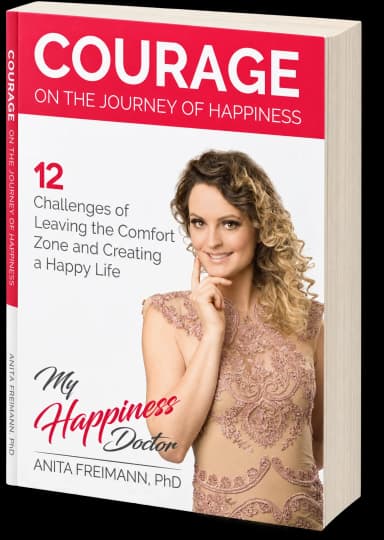
Free preview of my book
Courage on the Journey of Happiness
Get the whole introduction free: how to use the book, who it is for, and my own story of why I wrote it, plus the full table of contents with all twelve challenges. This article grows out of one of them, Healthy Relationships with Your Family of Origin.
Sources
- 1.Beck, A. T., & Haigh, E. A. P. (2014). Advances in cognitive theory and therapy: The generic cognitive model. Annual Review of Clinical Psychology, 10, 1–24. doi.org/10.1146/annurev-clinpsy-032813-153734
- 2.Beck, J. S. (2021, June 8). Guest blogger Dr. Judith Beck: Helplessness. Beck Institute for Cognitive Behavior Therapy. beckinstitute.org/blog/guest-blogger-dr-judith-beck-helplessness/
- 3.Gunderson, E. A., Gripshover, S. J., Romero, C., Dweck, C. S., Goldin-Meadow, S., & Levine, S. C. (2013). Parent praise to 1- to 3-year-olds predicts children's motivational frameworks 5 years later. Child Development, 84(5), 1526–1541. doi.org/10.1111/cdev.12064
- 4.Bandura, A. (1977). Self-efficacy: Toward a unifying theory of behavioral change. Psychological Review, 84(2), 191–215. doi.org/10.1037/0033-295X.84.2.191
- 5.Sitzmann, T., & Yeo, G. (2013). A meta-analytic investigation of the within-person self-efficacy domain: Is self-efficacy a product of past performance or a driver of future performance? Personnel Psychology, 66(3), 531–568. doi.org/10.1111/peps.12035
- 6.Cohen, G. L., & Sherman, D. K. (2014). The psychology of change: Self-affirmation and social psychological intervention. Annual Review of Psychology, 65, 333–371. doi.org/10.1146/annurev-psych-010213-115137
This article is for education and reflection and is not a substitute for professional help.

About Anita
Anita Freimann, PhD, the Happiness Doctor, holds a doctorate in the economics of happiness and spent more than 16 years at the Faculty of Economics in Osijek. She is the author of Courage on the Journey of Happiness and the creator of Permission for Life.
More about Anita