Inner freedom
How to Break Bad Habits Without Relying on Willpower
A bad habit isn't a flaw in your character. It's a path your days have worn so deep that your feet find it on their own. Here's why habits stick, how long change really takes, and seven gentle steps to break one.

Anita Freimann, PhD · The Happiness Doctor
7 min read

In this article
- What is a habit loop?
- Why are bad habits so hard to break?
- Expect resistance: it means you are changing
- What happiness research says about breaking bad habits
- How long does it take to break a habit?
- How to break bad habits: seven gentle steps
- How to stop a bad habit you've already tried to quit
- Questions readers ask
I had one of my aha-moments during a lecture on habits by John Assaraf. He pointed out that today almost every “how” has already been answered. How to increase sales, how to record a video, how to give a lecture, how to fish: someone has done it before us, and a few minutes online will tell us how. So if we know how, why don't we do it? Knowing is rarely the problem. The real question is whether we are truly determined to act, and persistent enough to keep going once the first enthusiasm fades.
Changing a habit means starting something new, and that wakes up resistance in all of us, especially at the beginning. It is said that only a wet baby loves change. Once you see how normal that resistance is, you can relax: you are not the only person who finds change hard.
In my book Courage on the Journey of Happiness, this insight opens the challenge about caring for our physical body, because almost every change we want to make in daily life begins with a habit. If you want to work on the thoughts behind your habits, start with how to change your mindset.
What is a habit loop?
A habit is something you do almost automatically, in the same situation, without really deciding to. Psychologists Wendy Wood and Dennis Rünger describe habits as responses we repeat in recurring contexts until the context itself is enough to set them off1. Many people know this as the habit loop: a cue (a time, a place, a person or a feeling), a routine (what you do) and a reward (what you get, even if it's only a moment of relief). A bad habit is simply a loop whose reward is small and quick, while its price comes later.
Why are bad habits so hard to break?
Because they no longer pass through the part of you that decides. Wood and Rünger put it plainly: the difficulty of changing an established pattern is not a failure of willpower, and not a sign that you secretly still want the old behaviour. Old habits keep being triggered automatically by familiar cues, and even after you learn a new habit, the old memory trace isn't necessarily replaced. That is why a familiar room, a certain hour or a certain person can switch the old pattern back on after weeks of doing well.
So if you have tried and slipped, there is nothing wrong with you. And if you notice that you stop yourself just before something new can begin, that is a related pattern I wrote about in self-sabotage.
Expect resistance: it means you are changing
The inner voice that says “start on Monday” or “just this once” doesn't prove you are weak. It shows up precisely because you are leaving the familiar. In the book I wrote that the clearer your vision is, and the less you confuse yourself with doubts, the better, and that the resistance shouldn't take you by surprise:
Keep in mind that your brain will discourage you, embrace that fact from the beginning.
What carries you through is persistence, not perfection. In the book's image of the action zone, persistence sits at the very top, at the opening into what I call the magic zone, and not by accident. Commit to the new behaviour for a set number of days and keep going. At some point the voice that talks you out of it grows quieter.
What happiness research says about breaking bad habits
As an economist who has spent many years studying happiness, I find it a relief that habit researchers don't treat bad habits as moral failings. In two diary studies by Wendy Wood, Jeffrey Quinn and Deborah Kashy, students noted what they were doing, thinking and feeling each time an hourly watch alarm went off. Between a third and a half of the behaviours they recorded were habits, done almost daily and usually in the same place, and while doing them, people were often thinking about something else entirely2.
Context matters more than we think. When Wood, Leona Tam and Melissa Guerrero Witt followed students who moved to a new university, habits such as watching TV and reading the newspaper survived the move only when the setting stayed similar, for example reading the paper with others. When the cues changed, the old habits lost their grip and some students acted on their current intentions instead3. Wood and Rünger see life transitions like a new job or a new home as a window of opportunity.
Two tools have particularly good support. In everyday diary studies by Jeffrey Quinn, Anthony Pascoe, Wendy Wood and David Neal, the strategy that worked best against strong bad habits was vigilant monitoring: thinking “don't do it” and watching carefully for slip-ups4. And across 94 tests, Peter Gollwitzer and Paschal Sheeran found that if-then plans had a medium-to-large effect on reaching goals, including protecting them from unwanted influences5.
How long does it take to break a habit?
Probably longer than you were promised, which is good news: it means you aren't failing. In the best-known study, Phillippa Lally and her colleagues at University College London asked 96 volunteers to choose one daily behaviour in a fixed situation, such as after breakfast, and keep it up for 12 weeks. The time it took for the behaviour to become about as automatic as it would get ranged from 18 to 254 days, the longest being estimates beyond the twelve weeks, and missing one opportunity didn't materially affect the process6. In a later summary, Lally and colleagues put the average at around 66 days7.
Strictly speaking, this measured how a new habit forms, not how an old one fades. But breaking a bad habit almost always means building a new response to the same cue, so it is the best guide we have. Think in months, not days, and let the 21-day promise go.
How to break bad habits: seven gentle steps
You don't break a habit in one heroic moment. You redirect it, the same way it was formed: in small situations, repeated until the new way feels like yours.
- Choose one habit, and name it precisely. Not “I'm always on my phone”, but “I check my email in bed before I've even got up”. A precise habit has a precise cue.
- Find the cue. For a few days, notice where you are, what time it is, who is with you and what you feel just before. Tiredness, boredom or the end of a hard conversation can all be cues.
- Ask what it gives you. Relief, a break, comfort, a feeling of control? Don't judge the answer. The reward is real, so the new routine has to give you something too.
- Make the old way harder and the new way easier. Put the remote in a drawer and the book on your pillow. If your habit lives on your phone, my guide to a social media detox goes further. If your life is changing anyway, a new job, a new home, a holiday, use that window.
- Write one if-then sentence. “If I reach for my phone the moment I wake up, then I'll open the window and look outside first.” Decide in advance, so you don't have to decide in the moment.
- Watch for the moment, and say “not now”. When you feel the pull, name it silently: there it is. This is the vigilance that helped most in the research above.
- After a slip, begin again the same day. A slip is not a verdict. Old patterns are not erased, so they will sometimes win. Ask what triggered it, adjust your plan and carry on. Persistence counts; perfection doesn't.
How to stop a bad habit you've already tried to quit
If you have tried many times, the problem is probably not your character but your strategy. Most of us fight a habit head-on, with guilt as our only tool, and guilt rarely changes the cue. Instead, change one thing in the situation, prepare a replacement that gives you a similar reward, and treat every slip as information about where the loop is strongest.
If a habit has become an addiction, or it harms you or the people around you, please don't carry it alone: a doctor or a qualified professional can help in ways no article can.
Remember the diary studies: while we perform our habits, our minds are often elsewhere. That is why the most useful habit of all may be presence, which I explore in how to live in the present moment. And if you want structure and company while you change the habits of a lifetime, that is what my programme Permission for Life is for. Begin with one loop. You don't need more willpower, only a clearer path and the patience to walk it again tomorrow.
Questions readers ask
Does it take 21 days to break a habit?
Not reliably. In the best-known study, building a new daily habit took anywhere from 18 to 254 days6. Expect weeks to months, and don't count a slow start as failure.
How do you break a habit loop?
Work with the cue, not only the behaviour. Where you can, change what sets the habit off; plan a new routine for the same cue that gives a similar reward, and repeat it until it becomes the easier path.
Can you replace bad habits with good ones?
Yes, and it is gentler than simply stopping. Because the old habit isn't erased, a new routine attached to the same cue gives you somewhere to go when the urge arrives. An if-then plan written in advance helps you choose it in the moment.
What should I do if I slip back into an old habit?
Begin again as soon as you can, without punishing yourself. In Lally's study, missing one opportunity didn't materially affect the process. Look at what triggered the slip, adjust the plan for that situation and carry on.
What is the best book to help me break bad habits?
Look for a book that gives you practice, not only insight. I wrote Courage on the Journey of Happiness as twelve challenges for changing how you live, one small step at a time. You can read the introduction free.
Your turn
Take five quiet minutes with a notebook and answer honestly:
- Which habit would I most like to leave behind, and what has it quietly been giving me all these years?
- When did I last change a habit successfully, and what helped me then?
- Who would I be a year from now if I kept going on the days I didn't feel like it?
Did this article speak to you? I’d love to hear what you noticed, what you tried, or what you’re still struggling with. Write to me at anita [at] anitafreimann [.] com. I read every message.
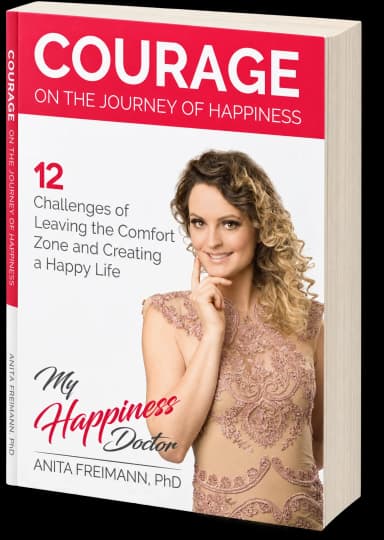
Free preview of my book
Courage on the Journey of Happiness
Get the whole introduction free: how to use the book, who it is for, and my own story of why I wrote it, plus the full table of contents with all twelve challenges. This article grows out of one of them, Caring for the Physical Body.
Sources
- 1.Wood, W., & Rünger, D. (2016). Psychology of habit. Annual Review of Psychology, 67, 289–314. doi.org/10.1146/annurev-psych-122414-033417
- 2.Wood, W., Quinn, J. M., & Kashy, D. A. (2002). Habits in everyday life: Thought, emotion, and action. Journal of Personality and Social Psychology, 83(6), 1281–1297. doi.org/10.1037/0022-3514.83.6.1281
- 3.Wood, W., Tam, L., & Witt, M. G. (2005). Changing circumstances, disrupting habits. Journal of Personality and Social Psychology, 88(6), 918–933. doi.org/10.1037/0022-3514.88.6.918
- 4.Quinn, J. M., Pascoe, A., Wood, W., & Neal, D. T. (2010). Can't control yourself? Monitor those bad habits. Personality and Social Psychology Bulletin, 36(4), 499–511. doi.org/10.1177/0146167209360665
- 5.Gollwitzer, P. M., & Sheeran, P. (2006). Implementation intentions and goal achievement: A meta-analysis of effects and processes. Advances in Experimental Social Psychology, 38, 69–119. doi.org/10.1016/S0065-2601%2806%2938002-1
- 6.Lally, P., van Jaarsveld, C. H. M., Potts, H. W. W., & Wardle, J. (2010). How are habits formed: Modelling habit formation in the real world. European Journal of Social Psychology, 40(6), 998–1009. doi.org/10.1002/ejsp.674
- 7.Gardner, B., Lally, P., & Wardle, J. (2012). Making health habitual: The psychology of ‘habit-formation’ and general practice. British Journal of General Practice, 62(605), 664–666. doi.org/10.3399/bjgp12X659466
This article is for education and reflection and is not a substitute for professional help.

About Anita
Anita Freimann, PhD, the Happiness Doctor, holds a doctorate in the economics of happiness and spent more than 16 years at the Faculty of Economics in Osijek. She is the author of Courage on the Journey of Happiness and the creator of Permission for Life.
More about Anita