Courage
How to Trust the Process When You Can't See Where It's Leading
Trusting the process isn't waiting for life to sort itself out. It's doing your part, persisting, and letting the dots connect later. Here's what that really means, what research says about finding meaning in hindsight, and seven gentle steps.

Anita Freimann, PhD · The Happiness Doctor
7 min read

In this article
- What does trust the process really mean?
- Signs you're waiting rather than trusting
- Why is it so hard to trust the process?
- Trusting the process is not sitting and waiting
- Connecting the dots: why life makes sense only looking back
- Does everything happen for a reason?
- What happiness research says about connecting the dots
- How to trust the process: seven gentle steps
- How to trust the process when you're struggling
- Questions readers ask
Two weeks before the launch of the first Croatian edition of my book, things unexpectedly got complicated, and I started to doubt myself and the whole project. I have told the story of that evening and the decision that followed elsewhere. Here I want to tell you what came after, the part I could not possibly have seen at the time.
The book sold out. What I cherish most are the hundreds of letters from readers who found themselves in my story and were inspired to make new, brave choices. That evening at home, full of doubt, I could see none of it.
In my book Courage on the Journey of Happiness, this idea has its own part in the introduction, called Connecting Dots and Persistence, because one doesn't work without the other.
What does trust the process really mean?
To trust the process means to keep doing your part, consistently and patiently, even when you can't yet see the result, and to stop demanding that life show you the whole map before you take a step. The key word is doing. You plant, you water, you pull the weeds, but you stop digging up the seed every morning to check whether it is growing.
Signs you're waiting rather than trusting
Sometimes “trust the process” quietly becomes an excuse. You might recognise yourself in a few of these:
- you say “it will happen when it's meant to” about something you haven't taken a single step towards
- you wait for a sign, a better moment or more certainty before you begin
- you keep starting over, because beginnings feel safer than the messy middle
- you check every day whether it's working, and give up when you can't see progress
- you use “everything happens for a reason” to avoid feeling disappointed or angry
Why is it so hard to trust the process?
Because most of us were raised to plan, control and deliver. Many women I work with have spent decades holding everything together: the job, the family, the calendar. Not knowing how something will turn out feels like failing at their most important task. And if life has let you down before, trusting anything, including yourself, can feel naive.
And the middle of any change is uncomfortable. The old life no longer fits and the new one isn't visible yet, and that in-between is exactly where most people give up.
Trusting the process is not sitting and waiting
Here is my honest version. Waiting for life to change on its own is one of the most comfortable corners of the comfort zone. It can sound spiritual, but often it is simply postponing. At the end of my book I finished the sentence “Persistence is…” with these words: a willingness for unlimited trying and the foundation of success. Trust without trying is just hoping.
So for me, trust has two halves. One is action: doing your part with love, again and again. The other is letting go of the need to control when and how the result arrives. When the English edition of my book became a new challenge for me, I wrote this:
Even though I cannot know what will happen and how, I do everything with lots of love and completely relaxed because I am certain it will go the best possible way.
Connecting the dots: why life makes sense only looking back
The best-known version of this idea comes from Steve Jobs' 2005 commencement address at Stanford, which I recommend in my book. After dropping out of college, with no idea what he wanted to do with his life, he dropped in on a calligraphy class simply because it fascinated him. Ten years later, it went into the typography of the first Macintosh. “You can't connect the dots looking forward. You can only connect them looking backwards,” he said1.
I have written about how one kind sentence from a professor changed the direction of my studies, at a time when I had no idea where I was going. Notice what such dots have in common. They are not moments of waiting, but of doing something: a class, a choice, a step towards what interested you. The dots connect later, but you make them now.
Does everything happen for a reason?
Many people believe it, and personally, as I wrote in my book, I trust that things will go the best possible way. But that is a belief, not a scientific fact, and you don't need to share it to use this article. Psychologists Konika Banerjee and Paul Bloom found that people often see purpose in the big events of their lives, non-believers too, not only religious people. Those who were better at thinking about other minds saw more purpose in their own life events, which suggests the habit grows out of our ordinary social thinking2.
There is a trap, too. Neal Roese and Kathleen Vohs describe hindsight bias: once we know how something turned out, it seems more predictable than it really was, partly because we remember selectively and make sense of the past in the light of what we know now3. So be gentle with your story, but keep it honest. Loss and injustice don't need to be explained as lessons. What you can choose is what you build after them.
What happiness research says about connecting the dots
As an economist who has spent many years studying happiness, I find this research reassuring, because it is less about whether events have a reason and more about what we do with them. Psychologist Dan McAdams and his colleagues asked adults aged 35 to 65, and students, to describe the high points, low points and turning points of their lives. People whose stories had more redemption sequences, where something bad turned into something good, reported higher well-being4.
McAdams and Kate McLean later summarised the field: people who find redemptive meaning in adversity, and who tell their lives with themes of personal agency, tend to enjoy higher well-being and maturity, though cause and effect still need untangling5. Laura King and Joshua Hicks studied lost possible selves, the lives we hoped for that didn't happen. Thinking about them went with regret and lower well-being at the time, but exploring them in depth predicted greater psychological complexity over time, one side of maturity6.
When Vicki Helgeson, Kerry Reynolds and Patricia Tomich combined 87 studies on benefit finding, seeing some good in a difficult experience, it went with more positive well-being, but also with more intrusive thoughts about what had happened, and the picture depended on how much time had passed7. Finding meaning doesn't erase the pain. It walks beside it.
How to trust the process: seven gentle steps
You learn to trust the process the way you learn any skill: by practising in small moments. These are the steps I return to myself.
- Name the process you are in. Write one sentence: what are you working towards, and what is your part in it? It is hard to trust a process you have never defined.
- Separate your part from life's part. Your part is the effort: the call, the application, the honest conversation. Life's part is the timing and the outcome. Do yours fully, and loosen your grip on the rest.
- Choose one small step for today. The dots are made of ordinary days. If fear stops you, read what fear of failure is really about, then take the step anyway.
- Measure effort, not results. For one month, write down what you did, not what you got. Progress is often invisible before it becomes obvious.
- Expect the messy middle. When nothing seems to be happening, remind yourself that this is part of the process, not proof that it has failed.
- Keep a record of your dots. Note small wins, doors that opened and lessons from the ones that closed. On hard days, read it back.
- Review, don't just endure. Trusting the process doesn't mean ignoring warning signs. Every few months, ask honestly whether this path is still yours.
How to trust the process when you're struggling
On hard days, trusting the process becomes very small. Not “everything will work out”, but “I can do the next thing”. Make the step tiny, rest without guilt and talk to someone who believes in you. Remember, too, that the timing of your life is not a race against anyone else's. And if what you carry weighs on you every day, trusting the process includes asking for help: a doctor or a qualified therapist can be one of your dots too.
Trusting the process is not something you decide once. You practise it again and again, and persistence is easier in good company. That is why my programme Permission for Life runs over twelve weeks, with women who walk the same path. Take one step today. One day you will look back and see how it all connected.
Questions readers ask
What did Steve Jobs say about connecting the dots?
In his 2005 Stanford commencement address, Steve Jobs said the dots of a life only make sense looking back, so you have to trust that they will link up later. His example was a calligraphy class that later shaped the first Mac.
Is trusting the process the same as giving up control?
Not quite. You let go of control over timing and outcomes, which were never fully yours, but you keep full responsibility for your part: your effort, your choices and how kindly you treat yourself along the way.
How do I know whether to keep going or change direction?
Ask whether you are still doing your part and whether the path still feels like yours. If you have been consistent for a long time and the goal no longer means anything to you, changing direction is not failure. It is another dot.
What can I say to a friend instead of “everything happens for a reason”?
Try “I'm so sorry this happened”, “I'm here” or “What would help right now?” In the middle of pain, presence helps more than explanations. Let her find meaning in her own time.
Is there a book that can help me trust the process?
I wrote Courage on the Journey of Happiness for women who want to stop waiting and start living by their own choices, one challenge at a time. You can read the introduction free.
Your turn
Take five quiet minutes with a notebook and answer honestly:
- Where in my life am I waiting for a sign instead of taking the next small step?
- What story do I tell about the hardest year of my life, and is there another honest way to tell it?
- If I trusted that I could handle whatever comes, what would I do differently this month?
Did this article speak to you? I’d love to hear what you noticed, what you tried, or what you’re still struggling with. Write to me at anita [at] anitafreimann [.] com. I read every message.
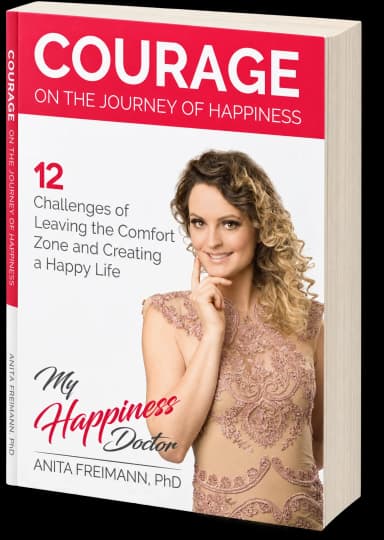
Free preview of my book
Courage on the Journey of Happiness
Get the whole introduction free: how to use the book, who it is for, and my own story of why I wrote it, plus the full table of contents with all twelve challenges. This article grows out of one of them, Healthy Selfishness and the Present Moment.
Sources
- 1.Jobs, S. (2005). ‘You've got to find what you love,’ Jobs says. Commencement address, Stanford University, 12 June 2005. Stanford Report. news.stanford.edu/stories/2005/06/youve-got-find-love-jobs-says
- 2.Banerjee, K., & Bloom, P. (2014). Why did this happen to me? Religious believers' and non-believers' teleological reasoning about life events. Cognition, 133(1), 277–303. doi.org/10.1016/j.cognition.2014.06.017
- 3.Roese, N. J., & Vohs, K. D. (2012). Hindsight bias. Perspectives on Psychological Science, 7(5), 411–426. doi.org/10.1177/1745691612454303
- 4.McAdams, D. P., Reynolds, J., Lewis, M., Patten, A. H., & Bowman, P. J. (2001). When bad things turn good and good things turn bad: Sequences of redemption and contamination in life narrative and their relation to psychosocial adaptation in midlife adults and in students. Personality and Social Psychology Bulletin, 27(4), 474–485. doi.org/10.1177/0146167201274008
- 5.McAdams, D. P., & McLean, K. C. (2013). Narrative identity. Current Directions in Psychological Science, 22(3), 233–238. doi.org/10.1177/0963721413475622
- 6.King, L. A., & Hicks, J. A. (2007). Whatever happened to “what might have been”? Regrets, happiness, and maturity. American Psychologist, 62(7), 625–636. doi.org/10.1037/0003-066X.62.7.625
- 7.Helgeson, V. S., Reynolds, K. A., & Tomich, P. L. (2006). A meta-analytic review of benefit finding and growth. Journal of Consulting and Clinical Psychology, 74(5), 797–816. doi.org/10.1037/0022-006X.74.5.797
This article is for education and reflection and is not a substitute for professional help.

About Anita
Anita Freimann, PhD, the Happiness Doctor, holds a doctorate in the economics of happiness and spent more than 16 years at the Faculty of Economics in Osijek. She is the author of Courage on the Journey of Happiness and the creator of Permission for Life.
More about Anita