Abundance
How to Let Go of Control Without Giving Up on What Matters
The need to control is usually fear dressed up as responsibility. Here's where it comes from, what research says, and seven gentle steps to loosen your grip.

Anita Freimann, PhD · The Happiness Doctor
7 min read

In this article
- What is the need for control?
- Signs you're a bit of a control freak
- Why do I feel the need to control everything?
- Change yourself, not the people around you
- What happiness research says about the need for control
- How to let go of control: seven gentle steps
- How to stop being controlling with the people you love
- Questions readers ask
When I rewind my life, one realisation stands out, and it is not a flattering one. I constantly had the need to change and control others, and that need led to my divorce, to broken friendships and to all sorts of other things. And yet I have no regrets. Everything happened for a reason, and it taught me the key to every change: concentrate on yourself, not on others.
Most of us don't call it control. We call it caring, being responsible, knowing better. We remind, correct and fix, afraid that if we let go, something will fall apart. But other people are not our projects, and the tighter you hold on, the more tired you become.
In my book Courage on the Journey of Happiness, this realisation sits in the introduction, before the first of twelve challenges, because every other change depends on it: you can only walk your own path.
What is the need for control?
The need for control is the urge to make people and situations turn out the way you think they should, because not knowing, or not deciding, feels unbearable. People call it control issues, or say someone is a control freak, but the label is usually unfair. Most people who try to control everything are not cold or bossy. They are capable, anxious and tired.
Some control is healthy: planning your week, looking after your money, setting boundaries. It becomes a problem when control turns from a tool into a need, and when it reaches into other people's lives. If what you are gripping has already happened, start with how to let go of the past.
Signs you're a bit of a control freak
You might recognise yourself in a few of these:
- you redo what others have done, because your way is better
- you give advice nobody asked for, and feel hurt when it isn't taken
- you can't relax until you know exactly how something will turn out
- an unexpected change of plan can ruin your day
- you feel responsible for other people's choices, moods and results
Why do I feel the need to control everything?
Nobody is born wanting to control everything. We learn it, usually for good reasons. If your childhood felt unpredictable, being in charge may have been the safest place to stand. If you were the responsible one, you learned that things go wrong unless you handle them. And many women carry a quiet belief that a good woman holds everything together: home, work, children, parents and everyone's moods.
Underneath almost every need for control is fear, and very often a sense of scarcity: not enough safety, time or love to go round, so you hold on tighter. If that sounds familiar, my article on the scarcity vs abundance mindset shows how to widen your view. And if your need for control comes with strong anxiety or compulsions, a qualified mental health professional can help in ways no article can.
Change yourself, not the people around you
We spend enormous energy trying to change our partners, children, parents and colleagues. It rarely works, and when it seems to, it costs the relationship something. The only person you can truly change is you, and here is the beautiful paradox: when you change, much around you changes too.
By changing ourselves, we change the world (and that’s actually the only way).
There is a reason the prayer usually attributed to the theologian Reinhold Niebuhr has travelled around the world1. It asks for “the serenity to accept the things I cannot change”, the courage to change what we can and the wisdom to tell the difference. Letting go of control is that wisdom in practice, not passivity.
What happiness research says about the need for control
As an economist who has spent many years studying happiness, I find it reassuring that research has names for what I lived. In 1975 psychologist Ellen Langer described the illusion of control: when a chance situation contains elements of skill, such as choice or familiarity, we feel more confident of success than the odds justify. In one study, people who had chosen their own lottery ticket asked a much higher price to give it up than people simply handed one, although the draw was pure luck2.
In 1982 Fred Rothbaum, John Weisz and Samuel Snyder described two ways of feeling in control. Primary control means bringing the world into line with your wishes. Secondary control means bringing yourself into line with what you cannot change, which they saw as a real, often overlooked form of control3. Their paper is called Changing the world and changing the self, almost the motto of this article.
Psychologist Michel Dugas and his colleagues in Quebec have long studied intolerance of uncertainty, how hard we find it to bear not knowing. In one small early study it was the key factor setting apart people with generalised anxiety disorder, a condition marked by excessive worry, from people without it4. You don't need a diagnosis to recognise the everyday version: when not knowing feels unbearable, controlling feels like relief.
The good news is that acceptance can be practised. The acceptance and commitment approach of psychologist Steven Hayes and colleagues teaches people to make room for difficult feelings while acting on what matters5. When Andrew Howell and Holli-Anne Passmore pooled five randomised experiments with university students, this kind of training had a small but significant positive effect on well-being6. And Brett Ford, Iris Mauss and colleagues found that people who tend to accept their emotions and thoughts without judging them felt less negative emotion during daily stress and reported better psychological health six months later. Interestingly, this link held for accepting thoughts and feelings, not for accepting situations7.
How to let go of control: seven gentle steps
You don't let go of control in one brave moment. You loosen your grip one finger at a time.
- Notice the grip. Control often shows in the body first: a tight jaw, raised shoulders, the itch to step in. For a few days, just notice when it appears and what set it off.
- Draw two circles. Write down what is worrying you. In one circle, put what is yours to influence: your words, actions, boundaries and reactions. In the other, put what isn't: other people's choices, the past, the outcome. Give your energy to the first circle and your acceptance to the second.
- Name the fear underneath. Ask what you are afraid will happen if you don't control this. Being hurt, being blamed, chaos? A named fear is easier to hold than a vague one.
- Turn “they should” into “I can”. Every time you catch yourself thinking that someone should change, ask what you can change in yourself instead. This is the core of my own lesson: concentrate on yourself, not on others.
- Let one thing be done differently. Let your partner load the dishwasher their way, let your child pack their own bag, let a colleague run the meeting. Resist the urge to correct. Most of the time, different is not wrong.
- Practise not knowing. Living with uncertainty is a skill you can train. Leave one evening unplanned, wait an hour before checking whether someone has replied, let a decision rest overnight. If letting go leaves your mind racing, how to stop overthinking is a good next step.
- Accept the feeling, then act on what's yours. When anxiety rises, don't fight it and don't obey it. Let it be there, breathe, and do the one thing that is in your circle. Then let the rest unfold.
How to stop being controlling with the people you love
This is where control hurts most, because it usually comes wrapped in love. We check, remind and correct, and to the other person it often sounds like: I don't trust you. Adults are allowed to make their own choices, including ones you would never make, and children need room to make small mistakes while you are still close enough to help.
Try replacing instructions with questions: “How would you like to handle this?” or “Do you want my advice, or shall I just listen?” Offer help instead of imposing it. Often the people around you grow into the trust you finally give them, and you discover how much energy you have left for your own life.
Letting go of control doesn't happen in a single decision. It happens in small daily moments when you choose trust over fear, and it is easier with people around you who are learning the same. It is no accident that the last part of my programme Permission for Life is called Free. You don't have to hold the whole world together. Take care of your own part, and let life surprise you with the rest.
Questions readers ask
Why do I struggle to let go of control?
Because control once felt like safety. If you learned early that things go wrong unless you handle them, letting go feels dangerous. Start small, with one situation and one week, and let experience show you that not everything falls apart.
What is the root of wanting control?
Usually fear: of uncertainty, of being hurt, of chaos or of not being good enough. Researchers who study intolerance of uncertainty describe how hard not knowing can be to bear. Control is often the mind's attempt to make an uncertain world feel safe.
Is letting go of control the same as giving up?
No. Giving up means you stop caring. Letting go means you keep caring, do your part and stop trying to steer what isn't yours to steer. Psychologists describe adjusting yourself to what you cannot change as a form of control in its own right.
What is a good mantra for letting go of control?
Choose something short, such as “I do my part, and I let the rest unfold” or “I can only change myself.” Many people also return to the first line of the Serenity Prayer.
What is a good book on how to let go of control?
Look for one that gives you practice, not only insight. I wrote Courage on the Journey of Happiness as twelve challenges for living your own life, and it begins with the same idea as this article: change starts with you. You can read the introduction free, the story of why I wrote it and what each challenge holds.
Your turn
Take five quiet minutes with a notebook and answer honestly:
- Whom am I trying to change right now, and what am I afraid will happen if I stop?
- When did control first start to feel like safety to me?
- What would I do with the energy I spend on others' choices if I spent it on my own life?
Did this article speak to you? I’d love to hear what you noticed, what you tried, or what you’re still struggling with. Write to me at anita [at] anitafreimann [.] com. I read every message.
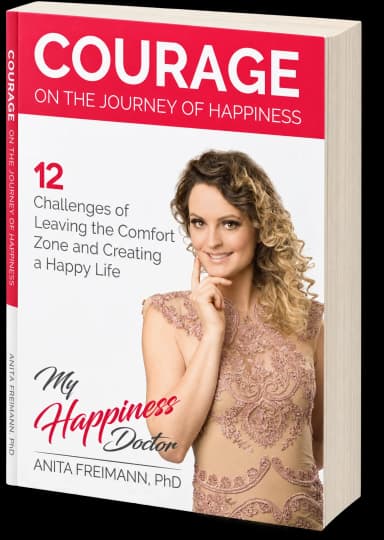
Free preview of my book
Courage on the Journey of Happiness
Get the whole introduction free: how to use the book, who it is for, and my own story of why I wrote it, plus the full table of contents with all twelve challenges. This article grows out of one of them, Healthy Selfishness and the Present Moment.
Sources
- 1.Yale Alumni Magazine (2014). Who wrote the Serenity Prayer? Looks like Niebuhr after all (on Fred R. Shapiro’s research). www.yalealumnimagazine.com/blog_posts/1776-who-wrote-the-serenity-prayer-br-looks-like-niebuhr-after-all
- 2.Langer, E. J. (1975). The illusion of control. Journal of Personality and Social Psychology, 32(2), 311–328. doi.org/10.1037/0022-3514.32.2.311
- 3.Rothbaum, F., Weisz, J. R., & Snyder, S. S. (1982). Changing the world and changing the self: A two-process model of perceived control. Journal of Personality and Social Psychology, 42(1), 5–37. doi.org/10.1037/0022-3514.42.1.5
- 4.Dugas, M. J., Gagnon, F., Ladouceur, R., & Freeston, M. H. (1998). Generalized anxiety disorder: A preliminary test of a conceptual model. Behaviour Research and Therapy, 36(2), 215–226. pubmed.ncbi.nlm.nih.gov/9613027/
- 5.Hayes, S. C., Luoma, J. B., Bond, F. W., Masuda, A., & Lillis, J. (2006). Acceptance and commitment therapy: Model, processes and outcomes. Behaviour Research and Therapy, 44(1), 1–25. doi.org/10.1016/j.brat.2005.06.006
- 6.Howell, A. J., & Passmore, H.-A. (2019). Acceptance and Commitment Training (ACT) as a positive psychological intervention: A systematic review and initial meta-analysis regarding ACT’s role in well-being promotion among university students. Journal of Happiness Studies, 20(6), 1995–2010. doi.org/10.1007/s10902-018-0027-7
- 7.Ford, B. Q., Lam, P., John, O. P., & Mauss, I. B. (2018). The psychological health benefits of accepting negative emotions and thoughts: Laboratory, diary, and longitudinal evidence. Journal of Personality and Social Psychology, 115(6), 1075–1092. doi.org/10.1037/pspp0000157
This article is for education and reflection and is not a substitute for professional help.

About Anita
Anita Freimann, PhD, the Happiness Doctor, holds a doctorate in the economics of happiness and spent more than 16 years at the Faculty of Economics in Osijek. She is the author of Courage on the Journey of Happiness and the creator of Permission for Life.
More about Anita