Purpose & work
How to Find Your Purpose in Life Without Waiting for One Big Calling
If you feel your life was meant to be something more, you're not late and you're not lost. Purpose is rarely found in one flash; it's built, step by step. Here's what research says, and seven gentle steps to begin.

Anita Freimann, PhD · The Happiness Doctor
7 min read

In this article
- What does life purpose mean?
- Signs you're longing for more purpose
- Why do I feel like I have no purpose?
- Your purpose leaves signposts along the way
- What happiness research says about finding your purpose
- How to find your purpose in life: seven gentle steps
- How to find my purpose in life after 40
- Questions readers ask
When I finished grammar school, I didn't really know what to do with my life. The ideas ranged from becoming a beautician to studying dentistry. I loved mathematics, so I enrolled in maths, and almost on the side in economics part-time. At the Faculty of Economics, the first to welcome us was an English professor. She said we were probably feeling quite confused and promised to explain everything simply. Her warmth made such an impression that I soon decided to study only economics.
Nobody handed me a mission. But looking back, I can see the thread. At grammar school I often tutored others at home. At 23 I started working at that same faculty, because I had always felt that working with people was my vocation. I wrote my doctorate on happiness because it intrigued me, and when more and more people came to me for advice, they kept telling me to put it all together. That is how my book was born. Today I know my calling is to share what I have learned about happiness. I didn't find it in one flash of insight. I built it, one curious step at a time.
In my book Courage on the Journey of Happiness, I write that I am convinced all of us have a purpose here, a calling worth listening to. But if you are in your forties and quietly feel that life was meant to be something more, I want to take the pressure off that word. Purpose is rarely one big mission waiting to be discovered. It is a direction you build.
What does life purpose mean?
Life purpose is a sense of direction: knowing what matters to you and letting it shape your goals and everyday choices, usually in a way that also reaches beyond yourself. Psychologists Patrick McKnight and Todd Kashdan describe purpose as a central aim in life that organises your goals and gives you a sense of meaning. They compare it to a compass that gives a navigator direction, and they add that following the compass is optional1.
A compass doesn't tell you where you will be in ten years. It tells you which way to take the next step.
Signs you're longing for more purpose
You might recognise yourself in a few of these:
- your life looks good on paper, yet you keep thinking there should be something more
- you are busy from morning to night, but can't say what it is all for
- you envy people who seem to know exactly why they get up in the morning
- you have done the quizzes and still have no answer
- the moments you feel most alive are rare
None of this means something is wrong with you. It means a part of you is asking for attention.
Why do I feel like I have no purpose?
Usually not because you don't have one, but because there has been no room for it. For years your days may have been organised around other people's needs, deadlines and expectations. That is responsible and often loving, but it leaves little room to notice what lights you up. If that sounds familiar, read how to find yourself again too.
The other reason is the story we are told: that purpose is one grand passion, and once you find it, everything clicks. While you wait for that big moment, ordinary signs go unnoticed. One honest note: if the emptiness comes with exhaustion that rest doesn't lift, or a low mood that has lasted for weeks, please talk to a doctor or a mental health professional. That deserves care first.
Your purpose leaves signposts along the way
When I look back, I see what I call signposts: people, moments and sentences that quietly turned me in a direction. In my book I wrote that life was sending certain people my way to serve as signposts on the road. That English professor was one of them. Years later, already her colleague, I told her what her welcome had meant to me, and she was very glad to hear it.
Never underestimate the power of one sentence to change your life.
Your signposts are probably already there: the subject you always come back to, the thing people ask you for help with, the afternoon you forgot the time. They rarely look important when they happen. And as I also wrote, some people realise they are quite satisfied with what they have. Purpose doesn't always ask you to change your life. Sometimes it asks you to live it more consciously.
What happiness research says about finding your purpose
As an economist who has spent many years studying happiness, I find one distinction especially freeing. Psychologist Michael Steger and his colleagues measure two separate things: how much meaning you already feel in your life, and how much you are searching for it. In their studies the two were barely related, and it was the meaning people already felt, not the searching, that went together with greater life satisfaction2.
Age plays a role too. In a sample of almost 9,000 people, those at later life stages generally reported more meaning in their lives, while younger people searched more. Searching was also more strongly linked to lower well-being at later life stages3. I read that as an invitation: in midlife, endless searching costs more than living what you already know matters.
So where does purpose come from? Todd Kashdan and Patrick McKnight describe three paths: gradually, through effort over time; after a life event that brings sudden clarity; and by observing and learning from the people around us4. Paul O'Keefe, Carol Dweck and Gregory Walton found that when a new interest became difficult, people led to believe that passions are fixed and only need to be found lost interest more than people who saw interests as something you develop5.
Purpose may matter beyond how we feel. Patrick Hill and Nicholas Turiano followed more than 6,000 American adults for 14 years. People with a stronger sense of purpose were less likely to die during that time, even after accounting for other aspects of well-being, and this didn't depend on age6. It is a link, not proof, so I share it as a reason to take purpose seriously, not as a health promise.
How to find your purpose in life: seven gentle steps
You don't find purpose by thinking harder. You find it by paying attention and acting, in small steps.
- Let go of the one-big-mission idea. You don't need a perfect sentence about your purpose. Start with a direction: what do you want more of in your life, and what less?
- Collect your signposts. Write down when you lose track of time, what people ask you for help with and which compliments you brush off. On paper, patterns appear.
- Ask who benefits. Purpose usually reaches beyond you. Whose life is a little better because of what you do? For me, that knowledge is still my greatest motivation.
- Try it on, small. Give a possible direction one month: a course, a few hours of volunteering, a conversation with someone who already does it. Treat it as an experiment, not a verdict.
- Expect the dip. Every new interest becomes difficult at some point. That doesn't mean you chose wrongly; interests grow when you keep developing them.
- Learn from people who inspire you. Choose two people whose lives move you. What exactly attracts you: their freedom, their courage, the way they help? That is information about you.
- Bring purpose into the life you already have. You may not need a new job. Amy Wrzesniewski and Jane Dutton describe hospital cleaners who made themselves part of patient care and came to see their work as being about healing people7. Ask where you could do the same at work, at home or in your community.
How to find my purpose in life after 40
If you are asking “what is my purpose in life?” at 45, you are not late. You are better equipped than at 20: you have decades of signposts behind you and a much clearer sense of what you don't want. Midlife often loosens old roles, and the question finally gets some space.
Sometimes the answer points to different work, and then career change at 40 is a good next read. More often it starts closer to home: a project that has waited for years, a way of helping that fits your real life. You will meet many names for this search, from ikigai and soul purpose to doing what you love. Whatever the name, the principle is the same: small steps in the direction that feels like yours.
Your purpose doesn't have to be grand to be real. It grows from the attention you pay to your signposts and the courage to follow them, one step at a time. That is the heart of my programme Permission for Life: permission to live your own life, in your own direction. To see where my own path began, read the free introduction to my book.
Questions readers ask
Is it too late to find your purpose in your 40s or 50s?
No. In a large study, people at later life stages generally reported more meaning in their lives than younger people. Experience makes the next step easier to see.
Can your purpose in life change?
Yes. Purpose often grows through effort over time, and it can shift after a life event or when you meet people who inspire you. What matters is that it gives you direction now.
What is the difference between passion and purpose?
Passion is what lights you up. Purpose is the direction that gives it a reason, often by reaching beyond yourself. Research suggests that seeing interests as something you develop helps you stay with them when they get hard, so you don't need a ready-made passion to begin.
Do I need to quit my job to live my purpose?
Not necessarily. Many people bring more purpose into their current work by changing what they focus on and whom they serve. If you want to leave, test the new direction first while your income still covers the bills.
What if I never find one big purpose?
Then you are like most people. Purpose doesn't have to be a single mission. As I wrote in my book, no work is less valuable as long as it is done honestly, ethically and responsibly.
Your turn
Take five quiet minutes with a notebook and answer honestly:
- If no one expected anything from me for a whole year, how would I spend my days?
- Whose single sentence once changed my direction, and whose life might my words be changing now?
- Where am I already useful in a way that matters to me, even if I have never called it purpose?
Did this article speak to you? I’d love to hear what you noticed, what you tried, or what you’re still struggling with. Write to me at anita [at] anitafreimann [.] com. I read every message.
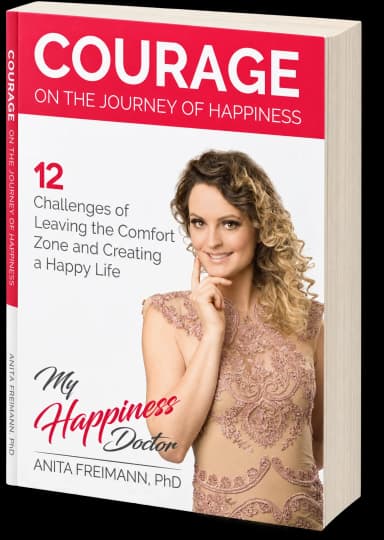
Free preview of my book
Courage on the Journey of Happiness
Get the whole introduction free: how to use the book, who it is for, and my own story of why I wrote it, plus the full table of contents with all twelve challenges. This article grows out of one of them, Do What You Love.
Sources
- 1.McKnight, P. E., & Kashdan, T. B. (2009). Purpose in life as a system that creates and sustains health and well-being: An integrative, testable theory. Review of General Psychology, 13(3), 242–251. doi.org/10.1037/a0017152
- 2.Steger, M. F., Frazier, P., Oishi, S., & Kaler, M. (2006). The Meaning in Life Questionnaire: Assessing the presence of and search for meaning in life. Journal of Counseling Psychology, 53(1), 80–93. doi.org/10.1037/0022-0167.53.1.80
- 3.Steger, M. F., Oishi, S., & Kashdan, T. B. (2009). Meaning in life across the life span: Levels and correlates of meaning in life from emerging adulthood to older adulthood. The Journal of Positive Psychology, 4(1), 43–52. doi.org/10.1080/17439760802303127
- 4.Kashdan, T. B., & McKnight, P. E. (2009). Origins of purpose in life: Refining our understanding of a life well lived. Psihologijske teme, 18(2), 303–313. hrcak.srce.hr/48215
- 5.O'Keefe, P. A., Dweck, C. S., & Walton, G. M. (2018). Implicit theories of interest: Finding your passion or developing it? Psychological Science, 29(10), 1653–1664. doi.org/10.1177/0956797618780643
- 6.Hill, P. L., & Turiano, N. A. (2014). Purpose in life as a predictor of mortality across adulthood. Psychological Science, 25(7), 1482–1486. doi.org/10.1177/0956797614531799
- 7.Wrzesniewski, A., & Dutton, J. E. (2001). Crafting a job: Revisioning employees as active crafters of their work. Academy of Management Review, 26(2), 179–201. doi.org/10.2307/259118
This article is for education and reflection and is not a substitute for professional help.

About Anita
Anita Freimann, PhD, the Happiness Doctor, holds a doctorate in the economics of happiness and spent more than 16 years at the Faculty of Economics in Osijek. She is the author of Courage on the Journey of Happiness and the creator of Permission for Life.
More about Anita