Courage
Fear of Change: Why We Cling to the Familiar and How to Move Forward Anyway
Fear of change isn't stubbornness. It's fear of the unknown and of losing what you already have. Here's why it holds you in place, what research says, and seven gentle steps towards the change you want.

Anita Freimann, PhD · The Happiness Doctor
7 min read

In this article
- What is fear of change?
- Signs fear of change is holding you back
- Why are people afraid of change?
- Fear of the unknown or fear of losing what you have?
- Your cheese is what you want from life
- What happiness research says about fear of change
- How to overcome fear of change: seven gentle steps
- Resistance to change: when part of you says no
- Questions readers ask
There is a small book I have recommended for years: Spencer Johnson's “Who Moved My Cheese?”, which you can read in an hour. Four characters live in a maze, and one day the cheese at their usual station is gone. The two mice run off to look for more. Of the two little people, Hem refuses to leave and waits for the old cheese to return, while Haw, after a long struggle with himself, walks back into the maze. As I wrote in my book, the cheese is a metaphor for what we want from life: a good job, a loving relationship, the things we own, peace within.
I like to pair it with a line attributed to the Scottish doctor and novelist A. J. Cronin, who saw life not as a straight, easy corridor but as “a maze of passages, through which we must seek our way, lost and confused”. That is fear of change in one picture: we know the corridor, not the maze. In my book Courage on the Journey of Happiness, this fear waits at the edge of the comfort zone, where the cheese may be running out, but at least we know the way.
What is fear of change?
Fear of change is the unease that appears when life asks you to leave something familiar: a job, a relationship, a home, a role, a way of seeing yourself. It is a normal human response, not a flaw, and it appears both when change is forced on us and when we choose it ourselves. You can long for something new and still be afraid of it.
Inside it there are usually two fears: fear of the unknown (I don't know what is out there) and fear of losing what you have (I know what I would give up). If what frightens you most is trying and failing, that is a close cousin, and I have written about fear of failure separately.
Signs fear of change is holding you back
You might recognise yourself in a few of these:
- you say “maybe next year” about the same thing every year
- you know what you no longer want, but wait for certainty about what you do want
- you stay because it's bearable, not because it's yours
- you research, plan and ask for advice, but never quite decide
- you feel relief when a decision is postponed, and disappointment soon after
Why are people afraid of change?
Because what we have is real, and what we could have is only possible. The familiar has a face, a routine and a price we already know. The new has none of that yet, so our imagination fills the gaps, and it rarely fills them with good news.
There is a second reason. In my book I describe motivation as an urge, a stimulus that makes us want to reach the behaviours, results and goals that satisfy us. While the old situation is still bearable, that urge stays weak and fear wins easily. That is why so many of us, like Hem, only move once the cheese is completely gone.
If anxiety about change stops you from living your daily life, a qualified professional can help.
Fear of the unknown or fear of losing what you have?
Fear of the unknown may run deep. Psychologist R. Nicholas Carleton reviewed the evidence for a provocative idea: that “fear of the unknown may be a, or possibly the, fundamental fear” behind anxiety1. In an experiment by Archy de Berker and colleagues, 45 volunteers learned to predict whether an electric shock would follow. Stress rose with the shocks, but people also felt most stressed when they could least predict what was coming2.
Fear of loss works differently. Daniel Kahneman, Jack Knetsch and Richard Thaler opened a famous paper with an economist who had bought good Bordeaux cheaply years before. A bottle would now fetch about $200 at auction, yet he would neither sell at that price nor buy another at it. We often demand much more to give something up than we would pay to get it: the endowment effect, rooted in loss aversion3. Put the two fears together and you have the trap: the familiar feels safer and more valuable than it is, the new riskier and smaller.
Your cheese is what you want from life
What I love about the cheese metaphor is that it turns the question around. Fear keeps staring at the empty station and asks: what will I lose? The cheese asks: what do I actually want? That shift moves your attention from the threat to a direction, and direction gives motivation its strength.
In the same part of my book I wrote that every life coach has their own coach, people who lift and inspire them, and that we can choose whom we listen to. Haw didn't need to stop being afraid. He needed a reason stronger than his fear, and the courage to keep walking while still unsure.
I believe we all serve as trainers to one another, and every new situation is an opportunity to learn.
What happiness research says about fear of change
As an economist who has spent many years studying happiness, I find my own field honest about this. William Samuelson and Richard Zeckhauser began their classic paper with a simple line: “Most real decisions, unlike those of economics texts, have a status quo alternative.” In a series of experiments, people stuck with the option presented as the current one disproportionately often: status quo bias4.
The hopeful part is that our relationship with not knowing can shift. Psychologists call finding uncertainty unbearable intolerance of uncertainty. In a small experiment, Robert Ladouceur, Patrick Gosselin and Michel Dugas used a gambling task to make one group of 21 people less tolerant of uncertainty and another more tolerant; the first group worried more5. One small study, but it suggests that how we hold uncertainty is not set in stone.
And change may be kinder than we fear: when economist Steven Levitt let people stuck on a big decision toss a coin, those who made a change, such as quitting a job, reported being happier on average six months later, and he suggests we may be too cautious about life-changing choices6.
How to overcome fear of change: seven gentle steps
You don't need to stop being afraid before you change. Fear softens when the unknown gets smaller and the loss gets an honest name. These are the steps I use myself.
- Name your cheese. Write one sentence about what you want, not what you want to escape. “I want work that uses what I know” pulls you forward; “I can't stand this job” only pushes.
- Count both columns. Write what this change could cost you, then what staying could cost you over the next five years. We usually count only the first.
- Make the unknown smaller. Fear feeds on missing information. Find one real piece this week: talk to someone who has done it, visit the place, read the details.
- Try a small version first. A weekend before a move, a course before a new career, one honest conversation before a final decision.
- Practise not knowing. Change one small routine on purpose: a new route, a new café, an evening without a plan. Each small uncertainty you get through shows you that not knowing is bearable.
- Choose whose voice is loudest. Spend time with someone who has made a change you admire, and ask how it really was.
- Set a date, not a feeling. Readiness rarely arrives on its own. Put the first step in your calendar and keep that appointment as you would with anyone else.
Resistance to change: when part of you says no
Sometimes fear of change doesn't feel like fear at all, but like irritation, tiredness or a sudden list of reasons why now is not the time. Researcher Shaul Oreg built a questionnaire for this inclination to resist change and found four faces of it: routine seeking, an emotional reaction when change is imposed on us, a short-term focus on the inconvenience, and cognitive rigidity, finding it hard to change our minds7.
I find these four a useful mirror, at home and at work. When a team resists a new way of working, it is rarely laziness: someone is losing a routine, someone feels the change was done to them, someone sees only the next hard month. Notice which face is speaking, in you or in others, and you will know what helps: a new routine, a voice in the decision, a longer view or simply more time.
Sometimes what keeps us from the new is not the future but a past we are still carrying. If that sounds like you, the next step is learning how to let go of the past. And if you would like to practise courage with women who walk the same road, that is what my programme Permission for Life is for. Hem is still waiting at the empty station. You don't have to.
Questions readers ask
What is the fear of change called?
An intense, persistent fear of change is sometimes called metathesiophobia. For most of us, though, fear of change is an ordinary human experience rather than a label to give ourselves.
Is fear of change normal?
Yes. Almost everyone feels it before a real change, even one they wanted. It becomes a problem when it starts making your decisions and keeps you where you no longer want to be.
Why am I so scared to try new things?
Usually because the new thing has no track record in your life yet, so your mind fills the gaps with worst cases. Small, low-stakes experiments give it real information instead of imagined danger.
How do I know if it's fear or my intuition telling me no?
In my experience, fear grows quieter as you learn more and take small steps, while a genuine no stays calm and steady even with all the information. Ask yourself: if I knew I would cope, would I still say no?
What are the best books about fear of change?
Spencer Johnson's “Who Moved My Cheese?” is short and memorable. If you want practice, not only a story, I wrote Courage on the Journey of Happiness about leaving the comfort zone through small challenges. You can read the introduction free.
Your turn
Take five quiet minutes with a notebook and answer honestly:
- Which change have I been postponing the longest, and what does postponing it protect me from?
- What have I already lived through that once felt like a huge change?
- If I trusted myself to cope with not knowing, what would I try?
Did this article speak to you? I’d love to hear what you noticed, what you tried, or what you’re still struggling with. Write to me at anita [at] anitafreimann [.] com. I read every message.
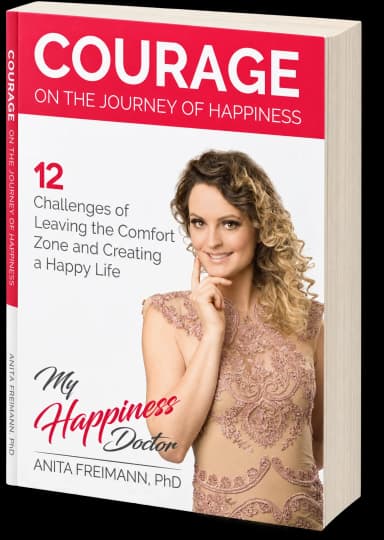
Free preview of my book
Courage on the Journey of Happiness
Get the whole introduction free: how to use the book, who it is for, and my own story of why I wrote it, plus the full table of contents with all twelve challenges. This article grows out of one of them, Healthy Selfishness and the Present Moment.
Sources
- 1.Carleton, R. N. (2016). Fear of the unknown: One fear to rule them all? Journal of Anxiety Disorders, 41, 5–21. doi.org/10.1016/j.janxdis.2016.03.011
- 2.de Berker, A. O., Rutledge, R. B., Mathys, C., Marshall, L., Cross, G. F., Dolan, R. J., & Bestmann, S. (2016). Computations of uncertainty mediate acute stress responses in humans. Nature Communications, 7, 10996. doi.org/10.1038/ncomms10996
- 3.Kahneman, D., Knetsch, J. L., & Thaler, R. H. (1991). Anomalies: The endowment effect, loss aversion, and status quo bias. Journal of Economic Perspectives, 5(1), 193–206. doi.org/10.1257/jep.5.1.193
- 4.Samuelson, W., & Zeckhauser, R. (1988). Status quo bias in decision making. Journal of Risk and Uncertainty, 1(1), 7–59. doi.org/10.1007/BF00055564
- 5.Ladouceur, R., Gosselin, P., & Dugas, M. J. (2000). Experimental manipulation of intolerance of uncertainty: A study of a theoretical model of worry. Behaviour Research and Therapy, 38(9), 933–941. doi.org/10.1016/S0005-7967%2899%2900133-3
- 6.Levitt, S. D. (2021). Heads or tails: The impact of a coin toss on major life decisions and subsequent happiness. The Review of Economic Studies, 88(1), 378–405. doi.org/10.1093/restud/rdaa016
- 7.Oreg, S. (2003). Resistance to change: Developing an individual differences measure. Journal of Applied Psychology, 88(4), 680–693. doi.org/10.1037/0021-9010.88.4.680
This article is for education and reflection and is not a substitute for professional help.

About Anita
Anita Freimann, PhD, the Happiness Doctor, holds a doctorate in the economics of happiness and spent more than 16 years at the Faculty of Economics in Osijek. She is the author of Courage on the Journey of Happiness and the creator of Permission for Life.
More about Anita