Relationships
Signs Your Partner Is Emotionally Unavailable, and What to Do Without Losing Yourself
Living next to someone you can't quite reach can be lonelier than living alone. Here's how to tell a hard season from a pattern, what research says, and seven gentle steps that start with you.

Anita Freimann, PhD · The Happiness Doctor
7 min read

In this article
- What does emotionally unavailable mean?
- Signs your partner is emotionally unavailable
- Why is someone emotionally unavailable?
- True partnership: the love we try too hard to hold on to
- What happiness research says about emotional distance
- How to deal with an emotionally unavailable partner: seven gentle steps
- Emotionally unavailable man or woman: does gender matter?
- Questions readers ask
Of the many stories about love I have heard from friends, colleagues and the women I work with, one has stayed with me. A woman I know once described her marriage as great: she and her husband were on good terms. And yet, for many years, they had not shared a bed.
I don't judge her, or him; people do the best they can. But many couples live like that, polite and functional, side by side and quietly alone. I have had several long relationships too, and for a long time I couldn't tell whether I simply fell in love easily or kept searching in others for what I myself was missing.
In my book Courage on the Journey of Happiness, one of the twelve challenges is devoted to true partnership: a bond in which you can look each other straight in the eyes and hold that look. This article is about what to do when that look keeps sliding away.
What does emotionally unavailable mean?
Emotionally unavailable is an everyday expression, not a clinical diagnosis. It describes someone who finds it hard to share their feelings, to receive yours, or to let closeness grow. It can be a season, after a loss or in an exhausting year, or a long-standing way of relating. Some couples argue loudly and stay connected; others never argue and slowly drift apart. If you are not sure what good looks like, start with the signs of a healthy relationship.
Signs your partner is emotionally unavailable
Any of these can happen on a tired day. What matters is whether they repeat:
- you talk about schedules and bills, rarely about the two of you
- when you share something painful, they change the subject, make a joke or rush to fix it
- they rarely say what they feel, even when you ask gently
- closeness comes and goes: warm one week, distant and busy the next
- difficult talks end in silence, a closed door or “you're overthinking it”
- they keep worries and plans that affect you both to themselves
- you do most of the reaching out, repairing and remembering
- you feel lonelier together than when you are on your own
Feeling alone in a relationship is often the first sign, long before it has a name.
One thing does not belong on this list. I know a woman who had to justify every receipt to her husband, down to a pair of stockings. That is not emotional distance; it is control. If a partner controls, threatens or hurts you, it is a safety issue: please contact local domestic abuse services or a qualified professional, and in immediate danger, your local emergency number.
Why is someone emotionally unavailable?
Usually not because they don't care. Many people learned early that feelings were unwelcome or that needing someone was risky, and distance became their way of staying safe. In my book I wrote that when we choose a partner, we are often guided by programmes created in early childhood. Others are overwhelmed for a while by a loss, a demanding job or a new baby. If it seems heavier than that, a doctor or therapist is a better guide than any label.
Sometimes the distance is not only theirs. It is worth asking, gently, why you chose someone hard to reach, and what you do when they come closer. Fear of closeness can live on both sides; I wrote about keeping love at a safe distance in self-sabotage. This isn't about blame. You can only change your own steps in the dance.
True partnership: the love we try too hard to hold on to
There is a saying I mention in my book: that we fall in love three times in a lifetime. The first love is young and idealised. The third comes when we least expect it and turns our ideas about love upside down. The second is the one many of us recognise here:
The second love we try hard to hold on to, which is challenging because it’s a difficult love we have to learn some lessons from.
But love is not measured by how hard we hold on. Holding on usually means explaining more, asking for less and waiting for a moment that never comes. True partnership is two people who can say what is going on without fear, and who both turn up. Without it, people live a life that only looks fine from the outside, constantly tense because they are not living in truth.
What happiness research says about emotional distance
As an economist who has spent many years studying happiness, I find attachment research the most helpful lens. In 1987 Cindy Hazan and Phillip Shaver proposed that romantic love is an attachment process and that the three styles seen in infancy, secure, avoidant and anxious, appear in adult love too, shaped in part by childhood relationships with parents1.
Today psychologist Chris Fraley and others describe attachment as dimensions that vary by degree, not as boxes. People high in avoidance “prefer not to rely on others or open up to others”, close to what we mean by emotionally unavailable2. The hopeful part: reviewing long-term studies, Fraley and Glenn Roisman concluded that early experiences do not determine adult outcomes, although styles seem more changeable in childhood than in adulthood3.
What builds closeness? Building on a model by Harry Reis and Phillip Shaver, Jean-Philippe Laurenceau, Lisa Feldman Barrett and Paula Pietromonaco asked people to record each social interaction, with anyone, right after it happened, for one or two weeks. Intimacy was greater when both people opened up, partly through feeling that the other was responsive, and sharing emotions mattered more than sharing facts4.
John Gottman calls small moments of reaching out bids for connection: a comment, a question, a touch. A partner can turn toward a bid, away from it or against it5. When Janice Driver and Gottman observed 49 newlywed couples over dinner and during a disagreement, playfulness and enthusiasm in ordinary moments went together with more humour and affection in conflict6. It is a link, not proof of cause.
How to deal with an emotionally unavailable partner: seven gentle steps
You can't make anyone available. But you can stop waiting in silence and change your half of the dance.
- Look for the pattern, not the moment. For a few weeks, notice when you feel close and when shut out. Is it new? Is it only with you, or with everyone?
- Name your own need first. Not “they are cold”, but “I miss being asked how I am”. A clear need is easier to hear than a verdict.
- Ask, don't diagnose. “I miss talking about us. Could we have half an hour on Sunday, phones away?” lands better than “you're emotionally unavailable”. Labels make people defend themselves; wishes give them somewhere to go.
- Turn toward small bids, including theirs. A partner who struggles with words may reach out in other ways: making you coffee, sitting closer. Notice it, answer it, and make small bids of your own.
- Go first with one feeling. Share something small but real: “I felt proud today.” Closeness grows in small, safe steps.
- Give it time, but not forever. Change takes months, not days. If you both want to work on it, a qualified couples therapist can help, for example with emotionally focused therapy, an approach built on attachment theory that a review co-written by Sue Johnson describes as evidence-based7.
- Keep a life that is yours. Friends, interests and time that fills you. Then ask honestly what you want. If you have lost track of that, start with finding yourself again.
Emotionally unavailable man or woman: does gender matter?
Most of what is online is about the emotionally unavailable man or the husband who won't talk. Research is more nuanced. Andrew Christensen and Christopher Heavey studied 31 married couples discussing a change the wife wanted and one the husband wanted. Overall, the men were more withdrawn. But both partners were more likely to push when they wanted a change, and to withdraw when their partner wanted it8.
So withdrawal is not simply a male trait, and an emotionally unavailable woman is a familiar story too. Whatever your partner's gender, look at your roles: if you are always the one asking for more, your partner may have become the one who steps back. The way out is rarely more pressure. It is a softer start, and an honest question about what each of you fears.
If you are tired of holding on and want to discover what you truly want from love and from life, my programme Permission for Life is there for that. Whatever your partner chooses, you can choose not to disappear. You deserve to be met.
Questions readers ask
Can an emotionally unavailable person change?
Yes, if they want to. Research suggests attachment patterns become more stable in adulthood, but early experiences do not decide the outcome3. Change needs their own motivation, time and often professional help. You can invite it; you can't do it for them.
Am I the one who is emotionally unavailable?
It is a brave question. Notice whether you change the subject when feelings come up, feel trapped when someone needs you, or keep one foot out of the door. Everyone does this sometimes; a pattern is a habit you can change, alone or with a therapist.
Is emotionally unavailable the same as avoidant attachment?
Not exactly. Emotionally unavailable is an everyday expression; attachment avoidance is a research concept describing how much a person prefers not to depend on others or open up2. They overlap, but no article can tell you where anyone stands.
Can an emotionally unavailable partner still love you?
Yes. Love and availability are not the same; someone can love you and still struggle to show it. Watch what they do over time: whether they make time for you, try when you ask, and come back after they withdraw. It matters not only whether you are loved, but whether you feel loved.
Should I leave an emotionally unavailable partner?
No list of signs can decide for you. Ask whether you have clearly said what you need, whether anything changes, and how you want to feel a year from now. If you feel afraid or controlled, your safety comes first. In my book Courage on the Journey of Happiness I call the goal true partnership; you can read the introduction free.
Your turn
Take five quiet minutes with a notebook and answer honestly:
- When did I last feel truly met by my partner, and what was different about that moment?
- What did I learn as a child about showing feelings, and how does it shape the way I love today?
- Am I living in my relationship, or mostly holding on to it?
Did this article speak to you? I’d love to hear what you noticed, what you tried, or what you’re still struggling with. Write to me at anita [at] anitafreimann [.] com. I read every message.
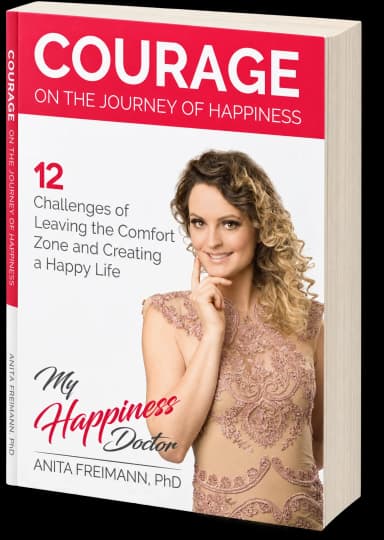
Free preview of my book
Courage on the Journey of Happiness
Get the whole introduction free: how to use the book, who it is for, and my own story of why I wrote it, plus the full table of contents with all twelve challenges. This article grows out of one of them, True Partnership.
Sources
- 1.Hazan, C., & Shaver, P. (1987). Romantic love conceptualized as an attachment process. Journal of Personality and Social Psychology, 52(3), 511–524. doi.org/10.1037/0022-3514.52.3.511
- 2.Fraley, R. C. A Brief Overview of Adult Attachment Theory and Research. University of Illinois at Urbana-Champaign. labs.psychology.illinois.edu/~rcfraley/attachment.htm
- 3.Fraley, R. C., & Roisman, G. I. (2019). The development of adult attachment styles: Four lessons. Current Opinion in Psychology, 25, 26–30. doi.org/10.1016/j.copsyc.2018.02.008
- 4.Laurenceau, J.-P., Barrett, L. F., & Pietromonaco, P. R. (1998). Intimacy as an interpersonal process: The importance of self-disclosure, partner disclosure, and perceived partner responsiveness in interpersonal exchanges. Journal of Personality and Social Psychology, 74(5), 1238–1251. doi.org/10.1037/0022-3514.74.5.1238
- 5.Ury, L. Want to Improve Your Relationship? Start Paying More Attention to Bids. The Gottman Institute (2019, updated 2026). www.gottman.com/blog/want-to-improve-your-relationship-start-paying-more-attention-to-bids/
- 6.Driver, J. L., & Gottman, J. M. (2004). Daily marital interactions and positive affect during marital conflict among newlywed couples. Family Process, 43(3), 301–314. doi.org/10.1111/j.1545-5300.2004.00024.x
- 7.Wiebe, S. A., & Johnson, S. M. (2016). A review of the research in emotionally focused therapy for couples. Family Process, 55(3), 390–407. doi.org/10.1111/famp.12229
- 8.Christensen, A., & Heavey, C. L. (1990). Gender and social structure in the demand/withdraw pattern of marital conflict. Journal of Personality and Social Psychology, 59(1), 73–81. doi.org/10.1037/0022-3514.59.1.73
This article is for education and reflection and is not a substitute for professional help.

About Anita
Anita Freimann, PhD, the Happiness Doctor, holds a doctorate in the economics of happiness and spent more than 16 years at the Faculty of Economics in Osijek. She is the author of Courage on the Journey of Happiness and the creator of Permission for Life.
More about Anita