Healthy selfishness
Me Time: Why It Isn't Selfish and How to Find It When You Have No Time
You don't need a free weekend to come back to yourself. Here's what me time really is, why it isn't selfish, what research says, and ideas for five minutes, an hour or a whole day.

Anita Freimann, PhD · The Happiness Doctor
7 min read
In this article
- What is me time? The real meaning
- Signs you need more me time
- Is me time selfish?
- What happiness research says about me time
- How to make time for yourself when you have none: six gentle steps
- Me time ideas for five minutes, an hour or a day
- Me time for mothers: you are not taking anything from your children
- Questions readers ask
Have you noticed how often we say we don't have time? It has become almost fashionable. In my book I wrote that today it's practically embarrassing to have time: if you admit it, people look at you as if you were worth less, as if you weren't joining in the general fuss about how busy everyone is.
A friend of mine once put it simply. We spend about eight hours a day sleeping and eight working, so there are still eight left to do with as we please. For many women those hours are full of children, parents, laundry and the commute. But I also noticed that most people wouldn't know what to do with free time anyway, because they rarely ask themselves what they want. So “I don't have time” is often less a fact than a comfortable excuse that keeps us in the zone of fear and procrastination. I don't say that to blame you. I say it because an excuse, unlike a fact, can be changed.
In my book Courage on the Journey of Happiness, finding time for yourself belongs to the very first challenge, because I see it as the condition for any change. Me time is the everyday practice of healthy selfishness: taking your needs seriously enough to give them a place in your day.
What is me time? The real meaning
Me time is time you set aside for yourself, away from work, family and other obligations, to do something you enjoy, or nothing at all. That is the dictionary meaning. The real one is deeper: it is time in which nobody needs anything from you. A walk, a book, a bath, a nap, a hobby. What makes it me time isn't the activity. It is that you chose it.
Signs you need more me time
You might recognise yourself in a few of these:
- you feel guilty sitting down while anything in the house is still undone
- the only time you are alone is in the car or the bathroom
- you snap at the people you love over small things
- when someone asks what you enjoy, you need a long time to answer
- you scroll late at night because it's the only time nobody needs you
Is me time selfish?
No. Selfishness takes something that belongs to others. Me time takes nothing from anyone; it simply stops you from giving yourself away until nothing is left. When you are rested and more yourself, the people around you don't get a smaller share of you. They get a better one.
Guilt will come, especially if you were raised to believe that a good woman is always available. Take the time anyway. If you doubt you deserve it at all, start with how to love yourself. Often the price of an hour for yourself is one clear no to someone else, a skill that deserves its own article.
In order to be good to others, you have to be good to yourselves first.
What happiness research says about me time
As an economist who has spent many years studying happiness, I find it telling that researchers now speak of time poverty. Laura Giurge, Ashley Whillans and Colin West point out that while the world has grown richer, most people still feel persistently short of time, and that this feeling is linked to lower well-being1. In an earlier study with samples from four countries, only about 28% of people spent money each month to buy themselves time, such as paying for a task they disliked, although doing so went together with greater life satisfaction2.
What happens when you are simply alone? Thuy-vy Nguyen, Richard Ryan and Edward Deci asked university students to sit by themselves for 15 minutes, with no phone and nothing to do. Strong feelings, pleasant and unpleasant, settled; people felt calmer, though sometimes lonelier. When people were alone because they wanted to be, solitude brought relaxation and less stress3.
Netta Weinstein and her colleagues followed 178 adults in the UK and the US, average age 47, for three weeks. On days with more time alone, people felt less stressed and freer to be themselves, but also lonelier and less satisfied with the day. When the time alone was freely chosen, those costs shrank or disappeared, and there was no ideal amount that suited everyone4. In a study of 2,035 people, from teenagers to adults aged 35 to 55 and older adults, feeling free from pressure and connected to yourself in solitude mattered at every age, and more so with age5.
And how you use free time may matter more than how much you have. Lauren Kuykendall, Louis Tay and Vincent Ng combined studies of 11,834 people and found a moderate link between leisure and well-being; how often and how varied people's leisure was mattered more than the total time spent on it6. These are mostly links, not proof of cause, but the message is kind to busy women: small, regular moments count.
How to make time for yourself when you have none: six gentle steps
You will rarely find me time lying around. You make it, the way you make room in a full wardrobe: by taking something out first.
- Catch the sentence “I don't have time”. For one week, finish it honestly each time: I don't have time for this, because I chose that. Sometimes the choice is right; sometimes it is only a habit.
- Look for hidden time on your screens. In my book I asked readers who feel they have no time to think about their hours in front of the television, computer and phone. My own time came from two places: fewer screens and an earlier alarm.
- Put yourself in the calendar. Write your me time down like any appointment, with your name on it. What isn't planned disappears first.
- Start smaller than you think. Five minutes you actually take are worth more than a free afternoon you keep postponing.
- Buy back an hour if you can. Pay for one task you dislike and spend the hour you gain on yourself, not on more work. If money is tight, trade with a friend: you take her children on Saturday morning, she takes yours on Sunday.
- Choose it, don't just wait for it. Time alone that is forced on you can feel lonely; time you choose tends to feel restful. Say it to yourself and to the people around you: this hour is mine.
Me time ideas for five minutes, an hour or a day
Me time doesn't have to be a spa weekend. Pick what fits the time you really have and what fills you, not what looks good in a photo.
If you have five minutes:
- drink your coffee sitting down, by a window, without your phone
- read two or three pages of a book while the washing machine finishes; page by page, it becomes a whole book
- step outside and look at the sky before you go back in
- put on one song you love and really listen to it
If you have an hour:
- walk with no destination and no podcast
- sit alone in a café with a pastry and a book
- take a bath with the door closed and your phone in another room
- go back to something you loved as a girl: drawing, dancing, singing, an instrument
If you have a day:
- take a train or a bicycle somewhere you have never been
- spend the morning in nature and the afternoon doing nothing at all
- wander through a museum or a market at your own pace
- plan a day with no plan, and notice what you want when nobody asks you for anything
Me time for mothers: you are not taking anything from your children
Mothers often feel the guilt most. But children learn from what we do. When they see you read, rest or close the door for half an hour, they learn that a grown woman is allowed to have needs, and that love doesn't mean disappearing. In practice, it means sharing the load: agree with your partner, a grandparent or another mother on fixed times that belong to each of you. If you parent alone, start with the minutes after bedtime, before you reach for the phone.
Me time is not a reward you earn once everything else is done, because everything else is never done. It is a small daily yes to yourself, and the place where you begin to notice what you actually want. Once you have that time, the next step is to be fully there in it, which is what living in the present moment is about. And if you'd like support in giving yourself this permission week after week, my twelve-week programme Permission for Life is built around exactly that.
Questions readers ask
What does “me time” mean in a relationship?
Each partner has some time of their own, alone or with their own friends and interests, and it isn't a sign that something is wrong. Asking for it is not a rejection. Talk about it openly and agree on regular times, rather than taking it secretly or not at all.
How much me time do I need?
There is no single number. In large American surveys, well-being rose with free time up to roughly two hours a day, stayed high up to about five and then dipped, mostly when people felt their time wasn't worthwhile7. That counts all free time, not only time alone. If you have almost none, start with minutes.
What is another way to say “me time”?
Time to yourself, personal time, alone time or, more formally, solitude. They are not quite the same: solitude means being alone, while me time can also be a dance class, as long as you chose it for yourself.
Is it normal to want a lot of time alone?
Yes. People differ, and in one diary study those who generally spent more time alone were not lonelier overall4. But if you are withdrawing from everyone, losing interest in things you used to enjoy or feeling low for weeks, please talk to a doctor or a mental health professional.
Is scrolling on my phone me time?
It can feel like it, but it rarely fills you. Scrolling is often escaping rather than resting, and an hour can vanish without a single memory. Try a simple test: afterwards, do you feel more like yourself, or less? Keep what passes.
Your turn
Take five quiet minutes with a notebook and answer honestly:
- When did I last spend an hour that belonged only to me, and how did I feel afterwards?
- Whose needs do I meet before my own without even noticing?
- What did I love doing before life became this full, and which small piece of it is still possible?
Did this article speak to you? I’d love to hear what you noticed, what you tried, or what you’re still struggling with. Write to me at anita [at] anitafreimann [.] com. I read every message.
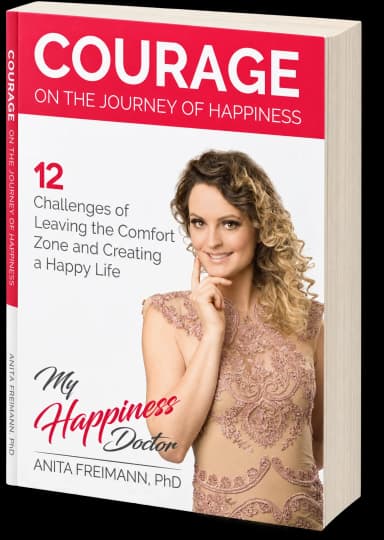
Free preview of my book
Courage on the Journey of Happiness
Get the whole introduction free: how to use the book, who it is for, and my own story of why I wrote it, plus the full table of contents with all twelve challenges. This article grows out of one of them, Healthy Selfishness and the Present Moment.
Sources
- 1.Giurge, L. M., Whillans, A. V., & West, C. (2020). Why time poverty matters for individuals, organisations and nations. Nature Human Behaviour, 4(10), 993–1003. doi.org/10.1038/s41562-020-0920-z
- 2.Whillans, A. V., Dunn, E. W., Smeets, P., Bekkers, R., & Norton, M. I. (2017). Buying time promotes happiness. Proceedings of the National Academy of Sciences, 114(32), 8523–8527. doi.org/10.1073/pnas.1706541114
- 3.Nguyen, T. T., Ryan, R. M., & Deci, E. L. (2018). Solitude as an approach to affective self-regulation. Personality and Social Psychology Bulletin, 44(1), 92–106. doi.org/10.1177/0146167217733073
- 4.Weinstein, N., Vuorre, M., Adams, M., & Nguyen, T. (2023). Balance between solitude and socializing: Everyday solitude time both benefits and harms well-being. Scientific Reports, 13, 21160. doi.org/10.1038/s41598-023-44507-7
- 5.Weinstein, N., Nguyen, T., & Hansen, H. (2021). What time alone offers: Narratives of solitude from adolescence to older adulthood. Frontiers in Psychology, 12, 714518. doi.org/10.3389/fpsyg.2021.714518
- 6.Kuykendall, L., Tay, L., & Ng, V. (2015). Leisure engagement and subjective well-being: A meta-analysis. Psychological Bulletin, 141(2), 364–403. doi.org/10.1037/a0038508
- 7.Sharif, M. A., Mogilner, C., & Hershfield, H. E. (2021). Having too little or too much time is linked to lower subjective well-being. Journal of Personality and Social Psychology, 121(4), 933–947. doi.org/10.1037/pspp0000391
This article is for education and reflection and is not a substitute for professional help.

About Anita
Anita Freimann, PhD, the Happiness Doctor, holds a doctorate in the economics of happiness and spent more than 16 years at the Faculty of Economics in Osijek. She is the author of Courage on the Journey of Happiness and the creator of Permission for Life.
More about Anita