Inner freedom
How to Forgive Yourself Without Letting Yourself Off the Hook
Forgiving yourself isn't pretending it didn't matter. It's taking honest responsibility and then putting the stone down. Here's why it's so hard, what research says, and seven gentle steps to begin.

Anita Freimann, PhD · The Happiness Doctor
7 min read

In this article
- What does it mean to forgive yourself?
- Signs you haven't forgiven yourself
- Why can't I forgive myself?
- I am sorry, please forgive me, I love you, thank you
- What happiness research says about forgiving yourself
- How to forgive yourself for past mistakes: seven gentle steps
- How to forgive yourself for hurting someone
- Questions readers ask
Years ago, in a period when I had it all, even a child, and yet something just did not add up, I came across a practice that is still one of the simplest I know. All you do is say four short sentences, as often as you can: I am sorry, please forgive me, I love you, thank you. It was the simplicity that attracted me. The words reminded me of the little phrases we all learned as children: please, thank you, here you are, sorry. I still say them today, often as soon as I open my eyes in the morning, and during the day whenever my mind starts to wander, while I cook, walk or shower.
Read slowly, those four sentences hold the whole road of self-forgiveness: an honest “I am sorry”, a humble “please forgive me”, and only then the kindness of “I love you” and “thank you”. Most of us either rush straight to the end, or never get past the beginning.
In my book Courage on the Journey of Happiness, this practice belongs to the challenge about spiritual techniques. Here I want to use it for one of the hardest things many of us ever do: forgiving ourselves.
What does it mean to forgive yourself?
Forgiving yourself means fully admitting that you did something wrong, and then choosing to stop punishing yourself for it, so that you can repair what you can and live by your values again. It is not pretending it didn't matter. It lies between two easier roads: endless self-punishment and quickly letting yourself off the hook. If what weighs on you is mostly what someone else did to you, start with how to let go of the past, where I write about forgiving others.
Signs you haven't forgiven yourself
You might recognise yourself in a few of these:
- you replay what you did, years later, as if one more replay could change the ending
- you punish yourself in small ways: no rest, no treats, no joy until you have somehow paid
- you keep apologising for the same thing, long after the other person has moved on
- you have told yourself it was no big deal, and yet it still stings whenever it comes up
- one mistake has quietly become your identity: a bad mother, a bad friend, a bad person
Why can't I forgive myself?
Often because we learned that feeling bad is the price of being good. If I stop punishing myself, the fear goes, it means I don't care, or I'll do it again. Many women also carry a lifetime of feeling not quite enough as a mother, a daughter or a partner, so every new mistake lands on an old bruise.
It also matters what exactly you are carrying. Psychologist June Tangney and her colleagues describe the difference between guilt and shame as a difference of focus: guilt is about what you did, shame is about who you are1. Guilt tends to move people towards apologising and repairing; shame tends to push them to hide, deny or defend themselves. Guilt turns harmful mainly when it fuses with shame. So ask gently: do you regret an action, or have you started condemning your whole self? And if guilt or shame feels overwhelming, or is tied to trauma, please don't carry it alone: a qualified therapist can help in ways no article can.
I am sorry, please forgive me, I love you, thank you
In my book I wrote that the key to those four sentences is taking responsibility for your life. Saying the words is easy. Living what they ask of you is not.
Although this concept is not easy to accept, let alone live, the technique itself is, fortunately, one of the easiest to practice.
For self-forgiveness I would add one thing: responsibility for your part, not for everything. Not for what other people chose to do, and not for what you couldn't have known then. “I am sorry” names your part honestly. “Please forgive me” asks for forgiveness where you can, from the person you hurt and from yourself. “I love you” is the acceptance that remains after that honest look. And “thank you” is for the lesson, and for the chance to live differently.
What happiness research says about forgiving yourself
As an economist who has spent many years studying happiness, I find it telling that research draws the same line. In two studies that followed people after they had hurt someone, Lydia Woodyatt and Michael Wenzel separated three ways of treating yourself: self-punishment, pseudo self-forgiveness, where you feel fine by playing down what you did, and genuine self-forgiveness, which means working through what happened, taking responsibility and accepting yourself while admitting the failure2. Only genuine self-forgiveness went with good outcomes, both for the person who did wrong and for the person they had hurt. Self-punishment and pseudo self-forgiveness brought no such benefit.
The title of an earlier paper says it plainly: no genuine self-forgiveness without accepting responsibility. Michael Wenzel, Lydia Woodyatt and Kyli Hedrick found that owning a wrongdoing usually made people think less of themselves, which is exactly why we are tempted to play it down. But that link softened when people reaffirmed the values they had broken, for example by confessing to the person they had wronged3.
Combining 65 samples with nearly 18,000 people, Don Davis and his colleagues found that people who forgive themselves more easily tend to report better psychological well-being4. It is a correlation, so it can't show what comes first. And forgiving yourself doesn't make you careless. When Michael Wohl, Timothy Pychyl and Shannon Bennett followed first-year students through two rounds of exams, those who forgave themselves for putting off revision the first time tended to procrastinate less the second time, apparently because they carried less negative emotion forward5. The link showed up mainly among students who had procrastinated a lot.
How to forgive yourself for past mistakes: seven gentle steps
Counselling psychologists Marilyn Cornish and Nathaniel Wade describe self-forgiveness in four parts: responsibility, remorse, restoration and renewal6. It is remarkably close to those four sentences. These are the steps I suggest.
- Name what you did, exactly. One or two sentences, without shrinking it or blowing it up. “I said something cruel to my sister” is honest. “I'm a terrible person” is shame talking.
- Take responsibility for your part, and only your part. Write down what was yours, and separately what belonged to other people or to circumstances you didn't choose.
- Let the regret be felt. Give it a few honest minutes. It is a feeling to move through, not a sentence to serve.
- Repair what you can. Apologise without excuses and change what needs changing. If contact isn't possible or would hurt the other person, repair indirectly: write the letter you won't send, or do something kind in the same spirit.
- Ask what this mistake says about your values. Regret points to what you care about. Write one sentence about how you want to act next time, and let that sentence, not the memory, guide you.
- Say the four sentences to yourself. “I am sorry. Please forgive me. I love you. Thank you.” Silently or aloud, as often as you need, especially when the old self-blame returns.
- Decide again when the memory comes back. It will. Self-blame is an old pattern, and like any pattern it can change with practice. Each time, remind yourself that you have done your part, and come back to today.
How to forgive yourself for hurting someone
When someone else was hurt, self-forgiveness naturally takes longer. Their pain is real, and you can't decide how long they need. What you can do is apologise sincerely, without “but”, and respect their answer, including distance. Forgiving yourself doesn't depend on their forgiveness. It depends on whether you have honestly done your part.
Forgiving yourself also doesn't mean you will never feel sad about it. It means the sadness no longer decides who you are. The person you hurt gains nothing from your endless self-punishment, but may gain a great deal from the kinder, more careful person you become.
Self-forgiveness is rarely one big moment. It is a decision you make again and again, and it is easier with people around you who are learning the same. That is the work we do in my programme Permission for Life. And when you are ready for the next step, from forgiving yourself to genuinely liking the person you are, read how to love yourself. Four short sentences, and you are allowed to say every one of them to yourself.
Questions readers ask
Can you forgive yourself for something unforgivable?
Some things can't be undone, and forgiving yourself doesn't say they were acceptable. It means you stop adding daily self-punishment to a harm that has already happened, and put that energy into repair and into living differently. With something this heavy, a therapist can be a real support.
How do I forgive myself for cheating?
Start with full honesty with yourself about what you did, without blaming your partner. Take responsibility, respect your partner's feelings and choices, and decide who you want to be from now on. Whether and how to talk about it is a serious decision; a couples or individual therapist can help you think it through.
What if the person I hurt won't forgive me?
Their forgiveness is theirs to give, and you can't demand it. You can apologise sincerely, repair what you can and respect their distance. Your self-forgiveness doesn't depend on their answer, but on whether you have honestly done your part.
How long does it take to forgive yourself?
There is no fixed timeline. Small mistakes can soften in days; bigger ones may return for years, on anniversaries or in similar situations. Each time, you decide again. What matters is that the memory weighs a little less this year than last.
Is there a good book on how to forgive yourself?
Look for a book that gives you practice, not only insight. I wrote Courage on the Journey of Happiness as twelve challenges, and forgiveness, of yourself and of others, runs through several of them. You can read the introduction free.
Your turn
Take five quiet minutes with a notebook and answer honestly:
- What am I still punishing myself for, and what would change in my days if I stopped?
- When I think of it, do I feel guilt about something I did, or shame about who I am?
- What does this regret tell me about what I truly value?
Did this article speak to you? I’d love to hear what you noticed, what you tried, or what you’re still struggling with. Write to me at anita [at] anitafreimann [.] com. I read every message.
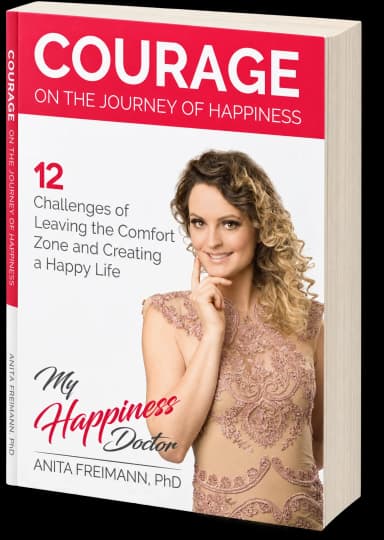
Free preview of my book
Courage on the Journey of Happiness
Get the whole introduction free: how to use the book, who it is for, and my own story of why I wrote it, plus the full table of contents with all twelve challenges. This article grows out of one of them, Practice of Spiritual Techniques – Raising Vibrations.
Sources
- 1.Tangney, J. P., Stuewig, J., & Mashek, D. J. (2007). Moral emotions and moral behavior. Annual Review of Psychology, 58, 345–372. pmc.ncbi.nlm.nih.gov/articles/PMC3083636/
- 2.Woodyatt, L., & Wenzel, M. (2013). Self-forgiveness and restoration of an offender following an interpersonal transgression. Journal of Social and Clinical Psychology, 32(2), 225–259. doi.org/10.1521/jscp.2013.32.2.225
- 3.Wenzel, M., Woodyatt, L., & Hedrick, K. (2012). No genuine self-forgiveness without accepting responsibility: Value reaffirmation as a key to maintaining positive self-regard. European Journal of Social Psychology, 42(5), 617–627. doi.org/10.1002/ejsp.1873
- 4.Davis, D. E., Ho, M. Y., Griffin, B. J., Bell, C., Hook, J. N., Van Tongeren, D. R., DeBlaere, C., Worthington, E. L., Jr., & Westbrook, C. J. (2015). Forgiving the self and physical and mental health correlates: A meta-analytic review. Journal of Counseling Psychology, 62(2), 329–335. doi.org/10.1037/cou0000063
- 5.Wohl, M. J. A., Pychyl, T. A., & Bennett, S. H. (2010). I forgive myself, now I can study: How self-forgiveness for procrastinating can reduce future procrastination. Personality and Individual Differences, 48(7), 803–808. doi.org/10.1016/j.paid.2010.01.029
- 6.Cornish, M. A., & Wade, N. G. (2015). A therapeutic model of self-forgiveness with intervention strategies for counselors. Journal of Counseling & Development, 93(1), 96–104. doi.org/10.1002/j.1556-6676.2015.00185.x
This article is for education and reflection and is not a substitute for professional help.

About Anita
Anita Freimann, PhD, the Happiness Doctor, holds a doctorate in the economics of happiness and spent more than 16 years at the Faculty of Economics in Osijek. She is the author of Courage on the Journey of Happiness and the creator of Permission for Life.
More about Anita