Happiness science
Eudaimonia: What Aristotle Meant by a Happy Life, and How to Live It Today
You can have a comfortable, pleasant life and still feel that something essential is missing. The ancient Greeks had a word for it. Here's what eudaimonia really means, what research says about it, and seven gentle ways to live it.

Anita Freimann, PhD · The Happiness Doctor
7 min read

In this article
- What is eudaimonia? Meaning and definition
- What did Aristotle mean by eudaimonia?
- Hedonic vs eudaimonic happiness: what's the difference?
- Happiness is never outside of us
- What happiness research says about eudaimonic well-being
- How to live a eudaimonic life: seven gentle steps
- What are examples of eudaimonia in everyday life?
- Questions readers ask
In my book I ask a question that still fascinates me: do the things that make us happy today match what made people happy 200 years ago, or before Christ? My parents' generation was delighted by walnuts on the Christmas tree. We have washing machines, cars and phones, so logically we should be far happier. And yet, as I wrote in the book, it isn't so.
That kind of question would not have surprised Aristotle. As I remind readers, for him philosophy began with a question, with human curiosity about everything and the attempt to make sense of life. More than 2,300 years ago he asked what a good human life really is, and his answer had a name: eudaimonia.
In my book Courage on the Journey of Happiness, questions like this are where every change begins. For the practical, everyday map, start with how to be happy. Here we go one layer deeper.
What is eudaimonia? Meaning and definition
The word joins the Greek eu, well, and daimon, divinity or spirit, although Aristotle himself made little of that origin1. It is usually translated as happiness, but often also as flourishing or well-being, because in English happiness sounds like a feeling, and eudaimonia isn't one.
A simple definition: eudaimonia is living well and doing well across a whole life, by using and developing the best in you. It asks not how you feel this afternoon, but whether your life is a good one, and truly yours.
What did Aristotle mean by eudaimonia?
In the Nicomachean Ethics, Aristotle starts from something we all recognise. Almost everyone, he says, calls the highest good happiness and treats “living well” and “doing well” as being happy. The trouble starts with what it consists of: pleasure, wealth or honour, and the same person calls it health when ill and wealth when poor2. His own answer has four surprisingly modern parts:
- It is the one thing we want for its own sake. We want pleasure, recognition and money at least partly because we hope they will make us happy; nobody wants happiness for the sake of something else.
- It is an activity, not a mood. Happiness, for Aristotle, is virtuous activity: doing what humans do, and doing it well1.
- It takes a whole life. In D. P. Chase's 19th-century translation, “it is not one swallow or one fine day that makes a spring”, and one good day doesn't make a happy life.
- It needs some outside support. Without friends, money and some influence, he says, it is impossible, or at least not easy, to do noble things.
Notice what is missing from that list: a feeling. That is the heart of the difference.
Hedonic vs eudaimonic happiness: what's the difference?
In happiness vs joy I describe the two traditions of well-being research in brief: the hedonic, about pleasure and avoiding pain, and the eudaimonic, about meaning and self-realisation3. Here is the part that is easy to miss: the difference often lies not in what you do, but why you do it.
Psychologists Veronika Huta and Richard Ryan defined hedonia as seeking pleasure and comfort, and eudaimonia as seeking to use and develop the best in yourself. Different people can have very different motives for the same activity, and some, like playing a musical instrument, can be high in both4. A walk can be a rest or a promise kept to yourself. Often it is both.
Happiness is never outside of us
In my book, when I describe a meaningful life, contributing to something bigger than yourself, loving and serving other people and trying to leave the world a little better than you found it, I admit that I found myself in it. It explains why I needed to write the book at all: to motivate people and to pass on what I know.
The other half was harder for me: a good life is built from the inside, from how you use what you have, not from what you collect. As I admit in the book, I had a hard time accepting that, but it doesn't make it any less true.
We should keep in mind that happiness is never outside of us.
This is not an argument against comfort; Aristotle himself wanted friends and enough money in a happy life. It is an argument against expecting outside things to do the inside work. If you long for clearer direction, how to find your purpose in life is a good next step.
What happiness research says about eudaimonic well-being
As an economist who has spent many years studying happiness, I find it remarkable how much of Aristotle has returned to science. In 1989 psychologist Carol Ryff argued that the reigning measures of well-being had little theory behind them and proposed six dimensions: self-acceptance, positive relations with others, autonomy, environmental mastery, purpose in life and personal growth. In 321 young, middle-aged and older adults, positive relations, autonomy, purpose and growth were not strongly tied to older measures such as life satisfaction5. Feeling satisfied and living fully are related, but not the same.
The field has grown fast, and not always tidily. Huta and Alan Waterman showed that researchers define eudaimonia as an orientation (values, motives, goals), a behaviour, an experience or a way of functioning, and that findings based on different definitions can be quite discrepant6. So when you read that eudaimonia does this or that, ask which eudaimonia was measured.
The most practical finding, for me, is about time. In an experiment by Huta and Ryan, 114 university students added at least one pleasure-seeking or one eudaimonic activity of their own choice to each day for ten days. The pleasure group felt more positive and carefree straight away. Only the eudaimonic group gained in meaning by the end, and three months later it reported more vitality, more inspiring experiences and fewer negative feelings, though not higher life satisfaction. The authors concluded that combining both pursuits may go with the greatest well-being. One student sample settles nothing, but it echoes Aristotle's swallow: flourishing works on a longer clock.
In my own field, eudaimonia has entered official statistics. Since April 2011 the UK Office for National Statistics has asked people, from 0 to 10, how far the things they do in life feel worthwhile, and calls this its eudemonic question, next to life satisfaction, happiness and anxiety7. Aristotle would have liked that.
How to live a eudaimonic life: seven gentle steps
You don't need to move to a Greek island to flourish. Eudaimonia grows from ordinary choices, repeated over seasons. These are the steps I suggest.
- Ask Aristotle's question about your week. Look at your calendar: what do you do only as a means to something else, and what is worth doing for its own sake? Every week needs some of the second kind.
- Check the why, not just the what. Before your next free hour, ask whether you want rest and pleasure or growth and meaning. Both are legitimate; knowing which you are choosing changes how you spend it.
- Use one strength on purpose. Name something you do well and care about, such as listening, teaching or making things beautiful, and use it deliberately once this week.
- Grow a little beyond your edge. Choose something slightly above your current skill: a language lesson, a difficult conversation, a first draft.
- Invest in people as well as projects. Aristotle counted friends among the things a good life needs. One honest, unhurried conversation is a eudaimonic act.
- Make one choice by your own measure. Autonomy means living by what you think is important, not by what others expect. Make one small decision this week by your own values.
- Judge by seasons, not single days. One swallow doesn't make a spring, and one bad day doesn't make a bad life. Once a month, ask the worthwhile question from 0 to 10, and choose one change.
What are examples of eudaimonia in everyday life?
Eudaimonia rarely looks dramatic. It looks like a woman of 45 learning the piano, badly and gladly. A manager helping a younger colleague find her feet. A neighbour planting olive trees she may never see fully grown. A friend who says the honest thing, kindly.
None of these is pleasant every minute. Learning is clumsy and olive trees grow slowly. But each uses and develops the best in a person, and that is eudaimonic happiness: not a peak of feeling, but a life well used.
Eudaimonia isn't something you achieve once and frame on the wall. You practise it, question by question, and it is easier in good company. That is the work we do together in my programme Permission for Life. Aristotle called it living well and doing well. I call it giving yourself permission.
Questions readers ask
How do you pronounce eudaimonia?
In English it is usually pronounced yoo-dih-MOH-nee-uh, with the stress on MOH (/ˌjuːdɪˈməʊnɪə/). You will also see the older spelling eudaemonia.
Is eudaimonia the same as happiness?
Not quite. In everyday English, happiness usually means a good feeling; eudaimonia is closer to a good life, flourishing over time. A eudaimonic life holds plenty of happy moments, but also hard days spent on something that matters to you.
What is the opposite of eudaimonia?
There is no single agreed opposite, but in psychology the closest idea is languishing. Corey Keyes described mental health as a continuum from languishing to flourishing; in his study of 3,032 American adults aged 25 to 74, 17.2% met his criteria for flourishing and 12.1% for languishing8. If life has felt empty for weeks, please talk to a doctor or a mental health professional.
Do you need a calling to live a eudaimonic life?
No. As I write in my book, it is not necessary to feel a calling or even to have a career. What matters is that what you do lets you feel good and at peace with yourself. Eudaimonia lives in how you do things, not in a job title.
Is eudaimonia selfish?
Not in Aristotle's sense. When he calls happiness self-sufficient, he means enough not for someone living alone, but with parents, children, a partner, friends and fellow citizens, because humans are social by nature2. Taking your own flourishing seriously is healthy selfishness: it gives you something to share.
Your turn
Take five quiet minutes with a notebook and answer honestly:
- What do I do purely for its own sake, and when did I last give it real time?
- Which part of me, a talent, a value or a way of caring for others, have I been keeping in a drawer?
- If I look at this past year as a whole, not at a single day, what made it feel worthwhile?
Did this article speak to you? I’d love to hear what you noticed, what you tried, or what you’re still struggling with. Write to me at anita [at] anitafreimann [.] com. I read every message.
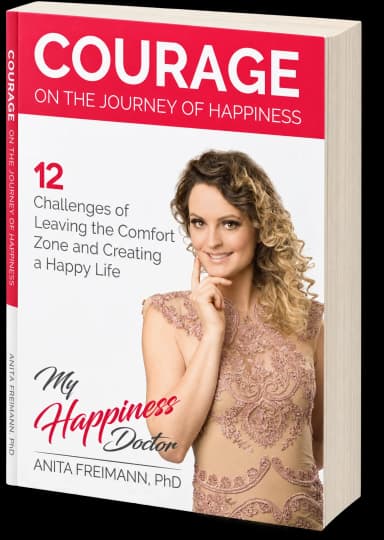
Free preview of my book
Courage on the Journey of Happiness
Get the whole introduction free: how to use the book, who it is for, and my own story of why I wrote it, plus the full table of contents with all twelve challenges. This article grows out of one of them, Do What You Love.
Sources
- 1.Kraut, R. (2026). Aristotle's Ethics. In E. N. Zalta & U. Nodelman (Eds.), The Stanford Encyclopedia of Philosophy (substantive revision 11 August 2026). plato.stanford.edu/entries/aristotle-ethics/
- 2.Aristotle. The Nicomachean Ethics, Book I (trans. D. P. Chase; Everyman's Library edition with an introduction by J. A. Smith). Project Gutenberg eBook #8438. www.gutenberg.org/ebooks/8438
- 3.Ryan, R. M., & Deci, E. L. (2001). On happiness and human potentials: A review of research on hedonic and eudaimonic well-being. Annual Review of Psychology, 52, 141–166. doi.org/10.1146/annurev.psych.52.1.141
- 4.Huta, V., & Ryan, R. M. (2010). Pursuing pleasure or virtue: The differential and overlapping well-being benefits of hedonic and eudaimonic motives. Journal of Happiness Studies, 11(6), 735–762. doi.org/10.1007/s10902-009-9171-4
- 5.Ryff, C. D. (1989). Happiness is everything, or is it? Explorations on the meaning of psychological well-being. Journal of Personality and Social Psychology, 57(6), 1069–1081. doi.org/10.1037/0022-3514.57.6.1069
- 6.Huta, V., & Waterman, A. S. (2014). Eudaimonia and its distinction from hedonia: Developing a classification and terminology for understanding conceptual and operational definitions. Journal of Happiness Studies, 15(6), 1425–1456. doi.org/10.1007/s10902-013-9485-0
- 7.Office for National Statistics. Personal well-being user guidance (ONS4 questions, including “worthwhile”). www.ons.gov.uk/peoplepopulationandcommunity/wellbeing/methodologies/personalwellbeingsurveyuserguide
- 8.Keyes, C. L. M. (2002). The mental health continuum: From languishing to flourishing in life. Journal of Health and Social Behavior, 43(2), 207–222. doi.org/10.2307/3090197
This article is for education and reflection and is not a substitute for professional help.

About Anita
Anita Freimann, PhD, the Happiness Doctor, holds a doctorate in the economics of happiness and spent more than 16 years at the Faculty of Economics in Osijek. She is the author of Courage on the Journey of Happiness and the creator of Permission for Life.
More about Anita