Happiness science
The Hedonic Treadmill: Why Good Things Stop Feeling Good, and How to Step Off
You wanted it, you got it, and a few weeks later it felt ordinary. That isn't ingratitude; it's how people are made. Here's what the hedonic treadmill is, why it's also good news, and seven gentle ways to step off.

Anita Freimann, PhD · The Happiness Doctor
7 min read

In this article
- What is the hedonic treadmill?
- Hedonic treadmill examples you will recognise
- Why do we get used to good things so quickly?
- Needs come to an end; desires don't
- Why the hedonic treadmill is also good news
- What happiness research says about the hedonic set point
- How to get off the hedonic treadmill: seven gentle steps
- Are experiences really better than things?
- Questions readers ask
In the part of my book about raising children, there is a short passage on marketing that reaches far beyond children. In the mid-1960s, I wrote, multinational companies shifted from making things according to what consumers needed to producing the needs themselves. Desire took the place of need, and desire, unlike need, has no natural end.
You probably know the pattern from the inside. You long for something, you finally have it, and a few weeks later it is part of the furniture of your life while your attention has moved on. That is not a flaw in your character. Researchers have a name for it: the hedonic treadmill.
In my book Courage on the Journey of Happiness, this passage belongs to the challenge Inspirational Parenting, because the way we want things is one of the first lessons our children learn from us. For the wider map, start with how to be happy.
What is the hedonic treadmill?
The hedonic treadmill is the tendency to return to a fairly stable level of happiness after good or bad events. You run, and you stay roughly where you started. The name comes from a 1971 chapter by psychologists Philip Brickman and Donald Campbell with a telling title, Hedonic Relativism and Planning the Good Society1. The process behind it is called hedonic adaptation: whatever stays the same, or keeps repeating, gradually stops moving us.
Sonja Lyubomirsky, Kennon Sheldon and David Schkade offered an image I like even more: a pedestrian walking up a descending escalator. Better circumstances carry her up; adaptation brings her back2.
Hedonic treadmill examples you will recognise
You don't need a lottery win to feel it:
- the kitchen you dreamed of for years, which now simply needs cleaning
- the pay rise that felt like freedom in March and like an ordinary salary by June
- the promotion, followed within months by a quiet wish for the next one
- the bigger home where you no longer notice the extra light
- the thrilling first months of a new hobby, settling into routine
The most famous example dates from 1978: major lottery winners were no happier than a comparison group and took less pleasure in everyday things3. Newer, larger studies paint a more nuanced picture, which I explain in can money buy happiness.
Why do we get used to good things so quickly?
Kennon Sheldon and Sonja Lyubomirsky describe two routes by which the happiness from a positive change wears away4. First, the change brings fewer fresh moments of joy, because what we fully expect no longer surprises us. Second, our expectations rise: yesterday's gift becomes today's normal, and we want even more.
Adverts, feeds and other people's lives on our screens keep fuelling those rising expectations. Adaptation is also one explanation researchers offer for what economists call the Easterlin paradox: in many nations, rising average incomes have not been matched by rising average well-being4.
Needs come to an end; desires don't
A need can be met: when you are cold and put on a warm coat, the need ends. A desire lives in the mind, and the mind can always picture something newer or better. When a whole economy speaks to our desires instead of our needs, the treadmill speeds up.
When desire replaced the need as the dominant aspect of consumer preoccupation, the activities of consumer society underwent a transformation, because the desires are psychological and inherently limitless.
Wanting is human, and beautiful things can bring real joy. The point is to notice who sets the speed of your treadmill: you, or someone who profits from your next desire.
Why the hedonic treadmill is also good news
Here is the part people often miss: the treadmill runs both ways. The capacity that makes a new home feel ordinary also helps you recover from disappointment. Across six studies, Daniel Gilbert, Timothy Wilson and their colleagues found that people overestimated how long they would feel bad after events such as a romantic break-up, an electoral defeat or rejection by a prospective employer5. They called the helper we overlook the psychological immune system.
Adaptation is not always complete, though. Following more than 24,000 people in Germany over 15 years, Richard Lucas, Andrew Clark and colleagues found that life satisfaction fell sharply with unemployment and then recovered, but on average not all the way, even after people found work again6. So be patient with yourself after a hard blow, and if it still weighs on you months later, talking to a qualified professional is a wise step.
What happiness research says about the hedonic set point
As an economist who has spent many years studying happiness, I find this the most hopeful part. The original model said we always adapt back to emotional neutrality, which would doom every effort to become happier, personal or political. In 2006 Ed Diener, Richard Lucas and Christie Napa Scollon proposed five important revisions7:
- The set point is not neutral: the level we drift back to is not an emotional zero.
- People have different set points, partly shaped by temperament.
- One person can have several set points: pleasant feelings, unpleasant feelings and life satisfaction can move in different directions.
- Set points can change under some conditions, perhaps the most important revision.
- People adapt differently: after the same event, some people's set point shifts and others' doesn't.
The authors saw hope in this for anyone who wants to reduce misery and increase happiness. Your baseline is a starting point, not a life sentence.
How to get off the hedonic treadmill: seven gentle steps
You can't switch adaptation off, and you wouldn't want to. But you can slow it down for the good things. In a three-month study of 481 students, Sheldon and Lyubomirsky found support for two brakes: continuing to appreciate a positive change, and experiencing it with variety. To appreciate, as they describe it, is to savour something, feel grateful for it and recognise that you might never have had it, or might lose it.
- Notice the moment it turns ordinary. When you realise you have stopped noticing something you once longed for, pause. Naming the treadmill is already a step off.
- Savour on purpose. Once a day, stay a few seconds longer with something good: the first sip of coffee, evening light in your kitchen, a message from a friend.
- Vary how you enjoy what you have. Take a different route, rearrange a room, meet a friend somewhere new. Novelty doesn't have to be bought.
- Give something up for a while. Jordi Quoidbach and Elizabeth Dunn had people eat a piece of chocolate in two sessions a week apart. Those randomly asked to give up chocolate in between savoured it more the second time, and were in a better mood afterwards, than those who ate as much as they liked or had no instructions8. A short pause can make an old pleasure new.
- Choose experiences, ideally shared. A concert, a course, a weekend with people you love: experiences tend to become part of your story and your relationships.
- Pause between desire and purchase. Before buying something non-essential, ask: is this a need or a desire, and whose? Wait a few days. If you still want it, enjoy it fully.
- Remember what you would miss. Imagine that one good thing in your life had never happened. Gratitude is a simple way back to what you already have, as I explore in scarcity vs abundance mindset.
Are experiences really better than things?
On average, yes, but less dramatically than headlines suggest. In 2003 Leaf Van Boven and Thomas Gilovich found that people said experiential purchases had made them happier than material ones, perhaps because experiences are more open to positive reinterpretation, become part of who we are and do more for our relationships9.
Good science checks itself. When Evan Weingarten and Joseph Goodman combined 141 studies, the advantage held but was modest, and about a third of it may be due to publication bias, the tendency for striking results to be published more often10. It shrank for experiences that turned out badly, for experiences enjoyed alone and for people with lower socioeconomic status. So don't trade the warm coat for a concert ticket; ask what a purchase will add to your days and relationships.
The treadmill will keep running; that is part of being human. But you can choose your pace and what you run towards. Stepping off, again and again, is how you begin to live by your own measure rather than by desires someone else designed. Learning to want what is truly yours is at the heart of my programme Permission for Life.
Questions readers ask
Is hedonic adaptation the same as the hedonic treadmill?
Almost. Hedonic adaptation is the process: our emotional reaction to a lasting change weakens over time. The hedonic treadmill is the metaphor for the result, running towards happiness while staying in place. The terms are often used interchangeably.
Who came up with the hedonic treadmill?
Psychologists Philip Brickman and Donald Campbell, in a 1971 chapter in a book on adaptation-level theory1. The idea was later revised by Ed Diener and his colleagues.
What is the 50-40-10 rule of happiness?
It comes from a 2005 paper suggesting that about 50% of differences in happiness between people are linked to genes, 10% to circumstances and up to 40% to intentional activity, with circumstances mattering little largely because we adapt to them2. The authors later accepted many critiques of the pie chart and wrote that such effects may be weaker than they believed11. I explain the debate in is happiness a choice.
How long does hedonic adaptation take?
It depends on the event and the person: people differ in how they adapt7, and some events, such as unemployment, can leave a lasting mark6. We get used most readily to what stays constant or keeps repeating.
Can you get off the hedonic treadmill for good?
Not entirely, and that is a blessing, because the same process helps us recover from setbacks. But research suggests appreciation and variety help a positive change lift you for longer4. Think of it as setting your own pace.
Your turn
Take five quiet minutes with a notebook and answer honestly:
- What did I long for a few years ago that I now take for granted?
- Which of my current desires are truly mine, and which were planted by adverts, social media or comparison?
- When did I last feel deeply content without buying or achieving anything?
Did this article speak to you? I’d love to hear what you noticed, what you tried, or what you’re still struggling with. Write to me at anita [at] anitafreimann [.] com. I read every message.
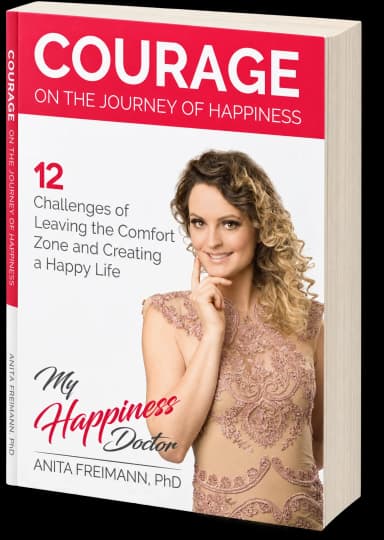
Free preview of my book
Courage on the Journey of Happiness
Get the whole introduction free: how to use the book, who it is for, and my own story of why I wrote it, plus the full table of contents with all twelve challenges. This article grows out of one of them, Inspirational Parenting.
Sources
- 1.Brickman, P., & Campbell, D. T. (1971). Hedonic relativism and planning the good society. In M. H. Appley (Ed.), Adaptation-level theory: A symposium (pp. 287–302). New York: Academic Press. (Record in the World Database of Happiness.) worlddatabaseofhappiness.eur.nl/publications/hedonic-relativism-and-planning-the-good-society-244/
- 2.Lyubomirsky, S., Sheldon, K. M., & Schkade, D. (2005). Pursuing happiness: The architecture of sustainable change. Review of General Psychology, 9(2), 111–131. doi.org/10.1037/1089-2680.9.2.111
- 3.Brickman, P., Coates, D., & Janoff-Bulman, R. (1978). Lottery winners and accident victims: Is happiness relative? Journal of Personality and Social Psychology, 36(8), 917–927. doi.org/10.1037/0022-3514.36.8.917
- 4.Sheldon, K. M., & Lyubomirsky, S. (2012). The challenge of staying happier: Testing the Hedonic Adaptation Prevention model. Personality and Social Psychology Bulletin, 38(5), 670–680. doi.org/10.1177/0146167212436400
- 5.Gilbert, D. T., Pinel, E. C., Wilson, T. D., Blumberg, S. J., & Wheatley, T. P. (1998). Immune neglect: A source of durability bias in affective forecasting. Journal of Personality and Social Psychology, 75(3), 617–638. doi.org/10.1037/0022-3514.75.3.617
- 6.Lucas, R. E., Clark, A. E., Georgellis, Y., & Diener, E. (2004). Unemployment alters the set point for life satisfaction. Psychological Science, 15(1), 8–13. doi.org/10.1111/j.0963-7214.2004.01501002.x
- 7.Diener, E., Lucas, R. E., & Scollon, C. N. (2006). Beyond the hedonic treadmill: Revising the adaptation theory of well-being. American Psychologist, 61(4), 305–314. doi.org/10.1037/0003-066X.61.4.305
- 8.Quoidbach, J., & Dunn, E. W. (2013). Give it up: A strategy for combating hedonic adaptation. Social Psychological and Personality Science, 4(5), 563–568. doi.org/10.1177/1948550612473489
- 9.Van Boven, L., & Gilovich, T. (2003). To do or to have? That is the question. Journal of Personality and Social Psychology, 85(6), 1193–1202. doi.org/10.1037/0022-3514.85.6.1193
- 10.Weingarten, E., & Goodman, J. K. (2021). Re-examining the experiential advantage in consumption: A meta-analysis and review. Journal of Consumer Research, 47(6), 855–877. doi.org/10.1093/jcr/ucaa047
- 11.Sheldon, K. M., & Lyubomirsky, S. (2021). Revisiting the sustainable happiness model and pie chart: Can happiness be successfully pursued? The Journal of Positive Psychology, 16(2), 145–154. doi.org/10.1080/17439760.2019.1689421
This article is for education and reflection and is not a substitute for professional help.

About Anita
Anita Freimann, PhD, the Happiness Doctor, holds a doctorate in the economics of happiness and spent more than 16 years at the Faculty of Economics in Osijek. She is the author of Courage on the Journey of Happiness and the creator of Permission for Life.
More about Anita