Presence
A Simple Morning Routine for Real Life: 5, 15 or 30 Minutes That Are Yours
Your morning doesn't have to start at 5 a.m. or look good on Instagram. It needs a few minutes that belong to you before the day starts asking. Here's what research says about mornings, six gentle steps and a routine for 5, 15 or 30 minutes.

Anita Freimann, PhD · The Happiness Doctor
7 min read

In this article
- What is a morning routine?
- Signs your mornings are running you
- Why are mornings so hard?
- The morning shows the day, but you still choose how to meet it
- What happiness research says about mornings
- How to create a morning routine: six gentle steps
- A simple morning routine for busy women: 5, 15 or 30 minutes
- Questions readers ask
There is a sentence written on my bedroom wall, and I start every day with it: “It's not what happens to you, but how you react to it that matters.” It reminds me of something easy to forget by noon: I can't choose everything the day brings, but I can choose how I meet it.
The line is usually attributed to the Stoic philosopher Epictetus, although these are not his exact words. What he taught, as recorded in the Enchiridion, is very close: people are disturbed not by things, but by the views they take of them1. It is a perfect first thought for a morning, because that is when our view of the day is formed.
In my book Courage on the Journey of Happiness, I write about an old saying: the morning shows the day. What you wake up with tends to colour everything after it. A morning routine is a way of choosing that colour a little more often, instead of leaving it to the alarm, the news and everyone else's needs.
What is a morning routine?
A morning routine is a short sequence of things you do after waking, in roughly the same order, so you don't have to decide each one again. Many routines you see online belong to people with no school run and very good lighting. Yours only has to fit your life.
Signs your mornings are running you
You might recognise yourself in a few of these:
- your hand finds the phone before your eyes are properly open
- you press snooze several times and start the day already late
- the first thing you feel is the list of everything you have to do
- you dress, eat and leave in a rush, and the whole day feels like catching up
- weeks go by without a single morning minute that was only yours
Why are mornings so hard?
Partly because of how we live. Long before alarm clocks, people rose and rested with the sun; today many of us go to bed late, work shifts or answer messages until midnight, and still expect to feel fresh at six. People also differ: some are natural larks, others are owls, and a routine copied from a lark can feel like a punishment to an owl.
And for many women, the morning simply isn't theirs: children, a partner, ageing parents, a commute that starts before the sun. If you have been blaming yourself for not having a perfect routine, please stop; you have been running a household, not failing a habit. And if you wake up with dread or heaviness most mornings for weeks, that is not something a better routine should fix; please talk to your doctor or a mental health professional.
The morning shows the day, but you still choose how to meet it
As I wrote in my book, the last thoughts we take to bed are often the ones we wake up with. So a morning routine really begins the evening before: no screens in the last hour if you can manage it, and going to sleep as calm as you can.
But the morning only shows the day; it doesn't decide it. That is the gift of the sentence on my wall. Even when a morning starts badly, I can still choose the next thought and the next step. A routine doesn't guarantee a good day; it is a small daily rehearsal of that choice.
It is said that the morning shows the day, that is, the first thought creates our day.
What happiness research says about mornings
As an economist who has spent many years studying happiness, I like it when big data and everyday experience agree. Sociologists Scott Golder and Michael Macy analysed 509 million public Twitter messages from 2.4 million people in 84 countries. People tended to wake up in a relatively good mood that wore off as the day went on; on weekends the morning high came about two hours later, which the authors took as a sign that people woke up later2. Why hand those first minutes straight to the inbox?
The mood you start with seems to matter, too. In a call centre study fittingly titled “Waking up on the right or wrong side of the bed”, Nancy Rothbard and Steffanie Wilk found that employees' mood at the start of the working day was linked to how they saw customers' emotions and how they felt after calls, and those feelings were in turn linked to how well they worked3.
What about larks and owls? Psychologists Renée Biss and Lynn Hasher studied 435 younger and 297 older adults in Toronto. In both age groups, people who leaned towards being morning types reported more positive mood, and the older adults were both more morning-oriented and in a better mood4. It was a single snapshot, so it shows a link, not proof that getting up early makes you happier.
A routine is what you do; a ritual is what it means to you. Reviewing research from psychology to anthropology, Nicholas Hobson, Michael Inzlicht and colleagues describe three things rituals seem to help us regulate: our emotions, our readiness to perform and our sense of connection5. So I care less about which activities you choose than about the meaning you give them.
How to create a morning routine: six gentle steps
You don't need a new personality for better mornings, only a few small decisions, repeated until they feel like yours.
- Start the night before. An earlier alarm only helps if you also go to bed earlier, so never take it from your sleep. Each of us knows how much sleep we need; plan your evening around it.
- Pick a time to get up that you can keep. Not the most heroic one. A nearly fixed time for bed and for getting up, most days of the week, turns a few good mornings into a rhythm.
- Give the first minutes to yourself, not your phone. The messages will wait ten minutes. If your phone pulls you in before you're properly awake, my social media detox guide has gentle ways to loosen its grip.
- Begin with one thought you chose. Read a sentence that steadies you, or ask how you want to meet today. Whatever happens later, the first thought was yours.
- Attach it to something you already do. The kettle, the first coffee, brushing your teeth. In a study by Phillippa Lally and colleagues, a new daily behaviour tied to a moment such as breakfast took people anywhere from 18 to 254 days to become automatic, and missing one day did not undo the progress6.
- Keep it small and flexible. Five minutes on hard days, thirty on calm ones. See what works for you, change what doesn't, and don't copy anyone's routine, including mine.
A simple morning routine for busy women: 5, 15 or 30 minutes
Choose the version that fits the day you actually have; some days that is five minutes, and those mornings count too. A mindful morning routine is simply a few minutes of living in the present moment before the day pulls you forward.
- 5 minutes, for the hardest mornings. Before you reach for your phone, sit up, feet on the floor, and take a few slow breaths. Read your sentence. Open the curtains and look outside for a moment. Then ask: what matters most today?
- 15 minutes, for ordinary days. Do the five, then add ten. Move for five: stretch, roll your shoulders, walk round the garden or the block; as I wrote in my book, five minutes of movement is better than none. Then plan for five: three things that matter today and one small thing just for you.
- 30 minutes, for mornings you can protect. Do the fifteen, then add fifteen minutes that feed you: read a book (one small challenge in my book is fifteen minutes of reading a day), listen to a guided meditation, walk outside or write a page with one of these journaling prompts.
A morning routine won't make your life perfect. What it can do is remind you, day after day, that you may begin the day as yourself, not only as everyone's helper. Giving yourself that permission, and keeping it when life gets busy, is the heart of my programme Permission for Life. It starts tomorrow morning, with five minutes that are yours.
Questions readers ask
How long should a morning routine be?
As long as you can keep on an ordinary weekday; for most people with full lives, that means five to thirty minutes. A short routine you repeat beats a long one you abandon.
What does a healthy morning routine look like?
There isn't one best routine. For me, a healthy morning routine protects your sleep, gives you a few quiet minutes before the phone, includes a little movement you enjoy and is short enough to keep. If you live with a health condition, ask your doctor what your mornings need.
Do I have to wake up at 5 a.m.?
No. The idea comes from the 5 a.m. Club, popularised by leadership author Robin Sharma: the first hour of the day is yours, split into twenty minutes of movement, twenty of reflection and planning, and twenty of learning. I wrote about it in my book, and I like the principle more than the exact hour. To try it, start in a season when it gets light early and move your alarm fifteen minutes earlier every week or two, going to bed earlier as you do.
What if I'm not a morning person?
You're in good company. I used to stay up until midnight; by the time I wrote my book I was usually in bed by half past ten, waking at five in summer and seven in winter. Morning types are relatively rare among young adults and more common among older ones4. You don't have to become a lark: build your routine around the time you actually get up.
What if my mornings belong to my children?
Then make your routine shorter, or move it. Some women wake ten minutes before the rest of the house; others take their five minutes after the school run, in the parked car. A calmer start for you often means a calmer breakfast table for everyone.
Your turn
Take five quiet minutes with a notebook and answer honestly:
- What thought do I usually wake up with, and where does it come from?
- Which part of my morning feels like mine, and which part belongs to everyone else?
- How would I like to feel by the time I leave the house, and what is one small thing that would help?
Did this article speak to you? I’d love to hear what you noticed, what you tried, or what you’re still struggling with. Write to me at anita [at] anitafreimann [.] com. I read every message.
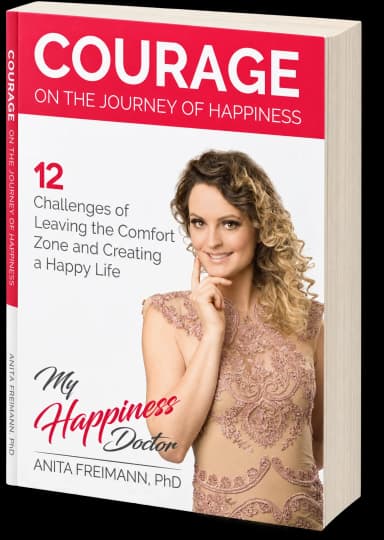
Free preview of my book
Courage on the Journey of Happiness
Get the whole introduction free: how to use the book, who it is for, and my own story of why I wrote it, plus the full table of contents with all twelve challenges. This article grows out of one of them, Caring for the Physical Body.
Sources
- 1.Epictetus. The Enchiridion (trans. T. W. Higginson), chapter 5. Project Gutenberg. www.gutenberg.org/ebooks/45109
- 2.Golder, S. A., & Macy, M. W. (2011). Diurnal and seasonal mood vary with work, sleep, and daylength across diverse cultures. Science, 333(6051), 1878–1881. doi.org/10.1126/science.1202775
- 3.Rothbard, N. P., & Wilk, S. L. (2011). Waking up on the right or wrong side of the bed: Start-of-workday mood, work events, employee affect, and performance. Academy of Management Journal, 54(5), 959–980. doi.org/10.5465/amj.2007.0056
- 4.Biss, R. K., & Hasher, L. (2012). Happy as a lark: Morning-type younger and older adults are higher in positive affect. Emotion, 12(3), 437–441. pmc.ncbi.nlm.nih.gov/articles/PMC3399900/
- 5.Hobson, N. M., Schroeder, J., Risen, J. L., Xygalatas, D., & Inzlicht, M. (2018). The psychology of rituals: An integrative review and process-based framework. Personality and Social Psychology Review, 22(3), 260–284. doi.org/10.1177/1088868317734944
- 6.Lally, P., van Jaarsveld, C. H. M., Potts, H. W. W., & Wardle, J. (2010). How are habits formed: Modelling habit formation in the real world. European Journal of Social Psychology, 40(6), 998–1009. doi.org/10.1002/ejsp.674
This article is for education and reflection and is not a substitute for professional help.

About Anita
Anita Freimann, PhD, the Happiness Doctor, holds a doctorate in the economics of happiness and spent more than 16 years at the Faculty of Economics in Osijek. She is the author of Courage on the Journey of Happiness and the creator of Permission for Life.
More about Anita