Happiness at work
Psychological Safety at Work: Why Good People Stay Silent and How to Change It
Most people don't stay quiet at work because they have nothing to say. They stay quiet because speaking up feels risky. Here's what psychological safety really is, how to recognise it and seven gentle steps for leaders and teams.

Anita Freimann, PhD · The Happiness Doctor
7 min read

In this article
- What is psychological safety?
- Psychological safety is not niceness or comfort
- Psychological safety examples: how to recognise it
- Why do people stay silent at work?
- Acting on your own conscience needs a safe place to land
- What happiness research says about psychological safety at work
- How to create psychological safety at work: seven gentle steps
- Psychological safety in the workplace: what organisations can do
- Questions readers ask
There is one film I always recommend when we talk about authority: Experimenter, from 2015, about the psychologist Stanley Milgram and his experiment on obedience. It doesn't have a particularly tense plot. And yet it is brutal in its own way, because it shows how unwilling most of us are to defy a person above us and act on our own conscience, and how automatically we trust authority. It is so easy to steer people, it seems.
In my book Courage on the Journey of Happiness, that film belongs to the challenge I called Do What You Love, because work is where most of us meet authority every day. For the bigger picture, read how to be happy at work. Here I look at one piece leaders, HR and teams often underestimate: whether people feel safe enough to say what they see.
What is psychological safety?
Psychological safety is a shared belief in a team that it is safe to take interpersonal risks: to ask a “stupid” question, admit a mistake, offer a half-formed idea or say “I think we're wrong”. The idea is older, but Harvard professor Amy Edmondson introduced team psychological safety in 1999. In her study of 51 work teams in a manufacturing company, psychological safety went together with more learning in the team, and that learning helped explain team performance1.
Notice the word shared. It isn't a personality trait. Two teams in the same company can feel completely different, because it is created in daily moments between people.
Psychological safety is not niceness or comfort
This is the most common misunderstanding, because the word safety sounds soft. Edmondson herself has said “it's not about being nice”2. It is about candour: saying the difficult thing, and hearing it, without anyone being humiliated. Nor, she added, is it an invitation to relax or lower expectations.
A team where nobody ever disagrees may feel pleasant, but often people are nice because they don't dare to be honest. Safety and high standards belong together. Safety without standards becomes comfort; standards without safety become fear.
Psychological safety examples: how to recognise it
Edmondson measured psychological safety with seven simple statements, which Google later shared in its guide to team effectiveness3. In everyday life, a safe team looks like this:
- a mistake is not held against the person who made it
- people can bring up problems and tough issues, even when the boss is in the room
- asking for help is normal, not a sign of weakness
- people who are different are not pushed to the edges
- it feels safe to try something new, and your skills are used
And the clearest sign that it is missing? The real meeting happens in the corridor afterwards.
Why do people stay silent at work?
Because speaking up has a cost you feel today, while silence has a cost that comes later, often for someone else. Psychologists James Detert and Amy Edmondson studied what they called implicit voice theories: taken-for-granted beliefs about when and why speaking up at work is risky or inappropriate. Across four studies, they found that such beliefs are widely held and help explain why people keep quiet, even about ideas that would help the organisation4.
These rules are rarely written down. You may recognise some: don't make your boss look bad in a meeting, don't raise a problem without a solution, don't be the one who slows things down. I believe we learn many of them early, at home and at school, and carry them into every team we join. So if you stay quiet, nothing is wrong with you. You are following rules that once kept you safe.
Acting on your own conscience needs a safe place to land
Milgram's study is the extreme version of this question. In the paper he published in 1963, people believed they were helping with a learning experiment and were told to give a “learner” ever stronger electric shocks for wrong answers. The learner was working with the experimenter, and no real shocks were given. Of the 40 participants, 26 went all the way to the highest switch on the machine; 14 stopped at some point after the learner protested5. The procedure left some of them extremely tense. Later re-analyses of Milgram's archives have questioned how the experiments were run, including how many participants truly believed the shocks were real6.
A meeting room is not a laboratory. But the same pull is there whenever the person with more power is in the room. That is why psychological safety is not a soft extra: it is what lets an ordinary, decent person act on their own conscience at work.
It shows one of the most important social experiments of all time, led by psychologist Stanley Milgram: how much we are unwilling to defy the authority of an authoritative or superior person and act on our own conscience and moral principles.
What happiness research says about psychological safety at work
As an economist who has spent many years studying happiness, I like research in which a company studies itself. In Project Aristotle, Google's researchers studied 180 of their own teams to find out what makes a team effective. They concluded that what mattered was less who was on the team and more how the team worked together. Of the five dynamics, ranked by importance, psychological safety came first, ahead of dependability, structure and clarity, meaning and impact3.
Other research agrees. In 2017 M. Lance Frazier and his colleagues pooled 136 samples, with more than 22,000 people and nearly 5,000 groups, into one meta-analysis of what builds psychological safety and what it relates to, from performance to helping colleagues7. Reviewing the field, Edmondson and Derrick Bransby described four main themes: getting things done, learning, improving the experience of work and leadership8.
Much of this research shows links rather than proof of cause, so I would never promise an organisation a number. But for someone who studies happiness, a better experience of work is not a side effect. It is the point.
How to create psychological safety at work: seven gentle steps
You can't order people to feel safe. You build it in small moments, repeated until people believe them. The first three follow Edmondson's advice, shared in Google's guide.
- Frame the work as learning, not a test. Say it out loud: “We haven't done this before, so we'll need everyone's eyes on it.” When mistakes are expected, pointing them out stops feeling like an accusation.
- Admit your own mistakes first. When a leader says “I got that wrong”, everyone else learns that it's allowed.
- Ask real questions, then wait. “What are we missing?” “Who sees this differently?” Then stay quiet longer than feels comfortable. Silence after a question is often someone finding their courage.
- Thank the messenger. The first seconds after someone brings bad news teach your team more than any value on the wall. Thank them, then deal with the problem.
- Name the unwritten rules. Ask your team which rules about speaking up they follow without being told. If “no problem without a solution” is one of them, change it publicly.
- Keep the bar high and clear. Be explicit about what good work looks like, so that candour is about the work, never about the person.
- If you're a team member, protect each other's voice. When a colleague raises something uncomfortable, build on it instead of letting it fall into silence. And if saying “I disagree” feels almost impossible, the habit may be older than this job; start with how to stop people pleasing.
Psychological safety in the workplace: what organisations can do
Psychological safety lives in teams, so it is built team by team. A company can have generous benefits and still have one team where nobody dares to speak. I would start with a short, anonymous survey based on statements like Edmondson's, then talk the results through with each team, not only with management. Train managers in how they respond, not only in how they present.
Where disrespect and fear are part of daily life, you are dealing with a toxic work culture, which needs firmer action than a workshop. A new title won't do it alone either, as I wrote about the chief happiness officer role.
Milgram's laboratory and your Monday meeting are worlds apart, but the question is the same: will the person with less power say what they see? If you learned to stay quiet, my programme Permission for Life is about permission to live, and speak, as yourself. And if you lead a team or an organisation, through The Institute of Happiness, the consulting practice I founded in 2017, I give talks and workshops for organisations that want people to feel well at work.
Questions readers ask
Who came up with psychological safety?
Harvard professor Amy Edmondson introduced team psychological safety in a 1999 study of work teams, describing it as a shared belief that the team is safe for interpersonal risk taking. The idea itself is older.
What are the 4 stages of psychological safety?
They come from Timothy R. Clark's 2020 book: inclusion safety, learner safety, contributor safety and challenger safety, from feeling that you belong to feeling free to challenge how things are done9. It is a practical model, not Edmondson's original research measure.
How do you measure psychological safety?
The classic approach is Edmondson's short survey: team members rate statements such as whether mistakes are held against them and whether it is safe to take a risk. Google used a similar item: “If I make a mistake on our team, it is not held against me.” Read the results team by team, not only as a company average.
Is psychological safety only the leader's responsibility?
Leaders have the most influence, because people watch how they react to questions, mistakes and bad news. But it is a shared belief, so every team member shapes it by how they respond when a colleague speaks up.
What if I don't feel safe at work because of bullying or harassment?
That goes beyond psychological safety and isn't something to solve with more courage alone. Keep notes, talk to someone you trust, use HR or reporting channels and seek independent advice if needed. If it affects how you feel day to day, please talk to a doctor or a mental health professional.
Your turn
Take five quiet minutes with a notebook and answer honestly:
- When did I last stay silent at work, and what was I afraid would happen if I spoke?
- Which unwritten rule about speaking up did I learn early, and do I still follow it?
- Who in my working life made it safe for me to speak, and what exactly did they do?
Did this article speak to you? I’d love to hear what you noticed, what you tried, or what you’re still struggling with. Write to me at anita [at] anitafreimann [.] com. I read every message.
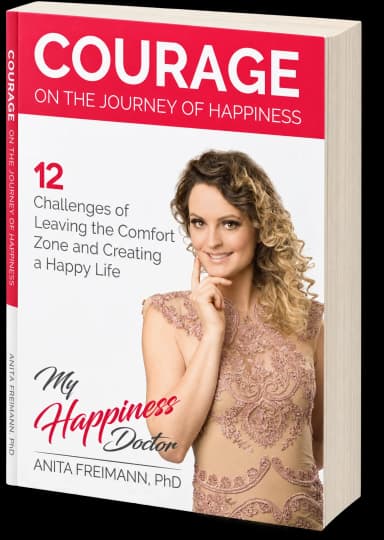
Free preview of my book
Courage on the Journey of Happiness
Get the whole introduction free: how to use the book, who it is for, and my own story of why I wrote it, plus the full table of contents with all twelve challenges. This article grows out of one of them, Do What You Love.
Sources
- 1.Edmondson, A. (1999). Psychological safety and learning behavior in work teams. Administrative Science Quarterly, 44(2), 350–383. doi.org/10.2307/2666999
- 2.Lau, V. (2022, April 28). Why psychological safety matters: My expert interview with Amy Edmondson. Mind Tools. www.mindtools.com/blog/expert-interview-amy-edmondson/
- 3.Google re:Work (2015). Guide: Understand team effectiveness. rework.withgoogle.com/intl/en/guides/understand-team-effectiveness
- 4.Detert, J. R., & Edmondson, A. C. (2011). Implicit voice theories: Taken-for-granted rules of self-censorship at work. Academy of Management Journal, 54(3), 461–488. doi.org/10.5465/amj.2011.61967925
- 5.Milgram, S. (1963). Behavioral study of obedience. The Journal of Abnormal and Social Psychology, 67(4), 371–378. doi.org/10.1037/h0040525
- 6.Perry, G., Brannigan, A., Wanner, R. A., & Stam, H. J. (2020). Credibility and incredulity in Milgram's obedience experiments: A reanalysis of an unpublished test. Social Psychology Quarterly, 83(1), 88–106. doi.org/10.1177/0190272519861952
- 7.Frazier, M. L., Fainshmidt, S., Klinger, R. L., Pezeshkan, A., & Vracheva, V. (2017). Psychological safety: A meta-analytic review and extension. Personnel Psychology, 70(1), 113–165. doi.org/10.1111/peps.12183
- 8.Edmondson, A. C., & Bransby, D. P. (2023). Psychological safety comes of age: Observed themes in an established literature. Annual Review of Organizational Psychology and Organizational Behavior, 10, 55–78. doi.org/10.1146/annurev-orgpsych-120920-055217
- 9.Clark, T. R. (2020). The 4 Stages of Psychological Safety. Berrett-Koehler. (LeaderFactor, the author's company) www.leaderfactor.com/signature/the-4-stages-of-psychological-safety
This article is for education and reflection and is not a substitute for professional help.

About Anita
Anita Freimann, PhD, the Happiness Doctor, holds a doctorate in the economics of happiness and spent more than 16 years at the Faculty of Economics in Osijek. She is the author of Courage on the Journey of Happiness and the creator of Permission for Life.
More about Anita